Matsuzaki-san is refreshingly eccentric. Although she has tossed her purple eye makeup since becoming a grandmother, there's still a purple sheen in her hair and fun artwork dangling from her earlobes.
It should not, therefore, have come as such a surprise that her garden and home are filled with whimsy. But it did. About ten seconds after we stepped out of Yuka's car in front of Matsuzaki-san's house, Fearless and I were fumbling through our purses for our cameras. When Matsuzaki-san was beckoning us into her foyer, we just ignored her and continued to snap pictures of the patio garden that runs along the side of her house.
This is not one of those raked-gravel-solemn-stone gardens we've grown accustomed to admiring when we visit Zen temples. There's not a koi pond in sight.
But there are turtles and lots of them. Her father collected turtles. She tells us she turned up her nose at his collection when she was growing up. Then he passed away and she grew fond of turtles because they remind her of him. Fearless and I know exactly what she means because we, too, have lost our fathers and treasure our memories of them. I think I'll scatter pennies in my garden when I get back to Norfolk or wherever it is we eventually call home.
I've spotted a few of these teacups filled with birdseed in American gardens but I've never noticed one perched on an inverted vase. There are a few crystal vases gathering dust in storage. I've never been good at remembering to fill them with flowers so maybe it's time to glue them to a few of Grandma's teacups.
Hey! I think I've just come up with 2012 Christmas gift ideas for my siblings. Please remind me of this when my stuff comes out of storage next summer.
This is the second time I've spotted these happy half-bricks in Kamakura. Matsuzaki-san is going to try to remember where she bought them so I can pick up a few for myself. She tells me the solar lights cost only 350 yen and change color like the Jackson Cascades. You can bet I'll be picking up at least a dozen of those pronto.
I know you want to see the inside of her house, especially since she has her Christmas decorations up, but you'll have to wait a day or so while I make an appearance at another JAW party and try to finish my reading assignment for book club.
Showing posts with label public art. Show all posts
Monday, December 5, 2011
Thursday, December 1, 2011
More Hakone Open-Air Museum
In the middle of the park there's a stained glass tower decorated with flat shiny sculptures. This one reminded me of something. I think Whitney Strieber might have used it for the cover of his alien abduction book. And I just spent fifteen minutes researching that, time that would have been better spent finishing my Christmas projects.
| The most eye-catching statue |
| Before cell phones, we held shells to our ears |
| Hard to get a good shot of The Hand of God |
| Lots of Henry Moore scuptures |
| This was my favorite sculpture |
| This is the other side of my favorite sculpture |
Wednesday, November 30, 2011
The Hakone Open-Air Museum: Public Art Tickles My Fancy
A cable car was a welcome relief after we dangled from a steel cable all the way up the mountain and halfway down the back side. The colorful maple leaves were a bonus, a feast for the eyes, and I was not about to complain that we were about a week too late to see them in their full splendor.
The cable car line ends where the Hakone Tozan Train begins so we hopped aboard and rode it to the next station which is just a hop, skip, and a jump from the Hakone Open-Air Museum, definitely one of Japan's best kept secrets.
Now I'll shut up and show you some of the wonderful statues we saw while strolling around the vast park setting.
| Yes, the "hair" is living plants. |
| Inside, I learned a LOT about Picasso. |
We had fun watching the 12-and-under crowd exploring this two-story high maze. It's a lot like the mazes at McDonald's playgrounds but bigger and cleaner. And I know what I'm talking about because I spent one of the worst quarter hours of my life chasing a four-year old through a McDonald's maze back in the day.
More statues tomorrow while I try to get a grip on the pictures I took at Matsuzaki's house today.
Saturday, November 5, 2011
Carving Wood in the Seventeenth Century
There are 5,173 wooden sculptures in Toshogu Shrine. A few more than five hundred of them can be seen on Yomei-mon, the striking gate leading to the inner precincts.
The Yomei-mon gate, deservedly designated a national treasure, is also called Higurashino-mon which translates to "the gate where people spend all day long to look". If I didn't have a train to catch, I'd probably still be standing there catching flies in my gaping mouth.
The gate rests on twelve pillars, one of them inverted to signify imperfection and the desire for long life. In ancient times it was believed that perfection was the beginning of decline so people used to leave space for three tiles on the roof when they built a house.
A sleeping cat is carved above the entrance to Okusha, the area of the shrine where Ieyasu Tokugawa is buried. This is the most famous sculpture in Toshugo so I had to try to blend into a class of yellow-capped students to get close enough to take a picture. Their guide was probably telling them that the sparrow perched on the cat's back means that peace has arrived in Japan after years of civil strife.
Another interesting carving can be found on the gable of one of the storehouses across from the sacred stable. People call this "The Imaginary Elephants" because the artist had never seen one and had to rely on his imagination and some limited written descriptions.
I hope the imperfections translated into a long life for him.
| Yomeimon at Toshugo in Nikko |
The gate rests on twelve pillars, one of them inverted to signify imperfection and the desire for long life. In ancient times it was believed that perfection was the beginning of decline so people used to leave space for three tiles on the roof when they built a house.
| Misa and Mineko outside Yomei-mon |
A sleeping cat is carved above the entrance to Okusha, the area of the shrine where Ieyasu Tokugawa is buried. This is the most famous sculpture in Toshugo so I had to try to blend into a class of yellow-capped students to get close enough to take a picture. Their guide was probably telling them that the sparrow perched on the cat's back means that peace has arrived in Japan after years of civil strife.
Another interesting carving can be found on the gable of one of the storehouses across from the sacred stable. People call this "The Imaginary Elephants" because the artist had never seen one and had to rely on his imagination and some limited written descriptions.
I hope the imperfections translated into a long life for him.
Tuesday, November 1, 2011
Arresting Sights in Kanazawa
We spotted this whimsical sculpture (above) on a street corner between Kanazawa castle and the samurai district. If I ever get caught up on all my random projects, I'll crack open the Adobe Photoshop manual and figure out how to transform this picture into a blog header. Don't hold your breath.
It speaks to me of adventure, walking (of course), bunions, and intestinal fortitude.
| Kotojitoro on railing near Kanazawa Castle |
Kenrokuen Garden's famous kotojitoro lantern is reproduced on sweets, manhole covers, and bridge railings.
Wandering around the grounds of Oyama-jinja, a Shinto shrine adjacent to Kanazawa castle, we spotted this "Neverending Story" statue. What do you suppose the story behind this statue might be?
Fearless gets credit for convincing us to visit Oyama-jinja after spotting the shrine's distinctive main gate from a bus window. The gate is an interesting mix of Japanese, Chinese, and European religious architectural elements, notably Dutch stained-glass windows on the third floor.
Maybe I'll post some more photographs from Oyama-jinja in particular and Kanazawa in general later this month. This morning I am embarking on an overnight trip to Nikko with three Shonan friends and a fully-charged camera. Bon voyage to me!
Wednesday, October 5, 2011
Art Imitates Art
My team raised over $700 for the Relay for Life this morning. We did this by cleaning out our closets and auctioning off our superfluous possessions to each other. Fearless and I tossed in a couple of those obis and kimono we've been sorting through, Jessica kicked in several adorable hand-knit baby hats, and Lynette whipped up a batch of tamales.
As is usually the case, I came home with more than I donated but most are earmarked as Christmas gifts and it was for a good cause. Plus, I managed to locate the box of fall decorations while I was cleaning out that closet. Life is good, and so were those tamales.
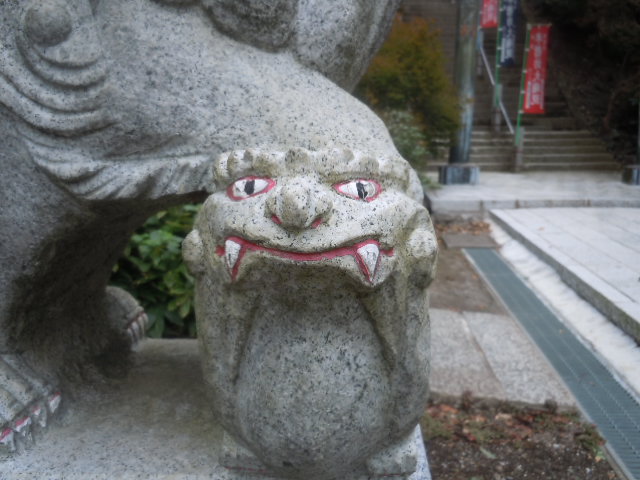
I did not bring home this statue (above) of a lion cub but only because it wasn't on offer today. I spotted this little guy at Kencho-ji in Kamakura last week. Is it just me, or does he bear an uncanny resemblance to a Maurice Sendak illustration?
I wonder how that happened.
As is usually the case, I came home with more than I donated but most are earmarked as Christmas gifts and it was for a good cause. Plus, I managed to locate the box of fall decorations while I was cleaning out that closet. Life is good, and so were those tamales.
I did not bring home this statue (above) of a lion cub but only because it wasn't on offer today. I spotted this little guy at Kencho-ji in Kamakura last week. Is it just me, or does he bear an uncanny resemblance to a Maurice Sendak illustration?
I wonder how that happened.
Saturday, October 1, 2011
The Japanese Book Club and the Chatty Cab Drivers
Here it is October already and I haven't yet written about my trip to Nagano Prefecture with the Japanese Book Club ladies in late August. It's taken me over a month to get a good geographical and historical fix on where I spent three of the most memorable days of my life.
You probably know Nagano as the site of the 1998 Winter Olympics. The long-term benefit to Nagano of hosting those games was the building of a bullet train line to shuttle athletes and spectators to and from Tokyo.
We took one of those trains from Tokyo's Shinjuku station to Chino where we loaded up on perishable items like milk, eggs, and bacon at a shop across from the train station before hopping in a taxi for a twenty-minute mostly uphill ride to Suzuki's "rustic mountain cabin" -- her words, not mine -- in Tateshina Village. Our driver prattled non-stop for the entire twenty minutes. Later Suzuki told me she had never been treated to such an indepth monologue on local history and hot spots in all her years of riding in a cab from the station to her cabin. Ishikawa said the driver might have been a bit nervous and giddy about transporting a foreigner. I was a bit giddy myself.
Suzuki's parents built this vacation getaway in the 1960s and she has continued to pay the taxes since they passed away. There are hundreds of cottages scattered across the hillside but all are on lots of at least a half acre and are hardly visible to each other. Homeowners are not permitted to build fences or to remove any trees surrounding their cottages.
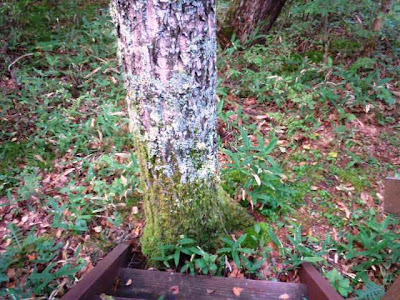
They take that tree covenant seriously. There's one hosting a hairy sort of pale green moss partially blocking the steps that provide the only access to Suzuki's cottage. Inspecting that moss, I decided it might offer an adequate cushion should I smack into the tree while fleeing from a fire in the middle of the night. But Suzuki's daughters will probably have to remove the tree when their turn to pay the taxes arrives.
Tateshina Village offers a quiet, cool respite from the summer heat and the hustle and bustle of Tokyo and its suburbs. People come here to commune with nature, to soak their weary bones in natural hot springs (there are hundreds from which to choose), and to feast their eyes on fabulous views of the Yatsugatake Mountains, a volcanic range situated on the border between Nagano Prefecture and Yamanashi Prefecture. There are more than twenty peaks in the Yatsugatake Mountains, ranging in height from 2300 to 2900 meters. (By way of comparison, the tallest mountain in Japan, Mount Fuji, is 3776 meters high.)
We spent the first afternoon hiking the dirt roads and paths that honeycomb Tateshina Village. Suzuki has been coming here every spring, summer, and fall for fifty years yet never ventures out the cottage door without her large laminated map. If I had paused to reflect on the possible ramifications of getting lost in the wilderness with two women a dozen years my senior, I would have insisted on holding that map. My bad.
There are neither street lights in Tateshina Village nor road signs. The only signs are short cedar posts stamped with the number of each lot although one of Suzuki's neighbors has affixed a sign atop his post dubbing his domain "Walden". This tickled me, of course, and even more so late that evening when I happened to glance through his window and see his profile bent over a book.
To be perfectly frank, at the time I spotted him I didn't care that he was reading. After spending fifteen minutes wandering around an inky dark highlands forest with two seventy-something women who would not let me hold one of the two feeble flashlights, that man could have been washing dishes or sitting on the toilet and my heart would have rejoiced at the sight of another human being. Our afternoon hike had eventually led us to a charming French restaurant where we celebrated our June, July, and August birthdays with a marvelous meal prepared by an owner-chef who spent his youth collecting John Lennon memorabilia and his middle age attending cooking classes in Paris. The restaurant is only a ten-minute walk from Suzuki's cottage but she left the map at the restaurant and we took the first wrong turn we could possibly take. Eventually she admitted her error -- one thing I love about Suzuki is she hates to be wrong as much as I do -- and we managed to find our way back to the restaurant where the waiter informed us the owner had found our map and set off in his car to return it to us. We didn't pass each other on the road thanks to that wrong turn so we loitered in front of the restaurant until he came back and then we set off for the cottage again.
Even with the map, we managed to take a wrong turn but Suzuki was quicker to admit her error the second time around and the cottage emerged on our right blessedly soon after Ishikawa-san's voice alerted the noctural forest creatures to our presence. "This reminds me of one of those American teenage movies where they all start disappearing one by one." It's funnier now than it was at the time.
On the second day, after a nourishing breakfast of salad, bread, and corn on the cob, we hiked half a mile to the nearest bus stop where we caught a ride to a rice field in the middle of nowhere. Our destination was a rustic open-air hot springs favored by the locals. The hot springs are about two miles from where the bus dropped us and I was so hot and sweaty by the time we got there I almost forgot to be embarrassed about disrobing in front of people to whom I'm not married.
If embarrassment wasn't such a powerful emotion, the big toe on my right foot would have been the only part of my anatomy to experience the rustic open-air hot springs favored by the locals. Conversations about onsen experiences with my American friends tend to focus on nudity (for people who favor bare midriffs and plunging necklines, we are a strangely modest nation). No one ever mentioned that the water in those hot springs is almost unbearably hot. Maybe they thought the name was self-explanatory but we're talking beyond tepid, beyond lukewarm. We're venturing into the region of boiling point here.
My flesh was a glowing pink when I emerged from the hot spring and my bones felt like a Slinky. I was sorely tempted to extract a beer from the vending machine conveniently located between the entrances to the separate men's and women's facilities but Suzuki-san had a different agenda. She called a cab and we were whisked to Hotel Heidi for cake and coffee by our second chatty cab driver who took us on a scenic route past a golf course and former iron mine. Hotel Heidi (click here for photo) was the villa of an imperial family member before the war. The cake was excellent and the waitresses were adorable in their Alpine costumes.
After strolling the hotel grounds and poking our heads into a little Swiss chalet where guests can have their pictures taken in Tyrolean garb, we headed downhill to man-made Lake Tateshina.
Suzuki-san and Ishikawa-san kindly pointed out our location on the tourist map near the lake. The Tateshina Village cottage is located off the road that's extending due north over Ishikawa's head. A third chatty cab driver responded to Suzuki's call and took us back to the cottage where we polished off the corn and talked about books late into the night.
On the third morning we aired our futons on the deck rail while closing up the cottage. Ishikawa cleaned the kitchen and bathroom while I vacuumed and Suzuki packed all the dirty linens in a box to be shipped back to her house in Kamakura. There's a washing machine in the cottage but Suzuki wanted to spend our last day sightseeing rather than doing laundry.
There's also a twin bed in one of the cottage bedrooms. They offered it to me upon arrival but I opted to sleep with them in the tatami room on double futons. This was both a great experience and something of a science experiment. I had heard that Japanese body temperatures are lower than ours and now I know for certain that at least two Japanese ladies can snuggle under down comforters for eight hours straight while at least one American woman tosses aside the comforter after a mere three hours.
Suzuki-san arranged for a cab driver to whisk us to a museum and shrine in nearby Suwa before our train was scheduled to depart Chino. This driver was remarkably less chatty than his predecessors, perhaps because he knew in advance he'd have three hours in which to regale us with insights and remarks. First he took us to some dumpsters where we placed three pre-sorted bags of trash in the appropriate receptacles and then he stopped at a building where Suzuki arranged to ship the box of linens while he showed me a wide variety of vegetables and fruits at an outside market beside the building.
The Suwa Taisho (Grand Shrine) was a real show-stopper but, alas, my camera battery petered out about fifteen meters into the first courtyard. The architecture of the museum we visited was more interesting than its contents which tended towards scrolls and mounted heads of boars and deer. The person who designed that museum is also responsible for a number of whimsical structures like the tree house shown above that dot the landscape of the hills overlooking Suwa. I'll have to ask Suzuki to remind me of his name. She bought a book about his work in the gift shop next to the train station just before we called it an adventure and headed for home.
Guess what? (Insert squeal of delight here.) Suzuki and Ishikawa want to hold another book club slumber party in Tateshina before I leave Japan! We're going back in May. Between now and then I'll be searching every nook and cranny of my brain to come up with the best possible reading assignment to cap off my tenure as their book guide. Your suggestions are most welcome.
You probably know Nagano as the site of the 1998 Winter Olympics. The long-term benefit to Nagano of hosting those games was the building of a bullet train line to shuttle athletes and spectators to and from Tokyo.
We took one of those trains from Tokyo's Shinjuku station to Chino where we loaded up on perishable items like milk, eggs, and bacon at a shop across from the train station before hopping in a taxi for a twenty-minute mostly uphill ride to Suzuki's "rustic mountain cabin" -- her words, not mine -- in Tateshina Village. Our driver prattled non-stop for the entire twenty minutes. Later Suzuki told me she had never been treated to such an indepth monologue on local history and hot spots in all her years of riding in a cab from the station to her cabin. Ishikawa said the driver might have been a bit nervous and giddy about transporting a foreigner. I was a bit giddy myself.
Suzuki's parents built this vacation getaway in the 1960s and she has continued to pay the taxes since they passed away. There are hundreds of cottages scattered across the hillside but all are on lots of at least a half acre and are hardly visible to each other. Homeowners are not permitted to build fences or to remove any trees surrounding their cottages.
They take that tree covenant seriously. There's one hosting a hairy sort of pale green moss partially blocking the steps that provide the only access to Suzuki's cottage. Inspecting that moss, I decided it might offer an adequate cushion should I smack into the tree while fleeing from a fire in the middle of the night. But Suzuki's daughters will probably have to remove the tree when their turn to pay the taxes arrives.
| The mossy tree mentioned above |
| This road was pretty scary after the sun went down |
There are neither street lights in Tateshina Village nor road signs. The only signs are short cedar posts stamped with the number of each lot although one of Suzuki's neighbors has affixed a sign atop his post dubbing his domain "Walden". This tickled me, of course, and even more so late that evening when I happened to glance through his window and see his profile bent over a book.
To be perfectly frank, at the time I spotted him I didn't care that he was reading. After spending fifteen minutes wandering around an inky dark highlands forest with two seventy-something women who would not let me hold one of the two feeble flashlights, that man could have been washing dishes or sitting on the toilet and my heart would have rejoiced at the sight of another human being. Our afternoon hike had eventually led us to a charming French restaurant where we celebrated our June, July, and August birthdays with a marvelous meal prepared by an owner-chef who spent his youth collecting John Lennon memorabilia and his middle age attending cooking classes in Paris. The restaurant is only a ten-minute walk from Suzuki's cottage but she left the map at the restaurant and we took the first wrong turn we could possibly take. Eventually she admitted her error -- one thing I love about Suzuki is she hates to be wrong as much as I do -- and we managed to find our way back to the restaurant where the waiter informed us the owner had found our map and set off in his car to return it to us. We didn't pass each other on the road thanks to that wrong turn so we loitered in front of the restaurant until he came back and then we set off for the cottage again.
Even with the map, we managed to take a wrong turn but Suzuki was quicker to admit her error the second time around and the cottage emerged on our right blessedly soon after Ishikawa-san's voice alerted the noctural forest creatures to our presence. "This reminds me of one of those American teenage movies where they all start disappearing one by one." It's funnier now than it was at the time.
| The Yatsugatake Mountains |
On the second day, after a nourishing breakfast of salad, bread, and corn on the cob, we hiked half a mile to the nearest bus stop where we caught a ride to a rice field in the middle of nowhere. Our destination was a rustic open-air hot springs favored by the locals. The hot springs are about two miles from where the bus dropped us and I was so hot and sweaty by the time we got there I almost forgot to be embarrassed about disrobing in front of people to whom I'm not married.
If embarrassment wasn't such a powerful emotion, the big toe on my right foot would have been the only part of my anatomy to experience the rustic open-air hot springs favored by the locals. Conversations about onsen experiences with my American friends tend to focus on nudity (for people who favor bare midriffs and plunging necklines, we are a strangely modest nation). No one ever mentioned that the water in those hot springs is almost unbearably hot. Maybe they thought the name was self-explanatory but we're talking beyond tepid, beyond lukewarm. We're venturing into the region of boiling point here.
| WARNING: That sign means "hot springs" not "coffee shop" |
After strolling the hotel grounds and poking our heads into a little Swiss chalet where guests can have their pictures taken in Tyrolean garb, we headed downhill to man-made Lake Tateshina.
Suzuki-san and Ishikawa-san kindly pointed out our location on the tourist map near the lake. The Tateshina Village cottage is located off the road that's extending due north over Ishikawa's head. A third chatty cab driver responded to Suzuki's call and took us back to the cottage where we polished off the corn and talked about books late into the night.
| The idyllic Lake Tateshina |
On the third morning we aired our futons on the deck rail while closing up the cottage. Ishikawa cleaned the kitchen and bathroom while I vacuumed and Suzuki packed all the dirty linens in a box to be shipped back to her house in Kamakura. There's a washing machine in the cottage but Suzuki wanted to spend our last day sightseeing rather than doing laundry.
There's also a twin bed in one of the cottage bedrooms. They offered it to me upon arrival but I opted to sleep with them in the tatami room on double futons. This was both a great experience and something of a science experiment. I had heard that Japanese body temperatures are lower than ours and now I know for certain that at least two Japanese ladies can snuggle under down comforters for eight hours straight while at least one American woman tosses aside the comforter after a mere three hours.
| Futons airing on the deck rail |
Suzuki-san arranged for a cab driver to whisk us to a museum and shrine in nearby Suwa before our train was scheduled to depart Chino. This driver was remarkably less chatty than his predecessors, perhaps because he knew in advance he'd have three hours in which to regale us with insights and remarks. First he took us to some dumpsters where we placed three pre-sorted bags of trash in the appropriate receptacles and then he stopped at a building where Suzuki arranged to ship the box of linens while he showed me a wide variety of vegetables and fruits at an outside market beside the building.
The Suwa Taisho (Grand Shrine) was a real show-stopper but, alas, my camera battery petered out about fifteen meters into the first courtyard. The architecture of the museum we visited was more interesting than its contents which tended towards scrolls and mounted heads of boars and deer. The person who designed that museum is also responsible for a number of whimsical structures like the tree house shown above that dot the landscape of the hills overlooking Suwa. I'll have to ask Suzuki to remind me of his name. She bought a book about his work in the gift shop next to the train station just before we called it an adventure and headed for home.
Guess what? (Insert squeal of delight here.) Suzuki and Ishikawa want to hold another book club slumber party in Tateshina before I leave Japan! We're going back in May. Between now and then I'll be searching every nook and cranny of my brain to come up with the best possible reading assignment to cap off my tenure as their book guide. Your suggestions are most welcome.
Thursday, June 16, 2011
Another Fork in the Road
| The Admiral, the Forkhead, and the Ancient Mariner |
A few days ago Fearless asked me if I like stone lanterns (yes) and if I would be interested in one featuring Anpanman (yes). Then she burst my hope bubble by informing me that such lanterns are not available for purchase. How curious. How mysterious. Still, I find myself scanning my yard first thing every morning. Hope springs eternal.
Friday, May 27, 2011
Any Port But This One In a Storm
The Ancient Mariner sauntered through the door last night after five days at sea and another long day of meetings. We spent the evening making plans for the holiday weekend, primarily a trip to Tokyo to visit the War Museum and Nikon repair shop.Tonight those plans are on hold thanks to Typhoon Songda. If the typhoon continues to head in our direction, most of the U.S. ships currently docked here will head out to sea to avoid the risk of being banged against the piers by high winds. At least he won't have to pack his sea bag since he hasn't gotten around to unpacking it yet.
The decision will be made and communicated by 7:00 am, at least that's what they are saying tonight, so there's still a chance we'll be on the 8:34 train to Tokyo. But I'm not holding my breath.
Sunday, May 15, 2011
No Need to Add Water or Fertilizer
Public art in Japan, at least the works that grab my attention, tend toward the whimsical. But then I've long favored that old-fashioned typewriter eraser in the Sculpture Garden in Washington, DC, even after my niece Mary made me feel extremely old by asking me what it was.
At any rate, here are a few of my favorite finds to keep you entertained until I get back from Osaka.
| Even the bakers are infused with the Public Art spirit here |
| The caps are separate from the stems and wave gently with every passing breeze |
Tuesday, May 4, 2010
Inhaling Wisteria and Yakisoba
Go bury your nose in the nearest wisteria even if it means climbing a barbed wire fence and facing down a Doberman. Assuming you survive the Doberman, you will thank me for this advice. (And if you don't survive the Doberman, I'll be consoled knowing that thoughts of me were among your last.)
Today's adventure took us to the village of Koshigaya, about 90 minutes and just one train transfer north of Yokosuka. Hisaizu-jinja Shrine was our specific destination and we had no trouble finding it. We just followed the trail of wisteria along the canal bank. Sniff, sniff, sniff, sniff. Aaaaaah.
Like many bridges in this country, the bridge we took across the canal was a work of art. Many manhole covers are works of art too. The people who work on neighborhood revitalization at the Department of Housing and Urban Development ought to try to sneak more whimsy into public projects in our country . . .
While we're wending our way to Hisaizu-jinja, I'll share some snippets from my guidebook, "A Flower Lover's Guide to Tokyo" by Sumiko Enbutsu.
In 1837, nearly 200 years ago, a rice farmer named Kawanabe Kunizo moved a 50-year old wisteria by boat from a village 20 kilometers away and planted it at Hisaizu-jinja shrine to express his gratitude to a famous scholar, Hirata Atsutane, who shared his extensive knowledge about classical literature with area farmers on his frequent visits to the shrine.
The shrine itself, which sits within a sacred forest of pine and cypress, is believed to have been founded in the 12th century.
Kawanabe planted his wisteria on the edge of a pond. We'll stroll to the other side of the pond in a minute to get a panoramic view.
Let's see what the trunk of an almost 250-year old wisteria looks like. Pretty much what I expected. How about you?
Oh, the view from across the pond is quite lovely. The only problem is I can't smell the wisteria from over here. Sniff, sniff. The scent is too delicate to carry this far. Sniff, sniff. I am starting to look like a Mississippi bloodhound tracking an escaped convict through a swamp.
Check out the miniature shrine on the tiny island in the middle of the pond. Egad! Shades of Shomyo-ji, there are at least two dozen turtles piled up on the left side of that island. I think I'll admire the festive lanterns instead and follow them to the food stalls along the path to the shrine. The food stalls and lanterns only appear when the wisteria is blooming. This is my lucky day!
Look at that enormous lantern! How can I give my readers an idea of the size of that thing? Oh, good, that lady is trying to get her two little dogs to pose in front of the lantern. Now you can see that it's definitely larger than your average lantern.
This is where I was going to insert the obligatory group picture but my pants look really stupid with my shoes so you'll just have to use your imagination.
Time for lunch. Would anyone care for a fishstick? I thought not. For the first time in my life, I tried yakisoba. Remember how Goldilocks tasted Baby Bear's porridge and she ate it all up? That was me and the yakisoba. Then we couldn't help but notice Jane moaning as she nibbled on a pancake shaped like a hockey puck so we all got one of those for dessert. They were piping hot, filled with custard, and really did taste like pancakes.
My only regret is that I talked myself out of tucking my knitting into my bag when I set out this morning. The trains weren't nearly as crowded as we were warned to expect by the official Navy Know-It-All(s) so I could have added an inch or two to my sock-in-progress. And Mary Beth could have borrowed one of my needles to poke the drunk who sprawled next to her between Tokyo and Koshigaya.
Today's adventure took us to the village of Koshigaya, about 90 minutes and just one train transfer north of Yokosuka. Hisaizu-jinja Shrine was our specific destination and we had no trouble finding it. We just followed the trail of wisteria along the canal bank. Sniff, sniff, sniff, sniff. Aaaaaah.
Like many bridges in this country, the bridge we took across the canal was a work of art. Many manhole covers are works of art too. The people who work on neighborhood revitalization at the Department of Housing and Urban Development ought to try to sneak more whimsy into public projects in our country . . .While we're wending our way to Hisaizu-jinja, I'll share some snippets from my guidebook, "A Flower Lover's Guide to Tokyo" by Sumiko Enbutsu.
In 1837, nearly 200 years ago, a rice farmer named Kawanabe Kunizo moved a 50-year old wisteria by boat from a village 20 kilometers away and planted it at Hisaizu-jinja shrine to express his gratitude to a famous scholar, Hirata Atsutane, who shared his extensive knowledge about classical literature with area farmers on his frequent visits to the shrine.
The shrine itself, which sits within a sacred forest of pine and cypress, is believed to have been founded in the 12th century.
Kawanabe planted his wisteria on the edge of a pond. We'll stroll to the other side of the pond in a minute to get a panoramic view.
Let's see what the trunk of an almost 250-year old wisteria looks like. Pretty much what I expected. How about you?
Oh, the view from across the pond is quite lovely. The only problem is I can't smell the wisteria from over here. Sniff, sniff. The scent is too delicate to carry this far. Sniff, sniff. I am starting to look like a Mississippi bloodhound tracking an escaped convict through a swamp.
Check out the miniature shrine on the tiny island in the middle of the pond. Egad! Shades of Shomyo-ji, there are at least two dozen turtles piled up on the left side of that island. I think I'll admire the festive lanterns instead and follow them to the food stalls along the path to the shrine. The food stalls and lanterns only appear when the wisteria is blooming. This is my lucky day!
Look at that enormous lantern! How can I give my readers an idea of the size of that thing? Oh, good, that lady is trying to get her two little dogs to pose in front of the lantern. Now you can see that it's definitely larger than your average lantern.This is where I was going to insert the obligatory group picture but my pants look really stupid with my shoes so you'll just have to use your imagination.
Time for lunch. Would anyone care for a fishstick? I thought not. For the first time in my life, I tried yakisoba. Remember how Goldilocks tasted Baby Bear's porridge and she ate it all up? That was me and the yakisoba. Then we couldn't help but notice Jane moaning as she nibbled on a pancake shaped like a hockey puck so we all got one of those for dessert. They were piping hot, filled with custard, and really did taste like pancakes.
My only regret is that I talked myself out of tucking my knitting into my bag when I set out this morning. The trains weren't nearly as crowded as we were warned to expect by the official Navy Know-It-All(s) so I could have added an inch or two to my sock-in-progress. And Mary Beth could have borrowed one of my needles to poke the drunk who sprawled next to her between Tokyo and Koshigaya.
Subscribe to:
Comments (Atom)