Showing posts with label Shonan. Show all posts
Thursday, December 8, 2011
Christmas in Kamakura
Have you ever wondered how a Japanese family decorates their home during the Christmas season? I have so I leaped at the chance to visit Matsuzaki-san's house in Kamakura a few days after Thanksgiving. We hadn't even pulled our decorations out of the closet yet but her house was decked out with wreaths, stockings, and all sorts of cute ceramic snowmen and angels.
Most of her decorations were things you'd find scattered around a typical American home during the holidays. I would guess she picked up lots of these doodads over the course of twenty plus years of Shonan Club gift exchanges.
The quantity of decorations astounded me more than anything else. "Where do you store everything?" She said that's a bit of a problem. Japanese houses are quite small by American standards but her walls are lined with pretty storage cabinets that soar to the ceiling. Not an inch of space is wasted.
A few of the decorations have such a Matsuzaki flair that I'm fairly certain she didn't pick them up at a gift exchange with American military spouses.
The linen table runners, for instance, feature holly embroidered on linen dyed her signature purple.
And purple was the primary ornament color on the tree in her new sun porch.
I was in such a holiday mood by the time I left her house that I decided to tackle that quilted Christmas tree skirt I've been thinking about for the past decade. I wonder if I have any purple fabric in my stash?
Monday, December 5, 2011
A Delightful Japanese Garden
Matsuzaki-san is refreshingly eccentric. Although she has tossed her purple eye makeup since becoming a grandmother, there's still a purple sheen in her hair and fun artwork dangling from her earlobes.
It should not, therefore, have come as such a surprise that her garden and home are filled with whimsy. But it did. About ten seconds after we stepped out of Yuka's car in front of Matsuzaki-san's house, Fearless and I were fumbling through our purses for our cameras. When Matsuzaki-san was beckoning us into her foyer, we just ignored her and continued to snap pictures of the patio garden that runs along the side of her house.
This is not one of those raked-gravel-solemn-stone gardens we've grown accustomed to admiring when we visit Zen temples. There's not a koi pond in sight.
But there are turtles and lots of them. Her father collected turtles. She tells us she turned up her nose at his collection when she was growing up. Then he passed away and she grew fond of turtles because they remind her of him. Fearless and I know exactly what she means because we, too, have lost our fathers and treasure our memories of them. I think I'll scatter pennies in my garden when I get back to Norfolk or wherever it is we eventually call home.
I've spotted a few of these teacups filled with birdseed in American gardens but I've never noticed one perched on an inverted vase. There are a few crystal vases gathering dust in storage. I've never been good at remembering to fill them with flowers so maybe it's time to glue them to a few of Grandma's teacups.
Hey! I think I've just come up with 2012 Christmas gift ideas for my siblings. Please remind me of this when my stuff comes out of storage next summer.
This is the second time I've spotted these happy half-bricks in Kamakura. Matsuzaki-san is going to try to remember where she bought them so I can pick up a few for myself. She tells me the solar lights cost only 350 yen and change color like the Jackson Cascades. You can bet I'll be picking up at least a dozen of those pronto.
I know you want to see the inside of her house, especially since she has her Christmas decorations up, but you'll have to wait a day or so while I make an appearance at another JAW party and try to finish my reading assignment for book club.
It should not, therefore, have come as such a surprise that her garden and home are filled with whimsy. But it did. About ten seconds after we stepped out of Yuka's car in front of Matsuzaki-san's house, Fearless and I were fumbling through our purses for our cameras. When Matsuzaki-san was beckoning us into her foyer, we just ignored her and continued to snap pictures of the patio garden that runs along the side of her house.
This is not one of those raked-gravel-solemn-stone gardens we've grown accustomed to admiring when we visit Zen temples. There's not a koi pond in sight.
But there are turtles and lots of them. Her father collected turtles. She tells us she turned up her nose at his collection when she was growing up. Then he passed away and she grew fond of turtles because they remind her of him. Fearless and I know exactly what she means because we, too, have lost our fathers and treasure our memories of them. I think I'll scatter pennies in my garden when I get back to Norfolk or wherever it is we eventually call home.
I've spotted a few of these teacups filled with birdseed in American gardens but I've never noticed one perched on an inverted vase. There are a few crystal vases gathering dust in storage. I've never been good at remembering to fill them with flowers so maybe it's time to glue them to a few of Grandma's teacups.
Hey! I think I've just come up with 2012 Christmas gift ideas for my siblings. Please remind me of this when my stuff comes out of storage next summer.
This is the second time I've spotted these happy half-bricks in Kamakura. Matsuzaki-san is going to try to remember where she bought them so I can pick up a few for myself. She tells me the solar lights cost only 350 yen and change color like the Jackson Cascades. You can bet I'll be picking up at least a dozen of those pronto.
I know you want to see the inside of her house, especially since she has her Christmas decorations up, but you'll have to wait a day or so while I make an appearance at another JAW party and try to finish my reading assignment for book club.
Sunday, December 4, 2011
Gearing Up for the Year of the Dragon: Peevish Takes Another Stab at Kimekomi
Fearless and I were treated to a swell time by Matsuzaki last week. She asked her friend, who teaches kimekomi in Tokyo, to show us how to make dragons for our upcoming special birthday year. The Year of the Dragon will be even more special for me than for Fearless because she'll be a mere forty-eight while I will celebrate the beginning of what the Japanese refer to as my "second life" when I turn sixty next July. Fearless is already tired of hearing me refer to myself as extra-special so she'll probably be ready to strangle me by the time the Year of the Dragon actually arrives.
I love the fact that turning sixty is cause for celebration here. If questioned about my age back home, I'd be mumbling behind my hand. Just my luck to get old a decade or so after America knocked Wisdom off its pedestal.
At any rate, we gathered at Matsuzaki's house in Kamakura. That in itself is worth a couple more posts but today I'll stick to kimekomi which, as most of you know by now, involves tucking small pieces of fabric into crevices carved into a small object filled with sawdust.
This is what our dragons are supposed to look like upon completion:
This is what I found inside the box of supplies the teacher distributed:
This is the teacher. She's using a sharp little spatula to smooth the crevices before filling them with glue. She doesn't speak a lick of English but Matsuzaki-san is an excellent translator.
You might recall that Matsuzaki-san operated a shop until last June where she sold all sorts of items -- tote bags, skirts, table runners, jackets, book covers, etc. -- she fashioned from scraps of old obis and kimono. She has, in short, nimbler fingers than most. The teacher gave each of us a pair of tiny scissors for cutting the excess fabric after the crevices were stuffed, but Matsuzaki-san was the only one of us permitted to touch the scissors. I picked mine up at one point but the teacher told me in no uncertain terms to drop them. Remember how I said she doesn't speak a lick of English? Yet I knew exactly what she was telling me. It was all in the tone of voice, hauntingly reminiscent of Nicholas Cage declaiming, "Put The Bunny Down!"
We covered the dragons' bodies today and will meet again soon to finish this project. Everyone else placed their fabric in the direction that was shown in the example but I glued mine in place upside down to look more like real dragon scales. Not that there is such a thing as a real dragon, of course.
This is what my dragon looked like at the end of the lesson:
So far, so good.
I love the fact that turning sixty is cause for celebration here. If questioned about my age back home, I'd be mumbling behind my hand. Just my luck to get old a decade or so after America knocked Wisdom off its pedestal.
At any rate, we gathered at Matsuzaki's house in Kamakura. That in itself is worth a couple more posts but today I'll stick to kimekomi which, as most of you know by now, involves tucking small pieces of fabric into crevices carved into a small object filled with sawdust.
This is what our dragons are supposed to look like upon completion:
This is what I found inside the box of supplies the teacher distributed:
This is the teacher. She's using a sharp little spatula to smooth the crevices before filling them with glue. She doesn't speak a lick of English but Matsuzaki-san is an excellent translator.
| Yuka-san and Matsuzaki-san |
| Teacher snipping excess fabric |
| Jamming fabric into crevice after excess fabric is snipped |
We covered the dragons' bodies today and will meet again soon to finish this project. Everyone else placed their fabric in the direction that was shown in the example but I glued mine in place upside down to look more like real dragon scales. Not that there is such a thing as a real dragon, of course.
This is what my dragon looked like at the end of the lesson:
So far, so good.
Labels:
crafts,
kimekomi,
Reiko,
Shonan,
Year of the Dragon
Friday, November 18, 2011
Ah So Moments
There is a cluster of gift shops and food concessions near the elevator that takes you to the base of Kegon Falls. Ouiser, who had visited Kegon Falls several months ago, mentioned fish sticks as we were strolling in that direction. "What an odd thing for her to remember" flashed across my mind in the seconds remaining before we reached the market area. Is there anything more mundane than fish sticks? Why would I want to buy one? Who over the age of eleven would want to eat one?
Oh! Or better yet Ah so! Here's a food-on-a-stick we didn't spot at the Minnesota State Fair.
The youngest member of my family owns a hat like the man is wearing in the picture. That hat is one of the more frivolous purchases we've made in the past several years. I've rarely bought a hat that I didn't later regret. Maybe this one will be the exception. Maybe he can cover it in plastic and wear it as an umbrella.
There was a calendar conflict today that I spent way too much time resolving. The JAW ladies gathered at Tadodai House at the same time the Shonan ladies made holiday decorations out of broken blue-and-white pottery at the community center. I decided to attend the latter, a smaller group where absences are more noticed, but woke up sneezing and coughing. The little boy next door is sick today also and stayed home from school. We sat next to each other in the flu shot clinic the day before yesterday. Ah so. I sent my regrets to the Shonan ladies, felt sorry for myself for a few minutes, then spent the morning knitting Christmas gifts for unsuspecting relatives.
I had expected to be sharing a picture of a pottery wreath today. Fish sticks are probably more interesting. Things always have a way of turning out for the better.
Oh! Or better yet Ah so! Here's a food-on-a-stick we didn't spot at the Minnesota State Fair.
The youngest member of my family owns a hat like the man is wearing in the picture. That hat is one of the more frivolous purchases we've made in the past several years. I've rarely bought a hat that I didn't later regret. Maybe this one will be the exception. Maybe he can cover it in plastic and wear it as an umbrella.
There was a calendar conflict today that I spent way too much time resolving. The JAW ladies gathered at Tadodai House at the same time the Shonan ladies made holiday decorations out of broken blue-and-white pottery at the community center. I decided to attend the latter, a smaller group where absences are more noticed, but woke up sneezing and coughing. The little boy next door is sick today also and stayed home from school. We sat next to each other in the flu shot clinic the day before yesterday. Ah so. I sent my regrets to the Shonan ladies, felt sorry for myself for a few minutes, then spent the morning knitting Christmas gifts for unsuspecting relatives.
I had expected to be sharing a picture of a pottery wreath today. Fish sticks are probably more interesting. Things always have a way of turning out for the better.
Sunday, November 6, 2011
Tokugawa's Tomb and the Worst Job in Japan: Nikko, Part 5
The tomb of Ieyasu Tokugawa is at the top of a heavily wooded hill. You must climb two hundred and seven stone steps to get there. (The guidebook says 200 but Ouiser counted otherwise.)
Vending machines are everywhere in Japan and the tomb is no exception. I stopped complaining about the steps after I passed a middle-aged man who apparently is responsible for restocking those machines.
The copper tomb sits in the center of a quiet clearing. The unpretentiousness of the tomb and setting, especially after all those ornate wood carvings, reminds me of Robert Kennedy's grave in Arlington Cemetery.
Circling the tomb, we notice a small crowd gathered at the base of a hollow tree. Mineko tells us the tree is thought to be something like a prayer amplifier so we stand in line to pray for our children and future grandchildren.
Before we leave Toshogu Shrine, Mineko takes me into a building, the Yakushi-doh, that has a dragon painted on the ceiling. A monk gives a brief lecture about the history of that painting (I can only assume since the lecture was in Japanese) and then strikes wooden clappers so we can hear the sound of the dragon crying. Cameras are not allowed in the Yakushi-doh or I would show you what a crying dragon looks like.
Enough of Nikko. I have a zillion more pictures to share but I'll save them for later, for those days when I forget to charge my camera.
Vending machines are everywhere in Japan and the tomb is no exception. I stopped complaining about the steps after I passed a middle-aged man who apparently is responsible for restocking those machines.
| Bless his heart! |
| Copper gate guarding the tomb |
Circling the tomb, we notice a small crowd gathered at the base of a hollow tree. Mineko tells us the tree is thought to be something like a prayer amplifier so we stand in line to pray for our children and future grandchildren.
| Ieyasu Tokugawa's Tomb |
Before we leave Toshogu Shrine, Mineko takes me into a building, the Yakushi-doh, that has a dragon painted on the ceiling. A monk gives a brief lecture about the history of that painting (I can only assume since the lecture was in Japanese) and then strikes wooden clappers so we can hear the sound of the dragon crying. Cameras are not allowed in the Yakushi-doh or I would show you what a crying dragon looks like.
Enough of Nikko. I have a zillion more pictures to share but I'll save them for later, for those days when I forget to charge my camera.
Thursday, November 3, 2011
Gazing Into An Abyss: Nikko, Part 2
"And if you gaze for long into an abyss, the abyss gazes also into you."--
Friedrich Nietzsche
Kanmangafuchi Abyss, formed by an eruption of nearby Mount Nantai, offers a pleasant riverside walking trail with nice scenery near central Nikko.
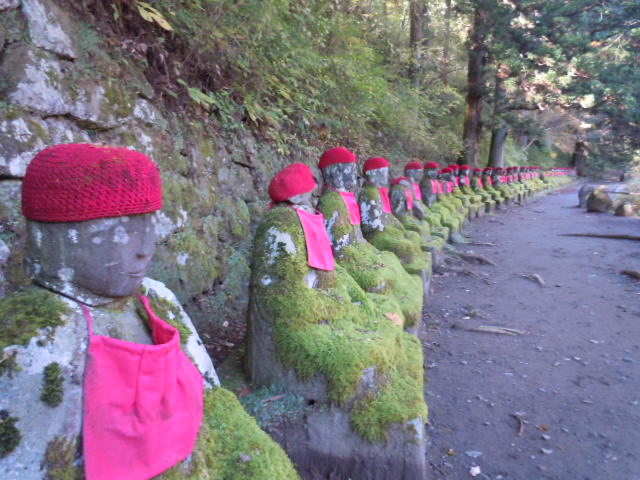
Kanmangafuchi is also known for its row of about 70 stone statues of Jizo, the Bodhisattva who cares for the deceased, especially infants. This group of statues goes by many names, including Bake Jizo (Ghost Jizo), Narabi Jizo (Jizo in a line) or Hyaku Jizo (100 Jizo). The story behind the last name is that about thirty of the statues were washed away by a flood and never recovered.
Mineko says we are supposed to pose with the Jizo who most resembles our husband.
We eschewed the bus today in favor of a taxi because we had lots of ground to cover before catching a late afternoon train back to Yokosuka via Tokyo.
My recent experiences with cab drivers in Japan have me thinking this is a great career option for history majors who, like me, favor captive audiences. Our Nikko driver was a jolly fellow who tipped us off that some of those thirty missing Jizo statues could be found at a little-known shrine downriver from the abyss. He took us there and I counted ten more Jizo before the cemetery distracted me.
What a great way to start the day! Lovely autumn foliage, water cascading down a gorge, umpteen Jizo, and a quiet cemetery. If we never make it to the famous shrine, I'll still feel this trip was a success.
Friedrich Nietzsche
Kanmangafuchi Abyss, formed by an eruption of nearby Mount Nantai, offers a pleasant riverside walking trail with nice scenery near central Nikko.
Kanmangafuchi is also known for its row of about 70 stone statues of Jizo, the Bodhisattva who cares for the deceased, especially infants. This group of statues goes by many names, including Bake Jizo (Ghost Jizo), Narabi Jizo (Jizo in a line) or Hyaku Jizo (100 Jizo). The story behind the last name is that about thirty of the statues were washed away by a flood and never recovered.
Mineko says we are supposed to pose with the Jizo who most resembles our husband.
| Too somber |
| Hat angle too jaunty |
| Ring around the collar? Not MY husband |
| Too ancient, believe it or not |
| The pained expression looks slightly familiar |
| "I'm melting," cried the Wicked Jizo of the West |
| The Winner! |
| Cab driver with Mineko |
My recent experiences with cab drivers in Japan have me thinking this is a great career option for history majors who, like me, favor captive audiences. Our Nikko driver was a jolly fellow who tipped us off that some of those thirty missing Jizo statues could be found at a little-known shrine downriver from the abyss. He took us there and I counted ten more Jizo before the cemetery distracted me.
What a great way to start the day! Lovely autumn foliage, water cascading down a gorge, umpteen Jizo, and a quiet cemetery. If we never make it to the famous shrine, I'll still feel this trip was a success.
Wednesday, November 2, 2011
Natural and Other Wonders in Nikko
Nikko was on the docket for our second, or was it third, Christmas in Japan but the Blonde Wonder came down with the flu so we watched thirty-seven episodes of The West Wing instead. Not that I'm complaining. Forced deferred gratification can be quite rewarding. Certainly this is true in Nikko's case.
Misa was so dismayed to learn at last month's kimono exhibition that I had not yet visited Nikko that she promptly contacted Mineko and together they came up with a plan to get me there. Ouiser agreed to tag along even though, like most Americans living in Japan, she had been to Nikko within two months of arriving on this island. Nikko is a tourist mecca. Foreigners flock there to feast their eyes on the most un-Japanese of Japanese shrines while native Japanese enjoy both this manmade marvel as well as the bountiful natural resources in the area, including mountains, lakes, hot springs, waterfalls, and gorges.
With two seasoned Japanese travelers calling the shots, I saw more of Nikko in thirty-six hours than the Ancient Mariner and I could have covered in a week. Let's hope the Navy finds someone to replace him by April 1 so we can reprise this trip before we leave Japan next summer.
Ouiser and I left Yokosuka at dawn, Mineko hopped on the train in Ofuna, and we hooked up with Misa in Tokyo just before boarding our express train in Asakusa. Nikko is about ninety minutes north of Tokyo by train so we arrived shortly before noon, tossed our bags in the hotel shuttle bus parked next to the train station, and then bought two-day passes for a local bus that travels between Nikko and Lake Chuzenji.
Mineko and Misa are remarkably adept at snagging seats on public transportation so I was blessed with the breathtaking views afforded by a window seat all the way up the long, winding incline to the lake district.
The almost 100-meter tall Kegon Waterfall, the only exit for the waters of Lake Chuzenji, is the most famous of Nikko's many waterfalls and is considered one of Japan's three most beautiful falls, along with Nachi Waterfall in Wakayama Prefecture and Fukuroda Waterfall in Ibaraki Prefecture.
We took a rather frightening elevator ride to the base of the falls to get the most impressive view. The trees around the waterfall are exceptionally colorful at this time of year although I wouldn't mind seeing the waterfall in winter as well since I hear it often freezes almost completely solid.
Another bus took us back down those hairpin turns and deposited us across the road from Tamozawa Imperial Villa, a summer residence and retreat for the Emperor and his family beginning in 1899. The villa fell into disrepair after the war but was restored by the city and opened to the public in 2000.
There are few things in life I enjoy more than poking my nose in other people's houses. Padding through Tamozawa Imperial Villa in my stocking feet and watching a video of the building's history was worth ten times the price of admission. This is where Emperor Hirohito, the Showa Emperor, spent the last year of the war and here I was, more than sixty-five years later, admiring his billiard room and remarking that his back staircase was a narrower replica of the staircase back home where my two older brothers used to suspend Brother #3 upside down until all the pennies -- probably four on a good day -- fell out of his pockets.
The villa seemed enormous to me but I later learned it is nowadays less than one-third its original size. In 1922 the villa was comprised of 106 rooms and 107,000 square meters. Yet it is still one of the largest wooden buildings in Japan and the interior is an interesting combination of Japanese and Western styles. Some floors are carpeted and many ceilings sport elaborate chandeliers but sliding paper doors and tatami flooring are also very much in evidence.
Misa had imagined the table in the Emperor's Interview Room would be much larger. "The purpose of a small table was probably to make the Emperor appear larger, kind of an optical illusion," I opined more pedantically than intended.
As much as I longed to narrate "The Emperor's New Clothes" from memory, I controlled myself.
| Mineko at Nikko station |
With two seasoned Japanese travelers calling the shots, I saw more of Nikko in thirty-six hours than the Ancient Mariner and I could have covered in a week. Let's hope the Navy finds someone to replace him by April 1 so we can reprise this trip before we leave Japan next summer.
| Hotel Japan shuttle bus |
Mineko and Misa are remarkably adept at snagging seats on public transportation so I was blessed with the breathtaking views afforded by a window seat all the way up the long, winding incline to the lake district.
| Mineko, Misa, and Ouiser at Kegon Falls |
We took a rather frightening elevator ride to the base of the falls to get the most impressive view. The trees around the waterfall are exceptionally colorful at this time of year although I wouldn't mind seeing the waterfall in winter as well since I hear it often freezes almost completely solid.
Another bus took us back down those hairpin turns and deposited us across the road from Tamozawa Imperial Villa, a summer residence and retreat for the Emperor and his family beginning in 1899. The villa fell into disrepair after the war but was restored by the city and opened to the public in 2000.
There are few things in life I enjoy more than poking my nose in other people's houses. Padding through Tamozawa Imperial Villa in my stocking feet and watching a video of the building's history was worth ten times the price of admission. This is where Emperor Hirohito, the Showa Emperor, spent the last year of the war and here I was, more than sixty-five years later, admiring his billiard room and remarking that his back staircase was a narrower replica of the staircase back home where my two older brothers used to suspend Brother #3 upside down until all the pennies -- probably four on a good day -- fell out of his pockets.
The villa seemed enormous to me but I later learned it is nowadays less than one-third its original size. In 1922 the villa was comprised of 106 rooms and 107,000 square meters. Yet it is still one of the largest wooden buildings in Japan and the interior is an interesting combination of Japanese and Western styles. Some floors are carpeted and many ceilings sport elaborate chandeliers but sliding paper doors and tatami flooring are also very much in evidence.
| The Interview Room |
As much as I longed to narrate "The Emperor's New Clothes" from memory, I controlled myself.
Thursday, October 27, 2011
Every Party Has a Pooper, That's Why They Invited Me
They drizzled chocolate spider webs on caramel apples.
They pinned a tail on a black cat.
They munched on "Mummy Dogs" and something that looked like an insect but was fiber cereal coated in chocolate.
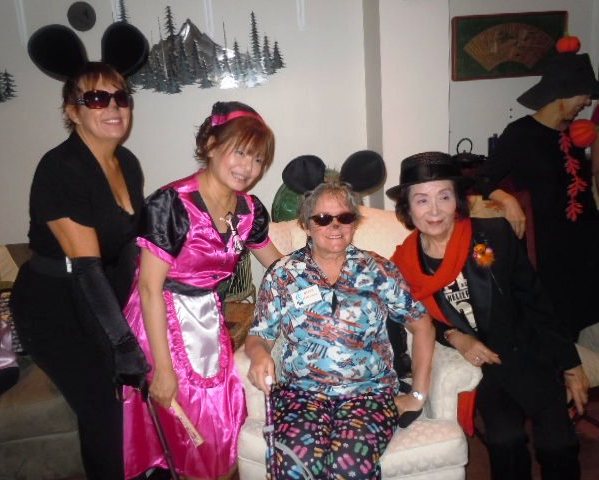
The four hostesses were costumed as a ghoul, diner waitress, and two blind mice. Yours truly was disguised as a taiko drummer although Big Bird mistook her for a tatami mat. Other than a pair of drumsticks pilfered from College Boy's bedroom, all the components of the drummer costume -- tabi shoes, skirt, hori jacket, and headband -- came out of my closet.
How did I come to possess the makings of a taiko drummer costume? What was I thinking? Heck if I can remember but I'm going to hang onto this stuff so my future grandchildren can play dress up on rainy days.
They pinned a tail on a black cat.
They munched on "Mummy Dogs" and something that looked like an insect but was fiber cereal coated in chocolate.
| Robyn, Kay, Ouiser, and Misa |
The four hostesses were costumed as a ghoul, diner waitress, and two blind mice. Yours truly was disguised as a taiko drummer although Big Bird mistook her for a tatami mat. Other than a pair of drumsticks pilfered from College Boy's bedroom, all the components of the drummer costume -- tabi shoes, skirt, hori jacket, and headband -- came out of my closet.
How did I come to possess the makings of a taiko drummer costume? What was I thinking? Heck if I can remember but I'm going to hang onto this stuff so my future grandchildren can play dress up on rainy days.
Tuesday, September 27, 2011
A Kimono Exhibition with Friends
A year ago this past May Matsuzaki-san took the Shonan Ladies to a kimono artist's studio on a Kamakura hilltop. That artist was Mitsuo Haruki and his works are currently on display in an ancient gallery in Kita-Kamakura. When Matsuzaki-san proposed visiting the exhibition today, how could I possibly say no?
My Norfolk neighbors probably couldn't pick me out in a police lineup, but Haruki-san's charming wife remembered me from our previous meeting. Being the oldest American woman in Japan -- by a landslide -- is a blessing and a curse but today I counted it a blessing and endeavored to comport myself in a somewhat dignified fashion. I even asked permission before snapping pictures. What I'm sharing here, the pictures I've spent the past three hours coaxing from my computer into this post, is just the tip of the iceberg.
Three old houses were connected sometime in the past to form the exhibit gallery. The building alone was worth the train fare if you are fond of ancient beams and charming courtyard gardens. I certainly am.
The first floor was devoted to Haruki-san's work - his preliminary sketches and kimono in various stages of completion -- while upstairs we found children's antique kimono, some more than a century old, lavish obis, and ornate dolls. The wall spaces not filled with kimono and obis held framed squares of Haruki-san's yuzen-dyed fabric.
The antique kimono were displayed behind glass as were the obis. My favorite child's obi was this simple purple one from the late Meiji or early Taisho period; my apologies for the reflection in the glass.
One of the American Shonan Ladies interviewed Haruki-san shortly after we met him in May 2010. Her interesting article appeared in the Stars and Stripes. You can read it by clicking here.
The congenial artist draped pieces of his art across the shoulders of Fearless and Artistic but ignored my shoulders and looped an exquisite length of turquoise silk around my neck instead. Maybe he was tempted to choke me. I can think of worse ways to die.
Fearless doesn't mind having her picture taken. We're going to have to drag her along on more outings this year.
The obis were incredible. My favorite -- not this orange one -- was reversible with a traditional Japanese bridge and cherry blossoms on one side and cheerful contemporary patterns on the other.
This is part of one of the staircases connecting one old house to another. Old wood speaks to me but I'm not sure what it's saying. (Here is where my mother, who was justifiably fond of her old oak staircase, would pipe up, "Please wipe me with Murphy's Soap!")
What a wonderful day in a long, long string of wonderful days. I treasure every moment of these marvelous adventures with my American and Japanese friends.
My Norfolk neighbors probably couldn't pick me out in a police lineup, but Haruki-san's charming wife remembered me from our previous meeting. Being the oldest American woman in Japan -- by a landslide -- is a blessing and a curse but today I counted it a blessing and endeavored to comport myself in a somewhat dignified fashion. I even asked permission before snapping pictures. What I'm sharing here, the pictures I've spent the past three hours coaxing from my computer into this post, is just the tip of the iceberg.
| The kimono featured in my May 22, 2010 post |
Three old houses were connected sometime in the past to form the exhibit gallery. The building alone was worth the train fare if you are fond of ancient beams and charming courtyard gardens. I certainly am.
The first floor was devoted to Haruki-san's work - his preliminary sketches and kimono in various stages of completion -- while upstairs we found children's antique kimono, some more than a century old, lavish obis, and ornate dolls. The wall spaces not filled with kimono and obis held framed squares of Haruki-san's yuzen-dyed fabric.
| Child's kimono from Taijo Era (1912-1926) |
The antique kimono were displayed behind glass as were the obis. My favorite child's obi was this simple purple one from the late Meiji or early Taisho period; my apologies for the reflection in the glass.
| This kimono began as a bolt of white silk |
| Detail of narcissis on right sleeve |
One of the American Shonan Ladies interviewed Haruki-san shortly after we met him in May 2010. Her interesting article appeared in the Stars and Stripes. You can read it by clicking here.
| Haruki-san and Fearless |
Fearless doesn't mind having her picture taken. We're going to have to drag her along on more outings this year.
The obis were incredible. My favorite -- not this orange one -- was reversible with a traditional Japanese bridge and cherry blossoms on one side and cheerful contemporary patterns on the other.
| Not my favorite, but you're getting warmer. |
| Here we go! This is Side A. |
| Here's a tiny glimpse of Side B. |
This is part of one of the staircases connecting one old house to another. Old wood speaks to me but I'm not sure what it's saying. (Here is where my mother, who was justifiably fond of her old oak staircase, would pipe up, "Please wipe me with Murphy's Soap!")
| This is a closet door. Excuse my drool. |
| The artist surrounded by his adoring fans |
Subscribe to:
Posts (Atom)