Showing posts with label Nikko. Show all posts

Thursday, November 17, 2011

What? Me Worry?


My only encounter with showy chrysanthemums this fall was a small display near Toshogu Shrine in Nikko. Did someone remember to drag the newcomers to the chrysanthemum exhibit in Yokohama while I was off exploring other parts of Japan? I have to stop worrying about things like this and savor each remaining day in the months left before the Ancient Mariner retires and we leave Japan.

He's downright gleeful about retiring, in case you wondered. He says things like "Next week I'm going to Seoul for the last time" and then does a little tap dance. When I discovered our property manager had executed a 15-month lease on our house without checking with us, I thought he would hit the roof. Where are we supposed to live until the tenants move out on August 31? "We'll spend the summer driving around the United States, visiting relatives." Maybe I should change his name to Alfred E. Neuman. What? Me worry?

I, on the other hand, cringe when I even think the word "last" let alone say it out loud. I am not the least bit gleeful about taking my last trip to the kitchen or fabric district in Tokyo or glimpsing the jizo statues at Hase-dera for the last time. The thought of saying goodbye to my Japanese friends has my stomach in knots. Some things are better left unsaid.

Tuesday, November 8, 2011

In Celebration of Children: Shichi Go San

A three-year old near Toshogu in Nikko
The Shichi Go San or 7-5-3 Festival is one of my favorite Japanese traditions. Boys who are 3 and 5 years old, and girls who are 3 and 7 are taken to a shinto shrine, often in their first kimono, and the parents pray for their continuing good health and prosperity.   The parents of this little girl kindly allowed me to take her picture when I spotted them exiting the shrine.

In feudal times, Japan's high childhood mortality rate was blamed on evil spirits.  When children reached the ages of 3, 5, and 7 (three and seven are especially lucky numbers here), the parents would thank the gods for protecting their offspring. 

See the bag the little girl is clutching in her right hand?  A sweet candy called chitose-ame is often given to the children in a bag decorated with cranes and turtles, symbols of longevity.

Remind me to pick up some crane and turtle washi paper before I leave Japan.  I'm sure my future grandchildren won't complain about getting bags of candy after I dress them in kimono and make them stand in front of the church on their birthdays.

Sunday, November 6, 2011

Tokugawa's Tomb and the Worst Job in Japan: Nikko, Part 5

The tomb of Ieyasu Tokugawa is at the top of a heavily wooded hill. You must climb two hundred and seven stone steps to get there. (The guidebook says 200 but Ouiser counted otherwise.)

Vending machines are everywhere in Japan and the tomb is no exception. I stopped complaining about the steps after I passed a middle-aged man who apparently is responsible for restocking those machines.

Bless his heart!
Copper gate guarding the tomb
The copper tomb sits in the center of a quiet clearing. The unpretentiousness of the tomb and setting, especially after all those ornate wood carvings, reminds me of Robert Kennedy's grave in Arlington Cemetery.

Circling the tomb, we notice a small crowd gathered at the base of a hollow tree. Mineko tells us the tree is thought to be something like a prayer amplifier so we stand in line to pray for our children and future grandchildren.
Ieyasu Tokugawa's Tomb

Before we leave Toshogu Shrine, Mineko takes me into a building, the Yakushi-doh, that has a dragon painted on the ceiling. A monk gives a brief lecture about the history of that painting (I can only assume since the lecture was in Japanese) and then strikes wooden clappers so we can hear the sound of the dragon crying. Cameras are not allowed in the Yakushi-doh or I would show you what a crying dragon looks like.

Enough of Nikko. I have a zillion more pictures to share but I'll save them for later, for those days when I forget to charge my camera.

Saturday, November 5, 2011

Carving Wood in the Seventeenth Century

There are 5,173 wooden sculptures in Toshogu Shrine. A few more than five hundred of them can be seen on Yomei-mon, the striking gate leading to the inner precincts.
Yomeimon at Toshugo in Nikko
The Yomei-mon gate, deservedly designated a national treasure, is also called Higurashino-mon which translates to "the gate where people spend all day long to look".  If I didn't have a train to catch, I'd probably still be standing there catching flies in my gaping mouth.

The gate rests on twelve pillars, one of them inverted to signify imperfection and the desire for long life.  In ancient times it was believed that perfection was the beginning of decline so people used to leave space for three tiles on the roof when they built a house.


Misa and Mineko outside Yomei-mon


A sleeping cat is carved above the entrance to Okusha, the area of the shrine where Ieyasu Tokugawa is buried.  This is the most famous sculpture in Toshugo so I had to try to blend into a class of yellow-capped students to get close enough to take a picture. Their guide was probably telling them that the sparrow perched on the cat's back means that peace has arrived in Japan after years of civil strife.

Another interesting carving can be found on the gable of one of the storehouses across from the sacred stable.  People call this "The Imaginary Elephants" because the artist had never seen one and had to rely on his imagination and some limited written descriptions.

I hope the imperfections translated into a long life for him.

Friday, November 4, 2011

Monkeying Around at Toshogu Shrine: Nikko, Part 3

Nikko's main attraction is Toshogu, a Shinto shrine surrounding the final resting place of Ieyasu Tokugawa, founder of the Tokugawa shogunate. In case you've forgotten, the Tokugawas ruled Japan for over 250 years until 1868.

Ieyasu is credited with uniting Japan after decade upon decade of civil strife, although at least one historian wryly notes that Ieyasu just happened to be the last of three close comrades still standing after the final battle. I recently spotted an unattributed Japanese proverb in a Laura Joh Rowland mystery that goes something like "Oda sowed the grain, Hideyoshi baked the bread, and Tokugawa ate the bread."

He was 60 when he was installed as Seii-taishogun in 1603 and resigned two years later to ensure his son's smooth succession and to focus on diplomatic and building projects (this was the beginning of what history now calls the "Edo Era" because he moved the seat of government from Kyoto to what is now Tokyo).

When he died in 1616 at the age of 73, he was enshrined in accordance with his last wishes.  "Enshrine my dead body in Mt. Kuno  for the first year of the death . . . and build a small shrine in Nikko and enshrine me as the god.  I will be the guardian of Japan."

Mt. Kuno was his hometown.  He chose Nikko as his final resting place because Nikko is located north of Tokyo and north was considered the taboo direction, the direction from which demons come (forgive the messenger, Russian readers).  Tokugawa chose to position himself in Nikko to protect Japan from "the evil things".

Although Ieyasu specifically requested "a small shrine", his grandson Iemitsu later decided to transform Toshogu into a stark reminder of the family's power and wealth.  About 40 billion yen (at today's rate) and more than 4.5 million workers labored for one year and five months to construct the shrine buildings we see today.

Enough with the pedantry.  Let's go in.

One of the first things to catch our eye is a colorful five-story pagoda (right) contributed by Tadakatsu Sakai in 1650.  The pagoda burned down in 1815 but was reconstructed to withstand earthquakes three years later by a descendant of Tadakatsu.   (Of parenthetical interest, Tadakatsu was the governor of Obama in Fukui Prefecture.  Obama means "little beach" in Japanese.)

The Sacred Stable with eight monkey panels
Next we enter a large courtyard and find three large storehouses facing a sacred stable (shinkyu).  Two sacred horses, they must be white, rotate stable duty for four hours every day.  They don't have to work on days when it rains or snows.

We're in luck! We've managed to arrive at the sacred stable after 10am and before 2pm on a balmy day so we catch a glimpse of a sacred horse.

To my credit, I succeed in taking this picture without blasting out the chorus of the Mr. Ed Theme Song.

Now let's go back outside and take another gander at those eight monkey panels scrolling across the front of the stable.  These carved panels are called sansaru (three monkeys) and work like a picture book.  To read the story, click here.

Of the 8,914 people who visited Toshogu on November 2, we are the only four who did not recreate the second panel for posterity.  How unlike me.

"Hear no evil, speak no evil, see no evil"

"Speak no evil, hear no evil, see no evil, see no evil"

Until today, I had no earthly idea those three monkeys are Japanese creations. They even have names! And, yes, they might have been born in India and wandered through China before they reached Japan, but we have to give Japan credit for the catchy slogan. Why? Wikipedia says so. If you don't believe me, or if you want to know the full story and see how good I am at summarizing, please click here.

Toshogu Shrine is fun!  Now let's wander up those steps to that big gate thing.

Thursday, November 3, 2011

Gazing Into An Abyss: Nikko, Part 2

"And if you gaze for long into an abyss, the abyss gazes also into you."--
Friedrich Nietzsche


Kanmangafuchi Abyss, formed by an eruption of nearby Mount Nantai, offers a pleasant riverside walking trail with nice scenery near central Nikko.

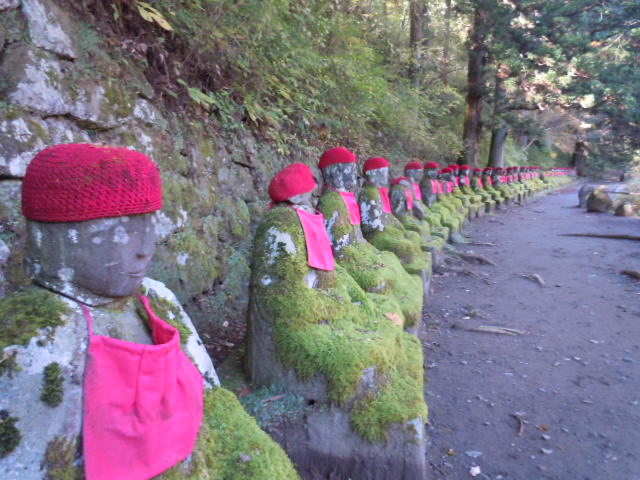
Kanmangafuchi is also known for its row of about 70 stone statues of Jizo, the Bodhisattva who cares for the deceased, especially infants.  This group of statues goes by many names, including Bake Jizo (Ghost Jizo), Narabi Jizo (Jizo in a line) or Hyaku Jizo (100 Jizo).  The story behind the last name is that about thirty of the statues were washed away by a flood and never recovered.

Mineko says we are supposed to pose with the Jizo who most resembles our husband. 

Too somber

Hat angle too jaunty

Ring around the collar?  Not MY husband

Too ancient, believe it or not

The pained expression looks slightly familiar

"I'm melting," cried the Wicked Jizo of the West

The Winner!

Cab driver with Mineko
We eschewed the bus today in favor of a taxi because we had lots of ground to cover before catching a late afternoon train back to Yokosuka via Tokyo.

My recent experiences with cab drivers in Japan have me thinking this is a great career option for history majors who, like me, favor captive audiences. Our Nikko driver was a jolly fellow who tipped us off that some of those thirty missing Jizo statues could be found at a little-known shrine downriver from the abyss. He took us there and I counted ten more Jizo before the cemetery distracted me.

What a great way to start the day! Lovely autumn foliage, water cascading down a gorge, umpteen Jizo, and a quiet cemetery. If we never make it to the famous shrine, I'll still feel this trip was a success.

Wednesday, November 2, 2011

Natural and Other Wonders in Nikko

Nikko was on the docket for our second, or was it third, Christmas in Japan but the Blonde Wonder came down with the flu so we watched thirty-seven episodes of The West Wing instead. Not that I'm complaining. Forced deferred gratification can be quite rewarding. Certainly this is true in Nikko's case.

Mineko at Nikko station
Misa was so dismayed to learn at last month's kimono exhibition that I had not yet visited Nikko that she promptly contacted Mineko and together they came up with a plan to get me there.  Ouiser agreed to tag along even though, like most Americans living in Japan, she had been to Nikko within two months of arriving on this island.  Nikko is a tourist mecca.  Foreigners flock there to feast their eyes on the most un-Japanese of Japanese shrines while native Japanese enjoy both this manmade marvel as well as the bountiful natural resources in the area, including mountains, lakes, hot springs, waterfalls, and gorges.

With two seasoned Japanese travelers calling the shots, I saw more of Nikko in thirty-six hours than the Ancient Mariner and I could have covered in a week.  Let's hope the Navy finds someone to replace him by April 1 so we can reprise this trip before we leave Japan next summer.

Hotel Japan shuttle bus
Ouiser and I left Yokosuka at dawn, Mineko hopped on the train in Ofuna, and we hooked up with Misa in Tokyo just before boarding our express train in Asakusa. Nikko is about ninety minutes north of Tokyo by train so we arrived shortly before noon, tossed our bags in the hotel shuttle bus parked next to the train station, and then bought two-day passes for a local bus that travels between Nikko and Lake Chuzenji.

Mineko and Misa are remarkably adept at snagging seats on public transportation so I was blessed with the breathtaking views afforded by a window seat all the way up the long, winding incline to the lake district.    

Mineko, Misa, and Ouiser at Kegon Falls
The almost 100-meter tall Kegon Waterfall, the only exit for the waters of Lake Chuzenji, is the most famous of  Nikko's many waterfalls and is considered one of Japan's three most beautiful falls, along with Nachi Waterfall in Wakayama Prefecture and Fukuroda Waterfall in Ibaraki Prefecture.

We took a rather frightening elevator ride to the base of the falls to get the most impressive view.  The trees around the waterfall are exceptionally colorful at this time of year although I wouldn't mind seeing the waterfall in winter as well since I hear it often freezes almost completely solid.

Another bus took us back down those hairpin turns and deposited us across the road from Tamozawa Imperial Villa, a summer residence and retreat for the Emperor and his family beginning in 1899.  The villa fell into disrepair after the war but was restored by the city and opened to the public in 2000.   

There are few things in life I enjoy more than poking my nose in other people's houses.  Padding through Tamozawa Imperial Villa in my stocking feet and watching a video of the building's history was worth ten times the price of admission.  This is where Emperor Hirohito, the Showa Emperor, spent the last year of the war and here I was, more than sixty-five years later, admiring his billiard room and remarking that his back staircase was a narrower replica of the staircase back home where my two older brothers used to suspend Brother #3 upside down until all the pennies -- probably four on a good day -- fell out of his pockets.

The villa seemed enormous to me but I later learned it is nowadays less than one-third its original size.  In 1922 the villa was comprised of 106 rooms and 107,000 square meters.  Yet it is still one of the largest wooden buildings in Japan and the interior is an interesting combination of Japanese and Western styles.  Some floors are carpeted and many ceilings sport elaborate chandeliers but sliding paper doors and tatami flooring are also very much in evidence.


The Interview Room
Misa had imagined the table in the Emperor's Interview Room would be much larger. "The purpose of a small table was probably to make the Emperor appear larger, kind of an optical illusion," I opined more pedantically than intended.

As much as I longed to narrate "The Emperor's New Clothes" from memory, I controlled myself.

LinkWithin

Related Posts with Thumbnails