Showing posts with label Temples. Show all posts

Sunday, May 6, 2012

Flat Stanley Visits a Shrine and a Temple

This is a torii (TO-REE), a gate that marks the entrance to a Shinto shrine.  I saw lots of torii today.  The Shinto religion is the ancient native religion of Japan.
 
We spotted another torii after we walked down a long path lined with cherry trees and azalea bushes.  Ryan's friends said this looked even prettier last month when the cherry trees were covered in pink blossoms.

We could see the shrine on the hill ahead of us through the second torii.

All the shrine buildings were painted an orange-red color. They looked pretty against the blue sky. (I think I was wrong about the Rainy Season starting early this year.)

There are a lot of steps in Japan.  I can't wait to run up these.

What are those people doing over there?  Can you see me?
Those people were rinsing their hands before going up to the shrine to pray.  I watched what they did and then picked up one of the ladles lying over the well, filled it with water from the well, and rinsed both my hands.  One man used his hand like a cup and rinsed his mouth and then spit the water out next to the fountain.  This is because you are not supposed to drink the water directly from the ladle.
Bad fortunes
Some people were buying fortunes at a little shop near the fountain. The ones who bought fortunes that predicted bad luck, like getting sick or failing a test, tied the fortune to one of these ropes or a tree branch so the bad luck could not follow them home.

Another thing you can do at a Shinto shrine is buy a wooden tablet, called an ema (EH-MAH), and write a prayer on it. There is a big rack where you can hang your prayer. I wonder what the person who drew the cartoon is praying for.

There is a picture on the front side of every ema. Most of the ema I saw had pictures of dragons because 2012 is the Year of the Dragon here.

Someone picked an ema with a picture of a horse.

Which would you choose, a dragon or a horse?

There is a smaller shrine next to the big shrine.

Not all torii are made of wood and painted that orange-red color. Some are made of stone, some are made of metal, and this one is made of concrete.
We passed through a different type of gate when we entered a Buddhist temple later in the day. Buddhism came to Japan from China almost two thousand years ago. I think I heard someone say this kind of gate is called roumon (ROH-OH-MOHN).


We did not wash our hands at the Buddhist temple. Instead, people lit sticks of incense, stuck them in a big pot filled with sand, and waved the smoke around. We had to take off our shoes to enter the temple so I'm glad I wore nice socks.

Visiting a shrine and temple was a nice way to spend the day. Lots of people were strolling around the gardens at both places. I saw children feeding turtles, three herons resting on an island, and plastic food in a restaurant window. You can look at those pictures tomorrow while I pack my things to come home.

Thursday, October 20, 2011

Enmei-en: A Cure for Whatever Ails You

On the far left side of the Enmei-en grounds -- we're still on that hilltop in the Noge neighborhood, people  -- hundreds of small Jizo statues are displayed in tiers.

Many of the statues have been lovingly swaddled in little outfits, some fashioned from wash cloths.  A few poignant gifts are scattered among the statues.  I spotted Mickey and Minnie cellphone charms, a small Winnie-the-Pooh, and a Guinness glass filled with what looked like water but might have been sake.

This place reminds me of a happy-ish cemetery or open-air mausoleum. Off to the right, a tall, stalwart Jizo supports two clinging and one suckling babe.

Some, not all, of the babies mourned here were aborted.  Whenever I visit a Jizo "cemetery", I remember the college history professor who forecast that centuries from now when US history in the 20th century is reduced to a single line in a textbook that sentence will probably mention abortion but not Watergate or the Vietnam War.  He called it "The Great Debate".  I cannot imagine having an abortion but I wish there were places like this back home where women who have had abortions could mourn their losses in peace. 


On our way back to the temple entrance, Ishii-san and I pass the Jizo where the elderly lady was ladling water on the babies' heads while praying.  Then, right in front of the entrance, we spot a statue that looks to me like it has lost a great deal of gilt to the elements.  This is because I am seeing the statue through Western eyes.   


Ishii-san explains that the statue is gaining gilt, not losing it. I can deposit 500 yen in the box and take a packet of gilt which I can apply to the statue with the brush provided. People apply the gilt to the part of the statue corresponding to the parts of their own bodies in need of a cure. We notice quite a buildup of gilt on the statue's knees, abdomen, kidneys, and ears.

This would make a great fundraiser for hospitals. Just place a statue in the lobby and see how fast those $5 bills pile up. Or how fast they disappear . . .

Wednesday, October 19, 2011

Noge: A Slice of Old Yokohama

Verbosity tends to be a natural by-product of any adventure with Ishii-san.  She chooses such interesting places with tantalizing histories that I never come home without a hundred photographs or a hankering to research the heck out of what she's shown me.  Right now I have no idea how many posts today's outing to Yokohama's Noge neighborhood will demand but I know it will be more than two.

Our adventure started out as a simple quest for pie. Ishii-san wanted to visit that pie shop adjacent to Sakuragicho station where the Ancient Mariner, College Boy, and I infamously sampled five different wedges a few months back.  But we couldn't just make a beeline for dessert.  Absolutely not.  We were going to earn our pie wedges.

Sometimes I think Ishii-san might be my mother reincarnated.  Maybe that's why I'm so fond of her.

She decided we would visit the pie shop via Yokohama's most famous temple and most famous shrine.  We hopped off the express train in Kamiooka and dashed across the platform to a local train going in the same direction, toward central Yokohama.  Disembarking at Hinedoche station, just a few stops up the line, we started walking toward Landmark Tower.

Just when things were starting to look familiar -- "This is the same route Kaji-san took to the Yokohama Quilt Show last November, when I first saw the pie shop!" -- we turned left into a narrow lane and then left again into a slightly less narrow lane.  Straight ahead of us was Enmei-in, also called Narita-san Yokohama Temple since it's a sister temple of Chiba Prefecture's Narita Shinsoji Temple which is a major temple of the Buddhist Shingon sect.  Local residents call it Nogeyama Fudoson which I'm betting loosely translates to "at the top of Heart Attack Hill in Noge".

Ishii-san ponders the fork in the road

We could have marched straight up those cement steps to the temple but chose the scenic route through the door on the left instead.  The scenic route offers a staged ascent past fascinating lava outcroppings and scores of very old statues and tablets.  A great deal of red paint is in evidence, probably to make the inscriptions easier to read (assuming, of course, that one can read Japanese). 

The temple was originally built in 1870 in Ota-mura and was moved to its present hilltop location in 1893.  According to every description in English I managed to find, people visit this temple to ward off evils and bad omens and bring about better fortune and career promotions. The torii near the pond at the base of the hill  and the statues, especially the main statue - Fudomyoo -- are thought to be the main attractions.

Yet it was the Jizo statues that captured my attention and heart.  How is no one has mentioned them?  This Bosatsu, known in Japan as as O-Jizo-Sama or Jizo-san, is the patron of children, expectant mothers, firemen, travelers, pilgrims and aborted or miscarried babies.  I never expected to see a Jizo display to rival the one at Hase-dera in Kamakura but Enmei-in absolutely takes the prize.


An elderly woman chanted a prayer while ladling water over the stone heads of three infants clambering up this statue in an alcove decorated with colorful pinwheels. Ishii-san supposes the lady lost a baby. I feel so sad but I can't stop watching the woman. I want to pray with her. I want to know if she's praying for her child, grandchild, or great-grandchild.

We move along to the other small shrines arranged along the sidewalk in front of the temple and the elderly woman seems to be following us. She tosses a coin in the money box at each altar and says another prayer. She does not seem the least bit bothered by our presence.

One of the small shrines holds a display of six Jizo. Ishii-san tells me that each of these is assigned to one of the six realms of existence.  Buddhists believe that all living beings are born into one of these six realms and are doomed to death and rebirth in a recurring cycle unless they can break free from desire and attain enlightenment.  Jizo vowed to relieve the suffering souls in each realm and this is why they are often shown in groups of six (Roku Jizo).


The six realms, from worst to best, are:  hell, hungry ghosts, animals, bellicose demons, humans,and heavenly beings.

Worship of the Six Jizō can be traced back to the 11th century in Japan, and specifically to the Shingon sect, but this grouping has no basis in Mahayana scripture or in the writings of Buddhist clergy.

Stay tuned for some of my favorite Jizo.

Wednesday, October 5, 2011

Art Imitates Art

My team raised over $700 for the Relay for Life this morning. We did this by cleaning out our closets and auctioning off our superfluous possessions to each other. Fearless and I tossed in a couple of those obis and kimono we've been sorting through, Jessica kicked in several adorable hand-knit baby hats, and Lynette whipped up a batch of tamales.

As is usually the case, I came home with more than I donated but most are earmarked as Christmas gifts and it was for a good cause. Plus, I managed to locate the box of fall decorations while I was cleaning out that closet. Life is good, and so were those tamales.


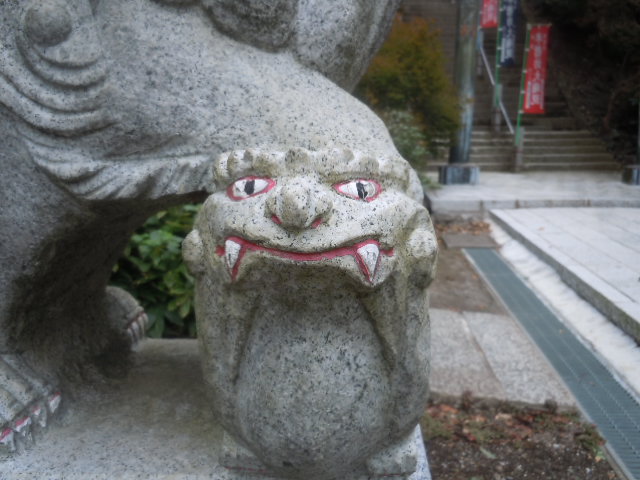
I did not bring home this statue (above) of a lion cub but only because it wasn't on offer today. I spotted this little guy at Kencho-ji in Kamakura last week. Is it just me, or does he bear an uncanny resemblance to a Maurice Sendak illustration?

I wonder how that happened.

Friday, September 30, 2011

Kencho-ji with Ishii

Ishii-san and I went searching for bush clover in Kamakura today. We didn't see much of that but we did see a whole lot of other things, munched on some very yummy fresh rice crackers, and walked our usual zillion miles.

Ishii read somewhere that Kencho-ji temple in Kita-Kamakura is a good place to see bush clover. Our route took us past Haruki-san's kimono exhibit so of course we took a little detour. Haruki and his wife were so gracious. They remembered my name! He pronounces "Kathy" the same way Yuuko Kaji does, with a very soft "th" that makes me feel all warm and fuzzy.

Ishii was wearing a lovely sashiko vest for the occasion, a long duster she spent a year creating. I wish I had taken some closeup pictures so you could see her exquisite craftsmanship. I, on the other hand, had spent the morning shelving books at the base thrift shop in a sleeveless shirt and found a ratty cardigan in the trunk of my car to cover my bare shoulders, something I feel as compelled to do when I am out and about in Japan as when I visited the Vatican at the age of fifteen.  (As the day grew warmer, the sweater grew increasingly loathsome.  I'm going to abandon it at the thrift shop the next time I shelve books.)

Karamon at Kencho-ji

Kencho-ji, constructed in the 13th century, is the oldest Zen training monastery in Japan -- surely you've heard this before -- and the first-ranked of the five great Zen temples of Kamakura. This was my third visit since March 2007 yet I still took a dozen pictures of the statue of fasting Buddha and the dragon picture (unryu-zu) on the Hatto ceiling. No matter where you stand in the room, the dragon's eyes seem to follow you. This is quite eerie and, so far, impossible to capture in a photograph.

Fasting Buddha

The map provided by the man at the ticket booth showed a garden near the rear of the temple grounds. This seemed like an obvious place to find bush clover so off we went. Except we skirted the building on the left when we should have marched directly through the building straight ahead and, lo and behold, we were behind the garden with no way to get through the tall hedge. That's when Ishii-san got that innocent look on her face that I really ought to recognize by now, the "As long as we're on this path, let's just take a little stroll and see what we can see" look. Those "little strolls" never fail to turn into arduous physical activity. Not that I'm complaining.

Today's "little stroll" took us eventually to the last building on the map, the Hanso-bo, which I think means "8,000 of the steepest steps you will ever climb".  Seriously, even those cute 10-year old school children in their bright yellow caps were huffing and puffing by the time they reached the fourth or fifth flight of stairs.  Japanese landscape designers must all take a special class in Deceptive Neverending Stairs because I can't count the number of times I've scampered up 80 steps only to discover another 80 steps across a short plateau and then yet another 80 steps camouflaged by a leafy maple tree.  Wheeze, gasp.

This is the first time Ishii-san has been to the Hanso-bo.  Her husband knows about those steps which is why I am here with her today and he's not.  


More often than not there's some sort of visual reward for scaling all those steps and today is a more often rather than a not. Thank God.

The Hanso-bo is a shrine that was moved here from Shizuoka in 1890 to protect the temple in the valley below. The final stretch of hillside beneath the shrine is littered with statues of winged creatures called tengu which look like a cross between warrior angels and the Wicked Witch of the West's flying monkey minions.

There's a viewing platform next to the shrine which offers a lovely view of Mt. Fuji on a clear day.  Today we couldn't see Mt. Fuji so I might just have to reprise that ascent.  But you can be darn sure I'll borrow a couple of cell phones and a kid who's willing to scamper up those steps ahead of me to scout out the view.


Ishii-san and Tengu

We spotted a patch of bush clover as we were working our way back toward the temple entrance but it had already finished blooming and that made us laugh. The bush clover seems relatively immune to the effects of the recent Typhoon Roke. Lots of other plants have leaves that are turning brown and shriveling up compliments of all the salt the typhoon carried from the sea to land.

Wednesday, June 22, 2011

More Hydrangeas, or Why I Slept Through Dinner the Night Before He Deployed

The Ancient Mariner trudged aboard the USS Blue Ridge this morning. A few hours later the Seventh Fleet sailed out of Tokyo Bay bound for exotic and not-so-exotic ports. By the time I see my Ancient Mariner again, my stepdaughter Jewls will be married (with her father in attendance if all goes according to plan), I will be another year older (shudder), and Pip will be heading back to college.

Pip and I did not give the Ancient Mariner the send-off he deserved. One of us feels awful about this. The other one of us will no doubt feel similar pangs of guilt about twenty years down the road.

We were going to have a nice "last supper" at home but the Ancient Mariner suggested going out for sushi instead when I limped through the door after a long afternoon of gazing at hydrangeas in Kamakura.  To cut to the chase, I dozed off at 6:00 pm and didn't wake up until after midnight.  Pip disappeared with a friend whose family is leaving Japan today. He said he didn't know we were going out to dinner so he ate with his friend instead.

The Ancient Mariner tells me I snored through two telephone calls, one doorbell ringing, and -- incredibly -- a siren on an emergency vehicle that parked across the street from our house for twenty minutes.  He says this is my typical sleeping pattern prior to one of his deployments, that he's come to expect it and doesn't take it personally.  This made sense fifteen or even five years ago when my body needed to store up energy for the long weeks of single parenthood stretching out ahead of me, but now?  Sheesh.  Old habits die hard.

Engaku-ji in Kita-Kamakura

More likely my body was simply exhausted from hiking the length of the grounds at Engaku-ji after viewing the hydrangeas at Meigetsu-in. The property is narrow. Mainly it's a central path lined with interesting buildings and views. The views and buildings are so interesting that it's not until you've reached the last shrine at the end of the path that you realize you've walked nearly a mile and will have to walk another mile to get back to the exit.

The gardens here are more orderly than the garden at Meigetsu-in. There are fewer varieties of hydrangea and the colors are more traditional, meaning white, pink, and blue.  There's a pond on one side of the path where we stop to admire irises, ducks, and turtles, and one long stretch of hydrangea bushes on the other side of the path that's attracted a pair of amateur artists who look so cute in their little caps and smocks.

My feet were pointed toward the exit when Weather Explorer spotted a directional arrow pointing off to the left toward a National Treasure, the O-gane, one of the three great bells of Kamakura.  I was less than enthusiastic.  I remembered climbing those 200 stone steps to see the bell last year.  Then a wave of guilt washed over me.  She may never pass this way again.  We made our ascent, we glanced at the bell, we admired the view.  Good thing, too, because I don't think I could bear having two things to feel remorseful about today.  One is bad enough.


Tuesday, June 21, 2011

Hydrangea in Kamakura


Meigetsu-in, Kita-kamakura
 A friend of mine who lives in Kamakura has never seen the hydrangeas blooming at the four shrines and temples most renowned for these flowers in her hometown.  Twice she's gotten as far as the Kitakamakura train station near two of these gardens but the sight of all the crowds surging from the station toward the hydrangeas paralyzed her.  She didn't get off the train.

Crowds don't bother temporary residents like Weather Explorer and Bossy.  This is Weather's first and last chance to see hydrangeas blooming in Japan and by the time June rolls around next year Bossy will be frantically rolling bottles of sake in Japanese fabric and hiding her plunder in Rubbermaid bins as a moving van chugs up to her door.

It's not just the "last chance" nature of this hydrangea outing that makes the crowds endurable.  Crowds are part of the attraction of visiting gardens during peak blooming seasons here.  We can and do grow hydrangeas back home, although not (yet) all these remarkable varieties, but enjoying them there is more of a solitary pursuit.  We like the social aspect of peak blooming seasons in Japan.


Our first stop is Meigetsu-in, a temple in North Kamakura with a gardening philosophy that can best be described as abundant, unrestrained, and eclectic.  A stark Zen garden of raked gravel and large rocks is an interesting counterpart to the profusion of hydrangea varieties on the other side of the grounds.  Off to the side there's a rabbit hutch ruled by the biggest tweedy brown bunny I've ever seen. 


This is what I mean by "eclectic"


Thursday, June 2, 2011

Get Thee to a Nunnery: Eisho-ji in Kamakura

Ishii-san at entrance to Eisho-ji
You've seen this little door before, perhaps twice. The Explorers spotted it a year ago on their way to the money-washing shrine and a few months later Ishii-san and I crawled through that door to view the garden on the other side. The garden is attached to Eisho-ji, the only remaining temple for nuns in Kamakura.

Today Ishii-san and I returned to Eisho-ji to see the recently reconstructed gate (left). This gate was destroyed during the Great Kanto Earthquake of 1923. An enterprising man hauled away all the fragments of the gate and rebuilt it in his backyard, which must have been enormous, and not just by Japanese standards.  The gate changed hands again 88 years later and was returned to the temple where it was once again reconstructed.

There's been a bit of construction in the neighborhood surrounding the temple over the course of the past 88 years.  Train tracks have been laid, houses have been built, roads have been diverted.  Visitors these days approach the gate from the interior of the temple complex, through the garden, after paying 350 yen to a nice man who sits in a booth just inside the little door.

Passing through the gate, we turned around to experience the perspective of a 17th Century visitor (above).

There's a ladder to the second story of the gate to Ishii's right (your left). A piece of plywood blocks the ladder. I did not succeed in goading her into removing the plywood and clambering up the ladder, more's the pity, but she was intrigued by a cave on a nearby hillside so we inched our way up that slippery slope and caught another view of the gate.


Later I found out that Ishii-san spotted some very special flowers while we were scaling that slope. These small purple wildflowers, called iwatabako, have a short blooming season in a limited area. She says only lucky people can see this flower. Had I only known, I would have taken a picture for her.

It was another lucky day for both of us.

Wednesday, April 20, 2011

New Sights in Old Asakusa: The Sky Tree and Secret Garden

Sky Tree and Five-Story Pagoda

The newest addition to the Tokyo skyline is the Sky Tree, rising 634 meters from the ground about one kilometer east of Asakusa and two kilometers northeast of Ryogoku, famous for sumo wrestlers and the Edo-Tokyo Museum.  The Sky Tree, scheduled to open sometime in 2012, will play an instrumental role in Tokyo's total transformation to digital communications.  And, yes, I'm wearing the scarf I dyed at the indigo shop in Saitama Prefecture a few years ago.

A few days ago I mentioned the (other) middle-aged ladies we met on our pilgrimage who told us about a special garden behind the Sensoji Five-Story Pagoda.  To access the garden, we entered the building on the right, followed arrows through a fascinating exhibit of ancient painted doors (from the original temple, I presume), and exited into a totally enclosed garden on the other side of the building.    

The garden was enormous, surprisingly so since it is surrounded by hundreds of small businesses and temple buildings in bustling Asakusa.  Either Weather or Shinagawa-san gets credit for the lovely picture at left, showing the Five-Story Pagoda reflected in the garden pond.  You might remember that my camera became a useless appendage a few stops back on our pilgrimage.

Tomoko-san, Bossy, and Weather-san in the Secret Garden

Water Striders (photo credit: Weather)
While I'm not a big fan of living things in general and dogs and insects in particular, the water striders skimming across the pond fascinated me. They were stationary for long periods of time then darted quickly in one direction or another, propelling themselves forward with a charmingly graceful and perfectly Olympian double breaststroke using both their front and back legs simultaneously. The end result of each darting motion was a quick little wrestling match between two water striders and then they were off again in search of new opponents.

That's my take on the natural world for 2011. I hope you enjoyed it.

Tuesday, April 19, 2011

In Conclusion: You, Too, Can Make a Hatsumode Shichi-fukujin

If it isn't one thing, it's another. In my case, if I've remembered to recharge my camera battery, I've forgotten to reinsert that memory thingamajig after downloading the latest batch of pictures. The night before our Seven Gods of Fortune pilgrimage I forgot to recharge the battery. "Way to go, knucklehead!" it sneered just before the camera blinked off at Imado Shrine. I've managed to steal a few pictures from my friends to wrap up this pilgrimage series.

(For posterity, and for friends who might want to make their own pilgrimages when they return to Japan after the radiation wafts into the stratosphere, I've included (here) a link to a nifty website that lists the shrines and temple in the order visited. Don't be dismayed when you see kanji rather than English words. Just click on the links from left to right and you'll be in business. You can pick up a map at the tourist center just outside the train station exit in Asakusa.)

The fifth stop on our pilgrimage was Hashiba Fudouson Temple, dedicated to Hotei, the fat and happy god of abundance and good health. A long and narrow stone path leads to a courtyard graced by a very old Gingko tree.

Just a block or so further along the road we found Ishihama Jinja Shrine, dedicated to Jurojin, the god of longevity. The Sumida River was still on our right but the neighborhood was sorely lacking in vegetation and had an industrial feel compliments of the three enormous tanks looming to the left of the shrine.

Tomoko-san bravely opened a little door in an ancient mound of what looked like lava on the right side of the shrine's courtyard and we all took a peek at a very old statue. 

Weather fondles a beast at Ishihama Jinja Shrine

The seventh shrine is as far from the sixth shrine as the sixth shrine is from the first shrine. There was a lone taxi parked next to Ishihama Jinja Shrine so we hopped in and tooled across Asakusa to Yoshiwara Jinja Shrine, dedicated to Benzaiten, the goddess of knowledge, art, beauty, and especially music. No pictures and I'm sorry about that because the statues flanking the entrance were remarkable for their gem-implanted eyes which sparkled ominously.

We hit one more shrine before we called it a complete pilgrimage, Ootori Jinja Shrine. We had already met all seven of the Seven Gods of Fortune so I have no idea to whom Ootori Jinja is dedicated. Perhaps the god Nara since the map pictures a man leaning against a deer. At any rate, I liked this shrine. Tomoko-san showed us the proper procedure for praying for everything you might imagine.

I approached this enormous wooden face and rubbed the forehead, then the eyes, nose, mouth, cheeks, and chin, and then ran my hands around the circumference in a clockwise fashion.

My prayer? Please, God, let us have lunch. It is nearly 2:00 pm and I am famished.

My prayer was answered in short order.

LinkWithin

Related Posts with Thumbnails