Showing posts with label Tokyo. Show all posts

Friday, May 4, 2012

Flat Stanley Visits Gardens on Greenery Day

Midori no hi (MEE-DOH-REE NO HEE), or Greenery Day, is dedicated to nature and the environment.  It is the third national holiday during Golden Week.  This was a good day for visiting parks and gardens.

There are many beautiful gardens in Tokyo.  We visited two of the oldest gardens.  They are feudal clan gardens.  Feudal clans ruled Japan hundreds of years ago.  They built these gardens before the United States of America became a nation!

This stone bridge is what I liked best at Korakuen garden. The name of this bridge is Engetsu-kyo because a full moon is formed by the bridge and its reflection on the water.

Can you see the shape of the full moon in this picture?

Kyu-Shiba-rikyu (Q-SHEE-BAH-REE-Q) is the name of the other feudal clan garden we visited. There is an island in the middle of a big pond at this garden. I had fun walking across all the bridges.

We saw lots of flowers blooming at Kyu-Shiba-rikyu.

The wisteria is just beginning to bloom
Irises usually don't bloom until June or July

What kind of flowers are these?
We saw lots of turtles sunning themselves on rocks in the pond. Big carp fish, called koi (KOH-EE), swam to the edge of the pond to tell me hello. I said "Ohayo gozaimasu" (O-HI-O GO-ZAH-EE-MAS) to the turtles and fish. That is how you say "Good morning!" in Japanese.

These people are drawing pictures of the peonies on the hill. We saw other people drawing pictures of trees and turtles.

Of all the things I saw at Kyu-Shiba-rikyu gardens, my favorite was a bride and groom posing for wedding pictures.

The bride is wearing a traditional Shinto wedding kimono in the first few pictures.


Shintoism is one of the two main religions in Japan.  Four out of every five Japanese people practice the Shinto religion.  Buddhism is the other main religion.  Three out of every four Japanese people are Buddhists.  Most Japanese people practice both of these religions.

The bride is wearing a white robe over her kimono in this picture.  This is how she will look during the wedding ceremony.

The bride and groom are holding traditional umbrellas in the next pictures.

These umbrellas are made by hand from many layers of paper and glue. They are strong enough to hold an inch or more of snow.

In Japan people don't just use umbrellas when it it raining. They use umbrellas to stay dry when it is snowing and to protect their skin on sunny days.

They even use umbrellas to protect flowers like peonies from snow and sun!

This was a fun holiday in Japan but I think tomorrow will be even more fun.  Tomorrow is Children's Day!

Thursday, May 3, 2012

Flat Stanley Celebrates Constitution Day

My new yukata!
Today is Constitution Day, or Kenpo Kinenbi (KEN-PO KEE-NEN-BEE).  This is the second national holiday that falls during Golden Week.  Showa Day, on April 29, was the first.

A constitution is a written promise of how a country will be governed.  Japan's constitution was adopted in 1947.  It describes the jobs of the Emperor, the Prime Minister, and the leaders who are elected to represent the Japanese people in the National Diet (DEE-ET).

It is raining in Tokyo for the third day in a row.  For hundreds of years rain fell in Japan every day from the beginning of June until early July.  The Japanese people call this "the Rainy Season".  Last year the Rainy Season started and ended a month early.  I think it is a month early this year, too.

How can we spend a rainy day in Tokyo?  Let's look at some more pictures and read a book.

Most Japanese people own bicycles that look like this one. Many people ride bikes to work or school and many others ride bikes to train or subway stations where there are special parking lots for bicycles. Most bikes have baskets in front of the handle bars. Many bikes have baskets behind the seat as well. Baskets make it easier to carry groceries and school books. Bicycle riders in Japan are not required to wear helmets.

Everywhere I look in Tokyo I see art. Even the footpaths in some of the older parks and gardens look like works of art to me! How many different shaped rocks do you see?

This kind of path is called "nobedan" (NOH-BED-AHN).


I was very surprised the first time I visited a public restroom and saw a traditional Japanese toilet. I could not figure out which was the front and which was the back of the toilet.

I did not have to use a traditional toilet because there are lots of "Western-style" toilets in Japan these days.  "Western-style" means they look like the ones at your house and school.  Some "Western-style" toilets here have heated seats. That's a really good idea!

We decided to buy a book of Japanese stories.  Shopping on a rainy day in Japan is fun.  The shopkeepers and clerks are so nice.  First they put our book in a clear plastic bag to protect it from the rain.

Then they put the book inside a paper shopping bag with handles. After that, they put the shopping bag inside an upside-down clear plastic bag. We sure did not have to worry about getting raindrops on our new book!


"The Toothpick Warriors" is a good story.
Should I tell you this story when I get home?

Wednesday, May 2, 2012

Flat Stanley Visits a Tokyo Park

Today we went to Ueno (OOH-EH-NO) Park. The park is famous for its cherry trees, many interesting museums, and Japan's first zoo.

Tokyo subway map

We rode the subway from our hotel to the park. Ueno Park is the green area in the upper right corner of this subway map (above). The large green area in the center of the map is the Imperial Palace where the Emperor of Japan and his family live.

The International Library of Children's Literature is in Ueno Park. There is a statue of Dr. Seuss in front of that library.

Little children like to visit the amusement park in the center of Ueno Park. They can ride on their favorite storybook characters like Anpanman, Thomas the Tank Engine, and Hello Kitty!

Kodomo (KOE-DOE-MOE) is the Japanese word for "children".


I was surprised to see a totem pole in Ueno Park!

You can see all the museums on this park map.

Ueno Park Zoo
Ueno Zoo is the oldest zoo in Japan. It opened 130 years ago!

Two new Giant pandas arrived from China last year.  The male panda is called Lili and the female panda is called Shinshin.

We had a hard time deciding which museum to visit.  There is a science museum, a museum of Western art, and a museum that shows what it was like to live in this neighborhood a hundred years ago.  All of those museums sounded fun to me but we decided to visit the Tokyo National Museum instead to learn more about the history of Japan.

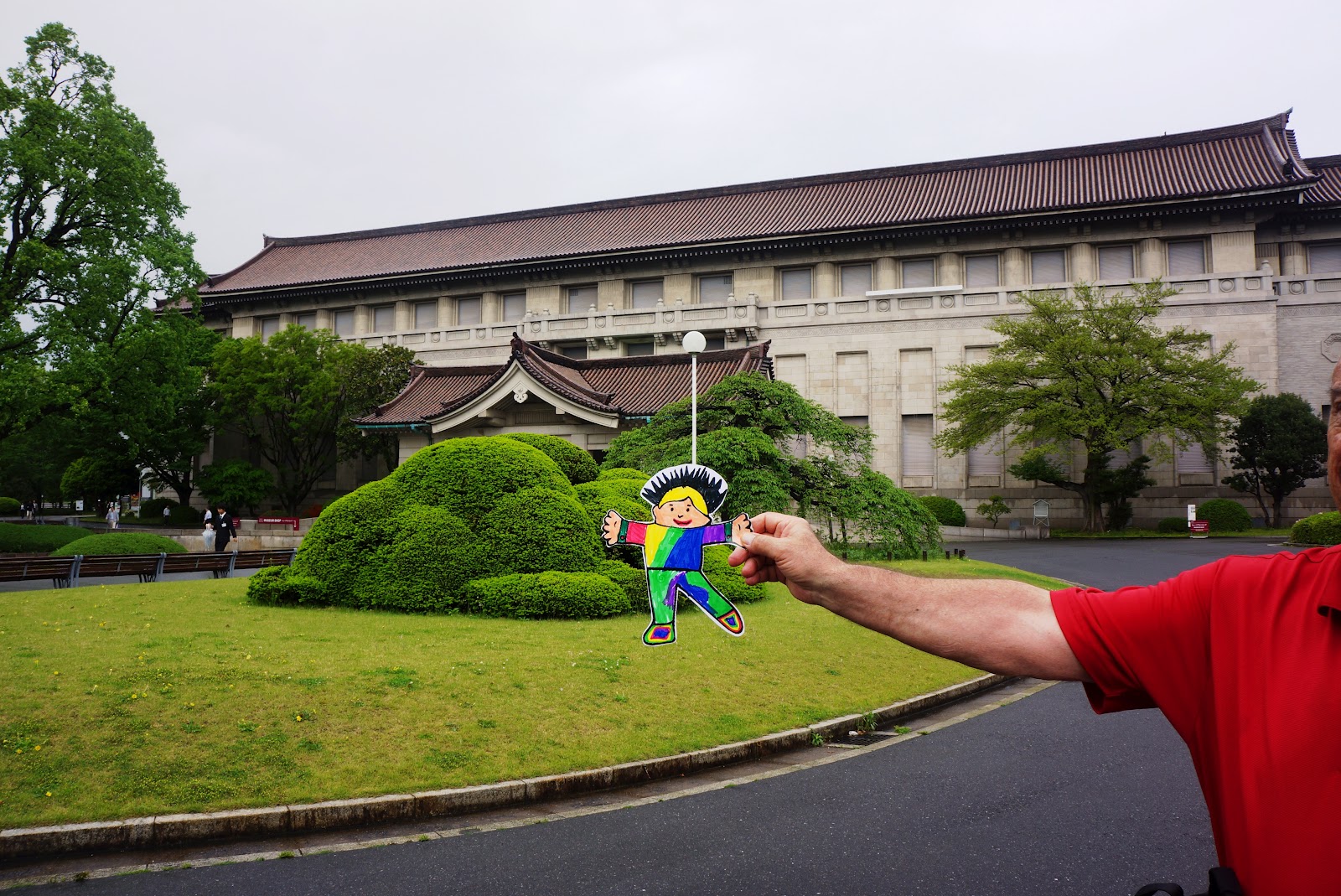
Honkan (Japanese Gallery) at Tokyo National Museum
The samurai armor from 300 years ago reminded me of Ewoks

Ancient metal helmets worn by Japanese warriors (samurai)
These girls attend Nankyo High School. They are proud of their school and are wearing their uniforms during Golden Week when school is not in session.

The girl on the far left has decorated her backpack with cell phone charms. Almost everyone in Japan decorates their cell phone and backpack with charms like this.

The girl on the far right is wearing a mask over her nose and mouth. Many people in Japan wear masks like this when they are suffering from colds or allergies. They want to protect other people from their germs. In Japan it is not polite to blow your nose in public.

We found a Peony Garden in a corner of Ueno Park. The Peony Garden is only open for two weeks every year so I picked a good time to visit Japan. This is one of the biggest flowers I have ever seen!

We spotted an ice cream cart as we were leaving the park.  Some of the flavors surprised me!


From left to right:  chocolate/vanilla, mango, melon, sweet potato, green tea, and vanilla.  Which flavor do you think I picked?

Tuesday, May 1, 2012

Flat Stanley Goes Shopping on a Rainy Day

I was hoping Ryan's friends would take me to Tokyo Disneyland today or Disney Sea but they said both of those amusement parks would be much too crowded with Japanese families during Golden Week. Besides, it looks like it might rain today. This would be a good day to shop for souvenirs.

The weatherman says to expect 20 degree temperatures today. Brrr! Maybe I should have brought my winter coat to Japan. Wait! I just remembered that temperatures in Japan are measured on a different scale than temperatures in the United States. The Japanese use Celsius thermometers. In the United States we usually measure temperatures with Fahrenheit thermometers. Twenty degrees on a Celsius thermometer is about the same as 67 degrees on a Fahrenheit thermometer. I won't even need a sweater!

Can I use my American dollars and cents to buy presents for Ryan and his classmates?  No.  I visited a bank to trade my American dollars for Japanese yen.

Stanley has 1,666 yen

I lined up the yen coins from my toe to my head. The shiny aluminum coin at the bottom is worth one (1) yen and, if placed carefully, can float on water. This coin reminds me of an American penny. You can't buy much of anything with just one.

In order going up, the other coins are worth five (5) yen, ten (10) yen, fifty (50) yen, one hundred (100) yen, and five hundred (500) yen. Two of those 500 hundred yen coins can be traded for one 1,000 yen note made out of paper. A 500 hundred yen coin is worth about six American dollars. I like the way the coins feel in my pocket.

In Japan there are no coins worth twenty-five yen. What coins should I use if I want to buy something that costs twenty-five yen?  Figure that out and then you can look at the pictures from my shopping trip.

Pokemon started in Japan in 1995

What do you think is in the bag?

Hello Kitty! and Anpanman inflatable swords

Did you know that Hello Kitty was born in Japan in 1974? She visited the United States for the first time in 1976.

The most popular fictional character in Japan for the past ten years in a row for children up to age twelve (12) is Anpanman. Anpanman is a year older than Hello Kitty. He first appeared in a picture book in 1973.

There are shopping arcades near many Tokyo train stations.

This shop sells socks.  I see Anpanman!

Here is another familiar Japanese character.

These shops sell vegetables, fruit, and fish.

Shopping makes me thirsty! Lucky for me, vending machines are everywhere in Japan: on street corners, on train platforms, and next to playgrounds. Many vending machines offer both hot and cold beverages. I like hot lemonade. The corn soup tasted good, too.

We had Chinese ramen noodles for lunch.  Yum.
Bakery in a train station
I did not expect to see so many French bakeries in Japan. There is at least one bakery inside or right next to almost every train and subway station. I like the regular French bread, the bread stuffed with cheese, and the little chocolate croissants the best.

I have not yet tasted the rolls topped with peas or the lemon honey donut holes. First I want to try the fish-shaped cakes filled with jam or custard.

Bandai Capsule Station
Bandai capsule stations are not hard to find here since the Bandai company was born in Japan. These days you probably see lots of these machines in the United States too. What does it cost you to buy a toy from one of these machines in Washington, D.C.? The machines in Tokyo cost two hundred yen. Which machine should I try?

Let's take a chance on the Peko-chan machine!

Have you ever heard of Peko-chan? She has been the mascot of the Fujiya Ginza company for more than fifty years. The Fujiya Ginza company is a bakery chain that sells cakes and cream puffs. Life-sized dolls, some with heads that bob up and down, stand outside the door of each shop and are dressed in clothes that change with the season. Peko-chan is so popular in Japan that a special Tokyo museum opened last year to honor her golden anniversary.

Speaking of popular, how many of you like manga (MAHN-GAH)?  Did you know that "manga" is the Japanese word that means "comics" or "cartoon"?  "Anime" (AH-NEE-MAY) is the word we use to describe the animated versions of these books.  Many Japanese people, including young teenagers, follow one or more manga series.  They can hardly wait to read the new story every month.

Luffy-san welcomes Flat Stanley to Japan

Luffy-san is the main character in One-Piece, one of the most popular manga and anime series in Japan today. I was so thrilled to meet him!

Manga and anime character goods are sold at "Jump shops" all over Japan. These shops are usually crowded with customers, mainly young adults. They are even more crowded during Golden Week!

I had fun shopping in Tokyo.  I hope you will like the souvenirs I found.

Cartoon masks in shopping arcade

LinkWithin

Related Posts with Thumbnails