Showing posts with label Kanazawa (Ishikawa Prefecture). Show all posts

Tuesday, November 1, 2011

Arresting Sights in Kanazawa


We spotted this whimsical sculpture (above) on a street corner between Kanazawa castle and the samurai district. If I ever get caught up on all my random projects, I'll crack open the Adobe Photoshop manual and figure out how to transform this picture into a blog header. Don't hold your breath.

It speaks to me of adventure, walking (of course), bunions, and intestinal fortitude.  

Kotojitoro on railing near Kanazawa Castle

Kenrokuen Garden's famous kotojitoro lantern is reproduced on sweets, manhole covers, and bridge railings.


Wandering around the grounds of Oyama-jinja, a Shinto shrine adjacent to Kanazawa castle, we spotted this "Neverending Story" statue. What do you suppose the story behind this statue might be?

Fearless gets credit for convincing us to visit Oyama-jinja after spotting the shrine's distinctive main gate from a bus window. The gate is an interesting mix of Japanese, Chinese, and European religious architectural elements, notably Dutch stained-glass windows on the third floor.


Maybe I'll post some more photographs from Oyama-jinja in particular and Kanazawa in general later this month. This morning I am embarking on an overnight trip to Nikko with three Shonan friends and a fully-charged camera. Bon voyage to me!

Monday, October 31, 2011

An Artist at Work: The Umbrella-Maker of Kanazawa

Ah, November. National Novel Writing Month is upon us so once again one of us is hard at work on a novel, a sequel no less, while the other is trying to shake off writer's block by exploring Japan and spending nine hours a day mindlessly smashing sparkly little gems in a thus far vain effort to get within one hundred thousand points of her little sister's score.

The good news is that the one of us working on a novel has received a nibble from an agent who might be interested in the book he wrote during National Novel Writing Month last year, a military thriller-romance set on the USS Blue Ridge. (So far I've only made it through the first sixteen chapters. His constant refrain these days is "It's fiction!" especially when I start wondering where he came up with all these ideas about romance aboard a Navy flagship.)

The bad news is that two weeks' worth of photographs and memories have been placed on the back burner. I haven't finished sharing the highpoints of the trip to Kanazawa and I haven't even started to tell you about our trip to Nikko or the flower exhibition in Tokyo or the Yokohama Quilt Festival. We've already made gingerbread houses and frosted Christmas cookies with the Japanese military spouses and we've made plans to spend the Thanksgiving weekend in Hakone and Tokyo. Assuming I can tear myself away from Bejeweled Blitz for four days . . .

What should I write about today? Since visiting the workshop of the last remaining traditional umbrella maker in Kanazawa was one of the highpoints of that trip for me, I'd like to unfurl a few for you.


A wagasa is a Japanese traditional umbrella consisting of washi (Japanese paper) with a bamboo handle and ribs.  If you have ever sipped a mai tai or similar frothy alcoholic beverage, you are familiar with the miniature versions of these umbrellas.  Nowadays the Japanese favor our much less expensive Western-style unbrellas for daily use, but wagasa are still used for traditional Japanese tea ceremonies and dance.

Because it rains and snows a lot in Kanazawa, their wagasa is famously strong.  Four layers of Japanese paper are painstakingly pasted to the central part of the umbrella.  Another characteristic of Kanazawa wagasa is its splendid color.


Hiroshi Matsuda has been making wagasa for 75 years. He started working in his father's umbrella shop when he was twelve years old. Yes, he is as happy and adorable in person as he looks in the picture above. If you want to know a little more about Matsuda-sama, click here.

Many of his umbrellas feature real leaves, clover and such, pasted between the layers of washi paper (see left).

Simply glimpsing Matsuda hard at work would have been enough of a treat, but Fearless and I also had the pleasure of watching Matsuzaki-san talk Matsuda-sama into selling her an umbrella.  They engaged in some serious flirting and she took pouting to a new level before waltzing out of the shop with a purple number that set her back a mere 35,000 yen (roughly $400).

Fearless and I were invited to select smaller souvenir-size umbrellas, about eight inches high, while Matsuda-sama wrapped the purple umbrella.

Peevish performs "The Flower Drum Song"

Sunday, October 30, 2011

Kanazawa: Bus Riding for Dummies

The easiest way to get around in Kanazawa is by bus and on foot. Unlike most Japanese "castle towns", here the town grew up around the castle rather than off to one side. Once you get to the castle, you're in the center of town and can walk easily to the other interesting historical areas.

My hometown bus system, with four routes connecting each quadrant of the compass, is the only one I've ever managed to master so I've pretty much avoided buses since pocketing my first driver's license in 1968. I want to ride buses. I think they're a great idea but, at the risk of sounding like a complete moron, they are just too complicated for me. The "how much" and "how to" pay the fare questions are bigger stumbling blocks for me than "which route". Getting on the wrong bus might lead to an adventure but fears of being chastised by a driver for incorrect change or enduring mutters or sighs, real or imagined, from passengers behind me in line have turned me into a long-distance walker.

If I wasn't traveling with Fearless and Matsuzaki-san, I would have walked from the hotel to the castle and missed out on a wonderful transportation experience.

There are several bus routes that pass the castle and garden, but the Loop bus is easiest for visitors. It costs 200 yen to ride the Loop bus but we each bought a day pass for 500 yen at the information center outside the train station. The pass looked like a scratch-off lottery card.  I saved mine because the month and day scratched off happen to be my father's birthday.  

About two dozen very cheerful schoolchildren boarded the bus with us. (Speaking of Kanazawa schoolchildren, the Ancient Mariner will be interested to learn that one of his favorite ballplayers, Hideki Matsui, grew up in this area and is the most famous graduate of the local high school.)

Now we're getting to the part I hope you'll share with your friends who work for the US Department of Transportation or any urban planners you happen to know.

Upon exiting the bus near an entrance to Kenrokuen, we noticed an electronic map on the wall of the bus shelter. The map showed the locations of the four Loop buses.


Our red bus had just let us off at Stop #9.

We stood there for a few minutes, watching our bus progress to Stop #10 and then on toward Stop #11.

This is the first technological innovation since Amazon's Kindle to make my jaw drop.

Please tell those urban planners to insert fare information at the bottom of the screen. I'd appreciate that.

Saturday, October 29, 2011

Kenrokuen: Japan's Grandest Landscape Garden

An old Kanazawa proverb says "Forgetting your lunch box is inconvenient; forgetting your umbrella is disastrous." Kanazawa and Valdivia (in Chile) share the distinction of being the wettest extra-tropical cities of their size or greater in the world so we were not surprised to feel raindrops the morning we visited Kenrokuen. Rain or shine, the garden is breathtaking.

At 25 acres, Kenrokuen is the largest of the three great landscape gardens in Japan. Kenrokuen translates as "a refined garden incorporating six attributes" which, according to my guidebook, are spaciousness, careful arrangement, seclusion, antiquity, elaborate use of water, and scenic charm.

Matsuzaki-san points to the oldest fountain in Japan
The Maeda lords, at one time the second most powerful family in Japan after the Tokugawa Clan, spent about 150 years creating this garden outside their castle. Construction began in the 1670s during the rule of the fifth lord and what we see today was finished by the twelfth lord in 1822. The garden was not opened to the public until after the Meiji Restoration almost fifty years later.

I have 47 more pictures of this bird if you are interested
The waterfall pre-dates our Declaration of Independence by two years.

Hisagoike Pond, where the garden originated

There were more babbling brooks than I could count. Not many flowers are blooming at this time of year but the leaves on the trees were just starting to turn red, orange, and yellow. This garden is more about trees and shrubs than flowers anyway and could easily have served as inspiration to Frederick Law Olmsted, the landscape designer responsible for Central Park in New York City and the grounds surrounding the Biltmore mansion near Asheville, North Carolina.

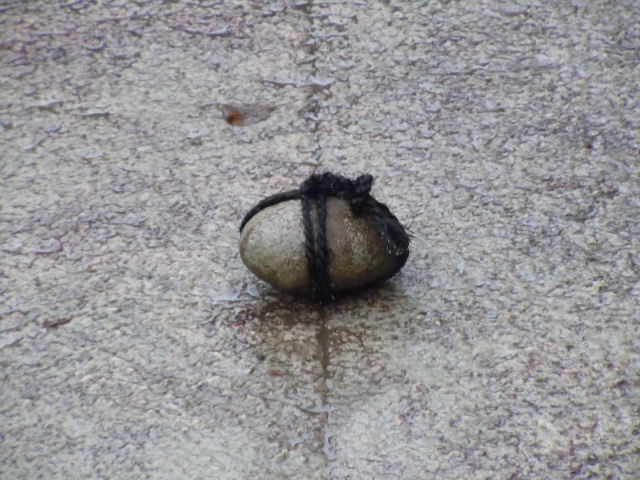
A bamboo bar prohibited us from crossing a bridge spanning one of the brooks. "What's that thing in the middle of the bridge?" we wondered.

A stone wrapped in twine. It surely means something but we are clueless. Hints from any of my Japanese friends who might be reading this would be greatly appreciated.

Fearless and Peevish with their friends outside Seisonkaku Villa

Of the many lovely stone lanterns tucked here and there in the garden, the most famous is the Kotojitoro on the edge of Kasumigaike Pond. We saw sweets in the gift shop decorated with the lantern's image and later spotted the distinctive design on manhole covers and metal railings around the city.

Here it is! Like everyone else who visits Kenrokuen, we must take at least a dozen photographs of Kotojitoro.

Two gardens down, one to go.

Friday, October 28, 2011

Kanazawa: A Gay Old Time

The young lady behind the desk at the base travel office was curious. To the best of her knowledge, this was the first time anyone had booked a trip to Kanazawa.

Fearless explained our quest to visit Japan's three great landscape gardens: Kairakuen in Mito, Korakuen in Okayama, and -- considered the grandest by some -- Kenrokuen in Kanazawa.

(We took a day trip to Mito during plum blossom time last February, fortuitous timing on our part since part of that garden was closed for repairs after the March 11 earthquake/tsunami. Next spring we'll get to Okayama if the planets and deployment schedule align properly.)

Kanazawa (literally, "marsh of gold") is in Ishikawa Prefecture, roughly in the center of the west coast along the Sea of Japan, about four hours by Shinkansen (bullet train) from Tokyo.  Since it was the second largest city after Kyoto to escape fire bombing during World War II, many historical areas have been preserved.  We decided to spend two nights there so we'd have ample time to explore the garden and historical districts.  Three or four nights would have been even better.

We booked two rooms at the Dormy Hotel, just down the street from the train station and central bus depot.  Matsuzaki-san wanted a single room; Fearless and I shared a double room.  Much to our surprise, the rooms were identical.  Each featured one (1) double bed.  Eek!  Fearless politely hugged the left side and I teetered on the edge near the window, praying I would not snore or accidentally brush her foot with mine.

We've decided to splurge on single rooms when we go to Okayama next spring.    

Matsuzaki-san and Fearless in Higashi Chaya
It was late afternoon when our train reached Kanazawa so we had time to explore Higashi Chaya, one of the city's two preserved and still semi-functioning geisha districts.  The second floors in this district are taller than other Japanese houses of the period because that's where the the geishas entertained their patrons.  Many of the old wooden tea houses have been converted to shops, much to my companions' delight.


Matsuzaki-san is a multi-tasker.  As she examined the wares offered, she asked each shopkeeper for restaurant recommendations.  Toro, on the bank of the nearby Asano River, was mentioned three times so that's where we went.  We didn't think to ask about the menu options until the hostess had seated us in a private room on short-legged chairs she had dragged out to accommodate those of us unaccustomed to kneeling through a meal.

Raw ingredients for Nabe (Japanese stew)

Toro specializes in (ie, "serves nothing but") nabe, a vegetable stew popular in Japan during the fall and winter months. There are places that offer beef and/or chicken nabe but Toro serves the fish variety.

Our hostess placed a large pot of broth on a heating element in the center of the table and then carried a large platter of seafood and vegetables into the room. Fearless and I made nervous eye contact when we spotted the mountains of mushrooms. Not liking mushrooms is something we have in common (besides that bed at the Dormy Hotel). We decided to share a bottle of sake. It was a good decision.

Those round green things that look something like olives are produced by Ginkgo trees.  If you want to know how they taste, you'll have to visit the restaurant yourself.

First of three helpings of Nabe

The hostess did not simply dump the raw ingredients into the boiling broth. She carefully selected various vegetables and fish parts to concoct our first helping. While we were swallowing that, she whipped up an oyster version and so on until we had tasted three different stews. She cooked enough nabe to satisfy a half dozen sumo wrestlers.

Restaurant owner thanks us for stopping by

There were two ceramic pots on table that looked like miniature chamber pots. We were supposed to deposit fish bones and other refuse in them but managed to stuff a few mushrooms in as well when the hostess left the room to get us some water.

I did eat some mushrooms and, for the first time ever, chewed and swallowed a couple of oysters.

The sake helped. They brew their own. Ishikawa Prefecture is famous for tasty sake on account of its plentiful rice production and abundant rainfall.

Definitely one of the most memorable meals I've enjoyed in Japan. So far.

Thursday, December 30, 2010

What I Talk About When I Talk with Dr. T: The Holiday Version

Most of my friends who teach conversational English in Japan work from some sort of lesson plan.  My approach tends toward extemporaneous because (a) I am lazy and (b) my students, Ishii and Dr. T, are quite advanced.  Ishii is so advanced, in fact, that she is now able to follow most of my digressions.  With Dr. T, it depends on the topic.

You might be wondering how one chooses a topic for a conversational English lesson.  This one tends to pluck topics out of thin air or off facebook, which is just another way of saying thin air when you think about it.  (And thinking about it is what I mean by 'digression'.)  I also favor 'stream-of-consciousness' and that was true long before I started reading James Joyce's epic novel.

Facebook was the source of this week's conversational gambit with Dr. T.  Just before I left the house to meet with Dr. T in his office at Yokohama City University Hospital, daughter Kate sent me a link to a New York Times article about Kenrokuen Garden in Kanazawa, one of the three highest rated gardens in Japan.  I was so intrigued that I tucked my Japan guidebook into my bag with the intention of researching the garden and Kanazawa during my train ride.  (Digression:  my hard-cover copy of Ulysses is much too bulky to lug around in my purse, elsewise I would have finished that project weeks ago.)

One can cover a lot of ground literally and figuratively during a twenty-minute train ride.  By the time I tapped on Dr. T's door, hung my coat on the fancy padded hanger, and took my first alternate sips of cold green tea and an apple-grape-mango juice, I had learned that Kenrokuen covers 25 acres and took about 150 years to complete.  "I am thinking about visiting Kanazawa," I announced.  And we were off to the races.

He told me about the Maeda clan, beginning with Maeda Toshiie, who was granted Kanazawa as a reward for service during a period of civil wars that rocked Japan 400 years ago.  A thriving castle town grew up around the castle Toshiie built and the clan ruled over Kanazawa for the next 300 years.  The Maedas were the second-most powerful family in Japan during the Tokugawa shogunate.  They controlled the largest domain in the country, amassed wealth (land and rice), and encouraged development of the arts: Kutani pottery, Yuzen silk dyeing, lacquerware, and Noh theater.

Kanazawa was the second-largest city, after Kyoto, to escape bombing during World War II so some of the old city is intact today and there is lots to see there besides the garden.  There's Seisonkaku Villa, built in 1863 by the 13th Maeda lord as a retirement home for his mother, and the Nagamachi Samurai District, a few residential streets remaining from the days when Lord Maeda had as many as 8,000 samurai retainers, each of whom had retainers of his own.  The Higashi Chaya District is one of three old entertainment quarters where 50 geisha practice their trade and one can get a peek inside the geisha world at Shima Geisha World, a quasi-museum cum tearoom.

When Dr. T mentioned Myoryuji Temple I knew I'd have to spend more than a day and half exploring Kanazawa.  Commonly referred to as Ninja-dera (Temple of the Secret Agents), this temple has hidden stairways, secret chambers, trick doors, and tunnels.  The Maedas built it for family prayers in 1643 and, to comply with Edo Period height restrictions, it looks just two stories high from the outside but inside four stories are obvious and three more stories are concealed.  This is something I simply must see even if it means phoning ahead for a reservation.   

Apparently the Ishikawa Prefectural Museum for Traditional Products and Crafts is the best place to learn about the handcrafted items for which Kanazawa is famous including bright Kutani pottery with five-color overglaze patterns, handpainted Yuzen silk, and nearly all of Japan's gold leaf.  Kanko Bussankan offers one-stop shopping for these products as well as a restaurant, but I think it would be more fun to go straight to the source.  Kaga Yuzen Dento Sangyo Kaikan, for instance, is a Yuzen cloth museum and shop where one can ask to see a 20-minute video describing (in English) the techniques of dyeing cloth and the role it played in Kanazawa history.  This is right up Artistic Explorer's alley and just wait until I tell her about the Kutani Kosengama (pottery kiln) where one can take a 15-minute tour to see the entire process of producing handmade Kutani ware, including the kilns and the painting.

That's probably as much sightseeing as one can possibly cram into a three-day weekend, but if there's time left over this one would vote for skipping watching Sakuda's artisans pound gold until it's as thin as paper in favor of visiting Shamisen no Fukushima, the only remaining shop making the three-stringed shamisen instruments geisha strum to entertain their customers, where one can have a half-hour lesson in English and cup of tea for about $4 and/or go upstairs to see how the instruments are made.  Apparently the sound box is covered with cat and dog skin.  Cat skin is more expensive.  This is yet another example of digression).

Dr. T says I will like the food in Kanazawa.  The local specialties are seafood, freshwater fish, duck, and mountain vegetables.  "What are mountain vegetables?"  Mushrooms.  This reminds me of something I've recently read about radioactive Chernobyl mushrooms - Where did I read that?  Not in Ulysses, for darn sure.  Something British.  Dry wit.  Ah, Alexander McCall Smith's Corduroy Mansions.  Of course.  - and suddenly we have veered away from Kanazawa into literature.

In the next hour we covered the following topics, not necessarily in this order and some more thoroughly than others, delivered in the style of James Joyce which I hope to eschew within the next 36 hours upon completion of what some have called the best book of the Twentieth Century:  Tolstoy, War and Peace, Anna Karenina, Dostoevsky, Bakunin, Trotsky, Karl Marx vice Jonathan Swift, Gulliver's Travels, back to Karl Marx and satire, my theory on The Communist Manifesto as satire and the subsequent irony known as Communism, his theory that the seeds of communism sprang up in several different places more or less simultaneously and therefore could not be entirely blamed on a general misinterpretation of Karl Marx, Charles Dickens, a fictional account of Charles Dickens' wife my Japanese book club will read this spring, what the Japanese book club ladies had to say about Shinju, an excruciatingly detailed biography of University of Michigan graduate and author Laura Joh Rowlands which was fresh in my mind since I had shared it with the book club ladies the previous week preforatory to our Shinju discussion, John Steinbeck, Yukio Mishima at length (why Dr. T thinks I ought to read The Temple of the Golden Pavilion, why I disliked The Sailor Who Fell from Grace with the Sea,  my abandonment of The Sea of Fertility tetralogy after not being able to comprehend more than a tenth of Spring Snow [vol. 1], his admission that he read the entire tetralogy at the age of 20 but did not comprehend any more than I, a foreigner, at age circa 54, and Mishima's dramatic suicide by seppuku after he and several followers barricaded themselves in Ichigaya, the 'Pentagon of Japan', and soldiers jeered his impassioned call for a military coup d'etat), the specific details of ritual suicide (we indulge in major grimacing at this point), speaking of knives why I enjoyed - I can't remember her first name but know she employs a masculine spelling to gain wider readership - Kirino's Out so much more than other modern Japanese mysteries like Yoshida's Villain - at this point he darts over to his desk to research Kirino while I continue to ramble - although, come to think of it, so far I'm enjoying a Japanese mystery I started reading the other night, Now You're One of Us, by someone whose name I can't recall, I think Asa but that doesn't strike me as a Japanese sort of name, Kirino's first name turns out to be Natsue and she used a different pen name for the thirty or so popular romance novels she wrote before venturing into the mystery genre, Kirino was born in 1951 as was Dr. T, he prints out her biography and a list of published works for me and I spot two words in English - Out and In - which leads me to suspect Kirino wrote a sequel to Out so I hope there's a English translator hard at work on my and my sister's behalf, then he mentions the Tony Awards show he saw on television the other night, a 14- or maybe 16-year old boy from Canada who received two awards, I share my dismay at not being able to find a Billy Elliott DVD at the Navy Exchange, monthly e-mails I receive from Broadway.com, Bon Jovi's performance on the aforementioned awards program, the difference between the Tony awards and the Grammy awards now that I realize we are talking about two different things, our preferences for watching movies - in a theater or at home - and how they have changed over the years, purchasing DVDs vice renting them, amusing anecdote about the time the Blockbuster clerk told me to stop apologizing for my tardy return of rental movies as the store staff fondly referred to Krentz family late fees as their 'Christmas bonus,' the cost of movie rentals in Japan (about $2.50 for two days), how NetFlix works, a painstakingly detailed plot synopsis of Inception compliments of back-to-back viewings pre- and post-Matt's arrival in Japan, the actor Ken Watanabe, The Last Samurai, speaking of Matt here's a ten-pound bag of Japanese snacks for the college student, our mutual distaste for scandals, Johnny Depp, John Cusack, Edward Norton, Meryl Streep, Emma Thompson, speaking of our mutual distaste for scandals I am going to have to put my Helena Bonham-Carter/Kenneth Branagh antipathy on the back burner for two or so hours in order to see The King's Speech which is getting really great reviews and is about Queen Elizabeth's father who it turns out was a stutterer - blank expression, my impromptu take on stuttering, immediate look of comprehension, mental note to partner with him the next time someone suggests a game of Charades - and confronted his speech impediment when - speaking once again of our mutual distaste for scandals - his brother abdicated the throne to wed the American divorcee Wallis Simpson, Cate Blanchett as Queen Elizabeth I, Shakespeare in Love, Edward and Wallis in France, Edward and Wallis erroneously placed in Russia which I let slide in order to talk about Colin Firth and Geoffrey Rush which makes him think of another actor with a British accent, Gladiator, perhaps Robin Hood, he means Russell Crowe and I am compelled to confide that as much as I enjoyed Crowe's performance in Gladiator I absolutely could not see Robin Hood because by then Russell had joined the ranks of the spurned along with Helena and Kenneth (we overcome our mutual distaste for scandals long enough for me to bring him up to date), which, of course, took us to Meg Ryan, Dennis Quaid, alcoholism, Randy Quaid, botched plastic surgery, Antonio Banderas, Melanie Griffith, Alfred Hitchcock movies, a year-by-year review of Clint Eastwood's acting and directing career, my college roommate's experience as an extra in Gran Torino, Al Pacino, Marlon Brando, obesity, Robert DeNiro, my sketchy memory of a Rolling Stone interview with with same wherein same showed no trace of a personality or mental activity, telephone call reminding Dr. T that he must move some of his staff to another hospital, review and mutual admiration of a colorful grid Dr. T has created to make sense of this puzzle, our mutual concern that staff members who have taken up residence near the hospital where they are currently employed will be upset when he tells them of the commute they will be facing with in the new year, "Happy New Year!" I chirp which makes us both giggle guiltily although there is no reason in the world I should feel the tiniest shred of guilt about the dislocation of the Yokohama medical establishment except I do due to Crippling Empathy Syndrome, the minimal progress he is making on readying his house for the new year, a suggestion that he hire someone to clean for him in light of his wife's invalid status, a quick draining of the fruit juice and green tea, a polite acceptance of payment that I hope to hide from Matt-the-Yen-squanderer, and a fond farewell until next week.

What will we talk about next week?  Certainly not a two-hour plot synopsis of Ulysses since my understanding of the 'plot' Joyce offers in the first 702 pages can be summed up in less than two minutes.  Lucky Dr. T.  Lucky you.              

LinkWithin

Related Posts with Thumbnails