Showing posts with label transportation. Show all posts

Wednesday, November 30, 2011

The Hakone Open-Air Museum: Public Art Tickles My Fancy


A cable car was a welcome relief after we dangled from a steel cable all the way up the mountain and halfway down the back side. The colorful maple leaves were a bonus, a feast for the eyes, and I was not about to complain that we were about a week too late to see them in their full splendor.

The cable car line ends where the Hakone Tozan Train begins so we hopped aboard and rode it to the next station which is just a hop, skip, and a jump from the Hakone Open-Air Museum, definitely one of Japan's best kept secrets.

Now I'll shut up and show you some of the wonderful statues we saw while strolling around the vast park setting.
Yes, the "hair" is living plants.

Inside, I learned a LOT about Picasso.


We had fun watching the 12-and-under crowd exploring this two-story high maze. It's a lot like the mazes at McDonald's playgrounds but bigger and cleaner. And I know what I'm talking about because I spent one of the worst quarter hours of my life chasing a four-year old through a McDonald's maze back in the day.

More statues tomorrow while I try to get a grip on the pictures I took at Matsuzaki's house today.

Tuesday, November 29, 2011

A November Weekend in Hakone: Fabulous Views and Black Eggs


Saturday afternoon we circuited Hakone by ferry, foot, ropeway, foot, cable car, foot, train, and taxi. Along the way we caught some splendid views of Mount Fuji and inhaled some noxious fumes on a smoldering volcano.


We hopped off the ropeway in Owakudani because our guidebook insisted we should eat the black eggs cooked in the open sulfur pits. One of us took the guidebook seriously.

When it came time to crack open the first of his five black eggs on an old wooden table littered with broken egg shells, the Ancient Mariner experienced a brief "public health" moment but curiosity and hunger trumped that Johns Hopkins degree in the blink of an eye.

He pronounced the eggs "delicious". I took his word for it.

Monday, November 28, 2011

A November Weekend in Hakone: Getting There was Half the Fun

We were travel rookies the first time we visited Hakone, four summers ago. With only 24 hours at our disposal, we booked a room within walking distance of the train station and never saw Mt. Fuji or Lake Ashi. These days we are more adventurous so the Ancient Mariner booked us at a lakeside hotel for two nights.

We didn't worry about how we'd get there until we woke up in Tokyo on Friday morning. A nice lady at Shinjuku station sold us three-day passes good for trains, cable cars, ropeways, and buses. We shelled out an extra $10 each for reserved seats on a "Romance Car" which would get us to Hakone thirty minutes faster (90 minutes versus two hours).

We rode a bus from Hakone-Yumoto station to Motohakone-ko, a four-block village on the south end of the lake. The bus that serves the lake's eastern shore, including our hotel and the aquarium at Hakone-en, had already stopped running for the day. We crossed the village twice searching in vain for a taxi. One of us was balancing the Tokyo shopping bags on top of his squeaky rolling suitcase. The other one of us was smugly toting her entire travel wardrobe and some of his in a small backpack.

"Maybe we should just start walking before the sun goes down and it gets even colder."

"Wait! What's that? Is that a ferry?"

So we caught the last ferry of the day to the aquarium next to our hotel.

View of Mt. Fuji from Ashinko Ferry

We had our pick of seats so opted for the front row. He perked up when the ferry rounded the bend and Mt. Fuji loomed into view.

View of Prince Hotel from Ashinko Ferry

The Prince Hotel was a bit fancier and more remote than we expected but the room was one of the largest we've seen in Japan. Those are double beds and there's a walk-out balcony, mini-bar, and CD player.

I'm glad we didn't have to walk the last leg even if it would have made a better story.

Wednesday, November 2, 2011

Natural and Other Wonders in Nikko

Nikko was on the docket for our second, or was it third, Christmas in Japan but the Blonde Wonder came down with the flu so we watched thirty-seven episodes of The West Wing instead. Not that I'm complaining. Forced deferred gratification can be quite rewarding. Certainly this is true in Nikko's case.

Mineko at Nikko station
Misa was so dismayed to learn at last month's kimono exhibition that I had not yet visited Nikko that she promptly contacted Mineko and together they came up with a plan to get me there.  Ouiser agreed to tag along even though, like most Americans living in Japan, she had been to Nikko within two months of arriving on this island.  Nikko is a tourist mecca.  Foreigners flock there to feast their eyes on the most un-Japanese of Japanese shrines while native Japanese enjoy both this manmade marvel as well as the bountiful natural resources in the area, including mountains, lakes, hot springs, waterfalls, and gorges.

With two seasoned Japanese travelers calling the shots, I saw more of Nikko in thirty-six hours than the Ancient Mariner and I could have covered in a week.  Let's hope the Navy finds someone to replace him by April 1 so we can reprise this trip before we leave Japan next summer.

Hotel Japan shuttle bus
Ouiser and I left Yokosuka at dawn, Mineko hopped on the train in Ofuna, and we hooked up with Misa in Tokyo just before boarding our express train in Asakusa. Nikko is about ninety minutes north of Tokyo by train so we arrived shortly before noon, tossed our bags in the hotel shuttle bus parked next to the train station, and then bought two-day passes for a local bus that travels between Nikko and Lake Chuzenji.

Mineko and Misa are remarkably adept at snagging seats on public transportation so I was blessed with the breathtaking views afforded by a window seat all the way up the long, winding incline to the lake district.    

Mineko, Misa, and Ouiser at Kegon Falls
The almost 100-meter tall Kegon Waterfall, the only exit for the waters of Lake Chuzenji, is the most famous of  Nikko's many waterfalls and is considered one of Japan's three most beautiful falls, along with Nachi Waterfall in Wakayama Prefecture and Fukuroda Waterfall in Ibaraki Prefecture.

We took a rather frightening elevator ride to the base of the falls to get the most impressive view.  The trees around the waterfall are exceptionally colorful at this time of year although I wouldn't mind seeing the waterfall in winter as well since I hear it often freezes almost completely solid.

Another bus took us back down those hairpin turns and deposited us across the road from Tamozawa Imperial Villa, a summer residence and retreat for the Emperor and his family beginning in 1899.  The villa fell into disrepair after the war but was restored by the city and opened to the public in 2000.   

There are few things in life I enjoy more than poking my nose in other people's houses.  Padding through Tamozawa Imperial Villa in my stocking feet and watching a video of the building's history was worth ten times the price of admission.  This is where Emperor Hirohito, the Showa Emperor, spent the last year of the war and here I was, more than sixty-five years later, admiring his billiard room and remarking that his back staircase was a narrower replica of the staircase back home where my two older brothers used to suspend Brother #3 upside down until all the pennies -- probably four on a good day -- fell out of his pockets.

The villa seemed enormous to me but I later learned it is nowadays less than one-third its original size.  In 1922 the villa was comprised of 106 rooms and 107,000 square meters.  Yet it is still one of the largest wooden buildings in Japan and the interior is an interesting combination of Japanese and Western styles.  Some floors are carpeted and many ceilings sport elaborate chandeliers but sliding paper doors and tatami flooring are also very much in evidence.


The Interview Room
Misa had imagined the table in the Emperor's Interview Room would be much larger. "The purpose of a small table was probably to make the Emperor appear larger, kind of an optical illusion," I opined more pedantically than intended.

As much as I longed to narrate "The Emperor's New Clothes" from memory, I controlled myself.

Sunday, October 30, 2011

Kanazawa: Bus Riding for Dummies

The easiest way to get around in Kanazawa is by bus and on foot. Unlike most Japanese "castle towns", here the town grew up around the castle rather than off to one side. Once you get to the castle, you're in the center of town and can walk easily to the other interesting historical areas.

My hometown bus system, with four routes connecting each quadrant of the compass, is the only one I've ever managed to master so I've pretty much avoided buses since pocketing my first driver's license in 1968. I want to ride buses. I think they're a great idea but, at the risk of sounding like a complete moron, they are just too complicated for me. The "how much" and "how to" pay the fare questions are bigger stumbling blocks for me than "which route". Getting on the wrong bus might lead to an adventure but fears of being chastised by a driver for incorrect change or enduring mutters or sighs, real or imagined, from passengers behind me in line have turned me into a long-distance walker.

If I wasn't traveling with Fearless and Matsuzaki-san, I would have walked from the hotel to the castle and missed out on a wonderful transportation experience.

There are several bus routes that pass the castle and garden, but the Loop bus is easiest for visitors. It costs 200 yen to ride the Loop bus but we each bought a day pass for 500 yen at the information center outside the train station. The pass looked like a scratch-off lottery card.  I saved mine because the month and day scratched off happen to be my father's birthday.  

About two dozen very cheerful schoolchildren boarded the bus with us. (Speaking of Kanazawa schoolchildren, the Ancient Mariner will be interested to learn that one of his favorite ballplayers, Hideki Matsui, grew up in this area and is the most famous graduate of the local high school.)

Now we're getting to the part I hope you'll share with your friends who work for the US Department of Transportation or any urban planners you happen to know.

Upon exiting the bus near an entrance to Kenrokuen, we noticed an electronic map on the wall of the bus shelter. The map showed the locations of the four Loop buses.


Our red bus had just let us off at Stop #9.

We stood there for a few minutes, watching our bus progress to Stop #10 and then on toward Stop #11.

This is the first technological innovation since Amazon's Kindle to make my jaw drop.

Please tell those urban planners to insert fare information at the bottom of the screen. I'd appreciate that.

Saturday, October 1, 2011

The Japanese Book Club and the Chatty Cab Drivers

Here it is October already and I haven't yet written about my trip to Nagano Prefecture with the Japanese Book Club ladies in late August.  It's taken me over a month to get a good geographical and historical fix on where I spent three of the most memorable days of my life.

You probably know Nagano as the site of the 1998 Winter Olympics.  The long-term benefit to Nagano of hosting those games was the building of a bullet train line to shuttle athletes and spectators to and from Tokyo.

We took one of those trains from Tokyo's Shinjuku station to Chino where we loaded up on perishable items like milk, eggs, and bacon at a shop across from the train station before hopping in a taxi for a twenty-minute mostly uphill ride to Suzuki's "rustic mountain cabin" -- her words, not mine -- in Tateshina Village. Our driver prattled non-stop for the entire twenty minutes. Later Suzuki told me she had never been treated to such an indepth monologue on local history and hot spots in all her years of riding in a cab from the station to her cabin. Ishikawa said the driver might have been a bit nervous and giddy about transporting a foreigner. I was a bit giddy myself.

Suzuki's parents built this vacation getaway in the 1960s and she has continued to pay the taxes since they passed away.  There are hundreds of cottages scattered across the hillside but all are on lots of at least a half acre and are hardly visible to each other.  Homeowners are not permitted to build fences or to remove any trees surrounding their cottages.

They take that tree covenant seriously. There's one hosting a hairy sort of pale green moss partially blocking the steps that provide the only access to Suzuki's cottage. Inspecting that moss, I decided it might offer an adequate cushion should I smack into the tree while fleeing from a fire in the middle of the night. But Suzuki's daughters will probably have to remove the tree when their turn to pay the taxes arrives.
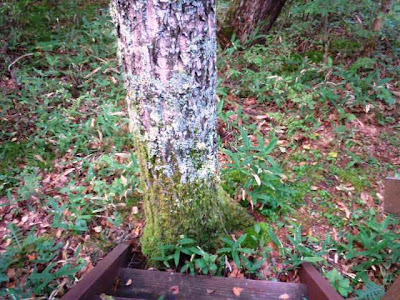
The mossy tree mentioned above
Tateshina Village offers a quiet, cool respite from the summer heat and the hustle and bustle of Tokyo and its suburbs. People come here to commune with nature, to soak their weary bones in natural hot springs (there are hundreds from which to choose), and to feast their eyes on fabulous views of the Yatsugatake Mountains, a volcanic range situated on the border between Nagano  Prefecture and Yamanashi Prefecture.  There are more than twenty peaks in the Yatsugatake Mountains, ranging in height from 2300 to 2900 meters.  (By way of comparison, the tallest mountain in Japan, Mount Fuji, is 3776 meters high.)
 
This road was pretty scary after the sun went down
We spent the first afternoon hiking the dirt roads and paths that honeycomb Tateshina Village. Suzuki has been coming here every spring, summer, and fall for fifty years yet never ventures out the cottage door without her large laminated map. If I had paused to reflect on the possible ramifications of getting lost in the wilderness with two women a dozen years my senior, I would have insisted on holding that map. My bad.

There are neither street lights in Tateshina Village nor road signs. The only signs are short cedar posts stamped with the number of each lot although one of Suzuki's neighbors has affixed a sign atop his post dubbing his domain "Walden". This tickled me, of course, and even more so late that evening when I happened to glance through his window and see his profile bent over a book.

To be perfectly frank, at the time I spotted him I didn't care that he was reading. After spending fifteen minutes wandering around an inky dark highlands forest with two seventy-something women who would not let me hold one of the two feeble flashlights, that man could have been washing dishes or sitting on the toilet and my heart would have rejoiced at the sight of another human being. Our afternoon hike had eventually led us to a charming French restaurant where we celebrated our June, July, and August birthdays with a marvelous meal prepared by an owner-chef who spent his youth collecting John Lennon memorabilia and his middle age attending cooking classes in Paris. The restaurant is only a ten-minute walk from Suzuki's cottage but she left the map at the restaurant and we took the first wrong turn we could possibly take. Eventually she admitted her error -- one thing I love about Suzuki is she hates to be wrong as much as I do -- and we managed to find our way back to the restaurant where the waiter informed us the owner had found our map and set off in his car to return it to us. We didn't pass each other on the road thanks to that wrong turn so we loitered in front of the restaurant until he came back and then we set off for the cottage again.

Even with the map, we managed to take a wrong turn but Suzuki was quicker to admit her error the second time around and the cottage emerged on our right blessedly soon after Ishikawa-san's voice alerted the noctural forest creatures to our presence. "This reminds me of one of those American teenage movies where they all start disappearing one by one." It's funnier now than it was at the time.

The Yatsugatake Mountains

On the second day, after a nourishing breakfast of salad, bread, and corn on the cob, we hiked half a mile to the nearest bus stop where we caught a ride to a rice field in the middle of nowhere. Our destination was a rustic open-air hot springs favored by the locals. The hot springs are about two miles from where the bus dropped us and I was so hot and sweaty by the time we got there I almost forgot to be embarrassed about disrobing in front of people to whom I'm not married.

If embarrassment wasn't such a powerful emotion, the big toe on my right foot would have been the only part of my anatomy to experience the rustic open-air hot springs favored by the locals. Conversations about onsen experiences with my American friends tend to focus on nudity (for people who favor bare midriffs and plunging necklines, we are a strangely modest nation). No one ever mentioned that the water in those hot springs is almost unbearably hot. Maybe they thought the name was self-explanatory but we're talking beyond tepid, beyond lukewarm. We're venturing into the region of boiling point here.

WARNING: That sign means "hot springs" not "coffee shop"
My flesh was a glowing pink when I emerged from the hot spring and my bones felt like a Slinky.  I was sorely tempted to extract a beer from the vending machine conveniently located between the entrances to the separate men's and women's facilities but Suzuki-san had a different agenda. She called a cab and we were whisked to Hotel Heidi for cake and coffee by our second chatty cab driver who took us on a scenic route past a golf course and former iron mine.  Hotel Heidi (click here for photo) was the villa of an imperial family member before the war.  The cake was excellent and the waitresses were adorable in their Alpine costumes.

After strolling the hotel grounds and poking our heads into a little Swiss chalet where guests can have their pictures taken in Tyrolean garb, we headed downhill to man-made Lake Tateshina.


Suzuki-san and Ishikawa-san kindly pointed out our location on the tourist map near the lake. The Tateshina Village cottage is located off the road that's extending due north over Ishikawa's head.  A third chatty cab driver responded to Suzuki's call and took us back to the cottage where we polished off the corn and talked about books late into the night.  

The idyllic Lake Tateshina

On the third morning we aired our futons on the deck rail while closing up the cottage. Ishikawa cleaned the kitchen and bathroom while I vacuumed and Suzuki packed all the dirty linens in a box to be shipped back to her house in Kamakura. There's a washing machine in the cottage but Suzuki wanted to spend our last day sightseeing rather than doing laundry.

There's also a twin bed in one of the cottage bedrooms. They offered it to me upon arrival but I opted to sleep with them in the tatami room on double futons. This was both a great experience and something of a science experiment. I had heard that Japanese body temperatures are lower than ours and now I know for certain that at least two Japanese ladies can snuggle under down comforters for eight hours straight while at least one American woman tosses aside the comforter after a mere three hours.

Futons airing on the deck rail

Suzuki-san arranged for a cab driver to whisk us to a museum and shrine in nearby Suwa before our train was scheduled to depart Chino. This driver was remarkably less chatty than his predecessors, perhaps because he knew in advance he'd have three hours in which to regale us with insights and remarks. First he took us to some dumpsters where we placed three pre-sorted bags of trash in the appropriate receptacles and then he stopped at a building where Suzuki arranged to ship the box of linens while he showed me a wide variety of vegetables and fruits at an outside market beside the building.


The Suwa Taisho (Grand Shrine) was a real show-stopper but, alas, my camera battery petered out about fifteen meters into the first courtyard. The architecture of the museum we visited was more interesting than its contents which tended towards scrolls and mounted heads of boars and deer.  The person who designed that museum is also responsible for a number of whimsical structures like the tree house shown above that dot the landscape of the hills overlooking Suwa.  I'll have to ask Suzuki to remind me of his name.  She bought a book about his work in the gift shop next to the train station just before we called it an adventure and headed for home.

Guess what?  (Insert squeal of delight here.)  Suzuki and Ishikawa want to hold another book club slumber party in Tateshina before I leave Japan!  We're going back in May.  Between now and then I'll be searching every nook and cranny of my brain to come up with the best possible reading assignment to cap off my tenure as their book guide.  Your suggestions are most welcome.

Sunday, May 23, 2010

Can You Tell Me How to Get to Sack of No Something Street?

Today's photo credit belongs to Weather Explorer.


She has an eye for interesting street signs whereas I tend to fixate on deciphering the traffic signals when I'm approaching an intersection like this one. This is what makes her a good navigator and me a reasonably passable international driver. Knock on wood.

The red light on top says "Do not even think about driving through this intersection" and the green arrow on the bottom says ". . . unless, of course, you wish to turn right, in which case you should make it snappy."

Thursday, April 15, 2010

Expanded Horizons: Gardens and Public Transportation

Just as I never made the transition from SuperNintendo to Nintendo64, denying Mario the certain joy of racing diagonally across my television screen, I was left standing by the side of the road when someone - a nefarious cabdriver I bet - invented zone rates for metropolitan bus systems. The "exact change only" rule came into vogue around the same time. Since most transit authorities never got around to posting a fare schedule anywhere near a bus stop and since I would rather walk ten miles across a desert landscape than risk the indignity of being chastised by a bus driver in front of all those passengers who did not have the benefit of my superior education yet somehow managed to unravel the bus fare mystery, my bus riding days drew to a screeching halt in 1974 or thereabouts.

That's not entirely true. Twenty years later I spent four pleasant months riding buses in Baltimore, an eminently people-friendly city, at least in my memory. Riding the bus in Baltimore, especially changing buses in the heart of town, gave me a chance to rub elbows with all sorts of interesting characters while saving my family money. When people-watching and fiscal responsibility collided ("We're eating peanut butter sandwiches this week because you met a lady at the bus stop who needs a new winter coat?"), my bus riding days were officially terminated. By someone I don't recall electing king, but there you have it.

Enter Reiko. Last week she showed me how to use my PASMO card -- the prepaid card I use to ride the trains and subways -- to enter and exit a bus. I don't have to earn a doctorate degree in bus fare terminology because the card reader on the bus automatically deducts the correct fare. The driver did not chastise me. None of the other passengers solicited me for new clothing.

Now that my explorations are no longer confined to the three-mile radius of any given train station, the world is my oyster. First stop: Yokosuka's celebrated Iris Garden.

We will have to come back in a few weeks to see the irises in bloom. Reiko says we are not allowed to help the volunteers prepare the iris fields. Volunteers must apply at city hall and attend training sessions before they are allowed to groom city parks.

And we won't want to miss the wisteria when it's blooming. "What are those yellow plants to the right of the arbor? They look like weeds."

Reiko says the plant with the yellow flowers is the source of canola oil.

We find very large rhododendrons blooming on the hillside overlooking the garden.

We are surprised these daffodils are still in bloom - the ones outside my kitchen door bloomed in January - but they look charming next to that patch of grape hyacinth.

Some sort of yellow globe bush catches my eye. The flowers look remarkably like cherry blossoms except, of course, for the fact that they're a sunny yellow hue.

Speaking of cherry blossoms, the trees in the Iris Garden are about a week behind the ones on base. Something else to file away for future reference . . .

Reiko is a champ at combining exercise and pleasure. We have made a pact to go on a two-hour hike in Kurihama for our next adventure.

Saturday, March 13, 2010

On Zama By Train and Other Good Things

Three trains brought me within four blocks of the back entrance to Camp Zama less than ninety minutes after I left Yokosuka this morning. Since Camp Zama is a U.S. Army Base, and the U.S. Army can give the U.S. Air Force a run for your money when it comes to sprawl, I spent another thirty minutes hiking from the gate to the field where the track meet was being held. This was a good thing. That brisk hike helped me rationalize the sack of bakery products I'd picked up on my way through the train station.


There was ample time to admire the scenery (above), polish off 150 pages in my book, and add another foot to the scarf I'm knitting between Matt's three events: a relay at 9:30 am, the 800 at noon, and the 1500 just before the meet ended at 3:00 pm. I don't know his times but there were more kids behind him on the final stretch than there were at the beginning of each race. This is a good thing.


We don't have a track here in Yokosuka so we have to travel to all the meets. Camp Zama is the closest place Matt's team will compete but that still meant being on the team bus at 5:30 am and not getting home until at 8:00 pm. I can't say I blame him for not wanting to spend Sunday riding a tour bus to experience the Takao-san Fire Walking Ceremony with his mother.

Friday, March 5, 2010

The Day It Rained Plum Blossoms

Clutching my copy of A Flower Lover's Guide to Tokyo: 40 Walks for All Seasons, I headed to Ikegami this morning with three adventurous ladies to explore the plum garden and nearby Honmon-ji temple.

Ikegami is a Tokyo ward less than an hour from Yokosuka assuming you switch to the right train in Yokohama which, of course, we did not. Thanks to two very helpful fellow passengers, we only had to backtrack one station to catch the train we wanted. Those two men were the first of many incredibly kind Nihonjin who touched our lives and hearts today.

Ikegami Baien, the plum garden, is roughly a mile due north of the train station. Today's glorious weather made for a pleasant stroll through the business district, across the Nomi-kawa river, and then through a residential neighborhood sprinkled with several small temples. Outside one house there was a flowering shrub that gave new meaning to the expression "Spring is in the air". Four noses twitched in unison and four faces were promptly buried in the shrub. Mmmmmm. I'd liked to buy a gallon bottle of that scent.


The garden was originally the residence of a famous Japanese painter and features two teahouses, oodles of stone lanterns, and hundreds of plum trees and azaleas. Admission was 100 yen (slightly over a dollar) although all of us were willing to pay ten times that much for the pleasure of wandering between those plum trees, especially when a light breeze sent a shower of pink and white blossoms drifting to the ground.


Most of the plum trees, thirty varieties in all, are grouped together on a hillside just inside the entrance. Above them, on the top of the hillside, are hundreds of azalea bushes which will bloom in late April or early May. (Note to self: schedule another visit to Ikegami when the azaleas are in bloom.)


Since the last thing the Krentz family needs is more furniture, Mike and I promised each other we would only buy garden ornaments, if anything, this time around. Stone lanterns appeal to me, the older the better, but I doubt we'll find any that fit our budget. Maybe I'll just have to settle for a stroll around the Tidal Basin in Washington, DC, every spring.


Ume is the Japanese word for plum, momo means peach, and sakura means cherry. That's generally the order in which they bloom. Some plum trees sure look a lot like cherry trees to this fruit novice but I don't suppose I need to be able to tell them apart to appreciate their beauty.


A man who works at the park insisted on taking our picture. That's Jane, me, Valerie, and Sherri. I think it's my sweater that's making my hair look reddish but maybe I need to start wearing a hat to protect my brunetteness (brunetteticity?).


What is it about old stone steps that makes them so irresistible? These were very slippery, especially coming down, and those handrails are only helpful if you are: (a) under five feet tall, (b) suffering from severe osteoporosis, or (c) not afraid of being mistaken for Groucho Marx. I chose Door Number Three.


We are all indebted to the elderly couple who steered us into a small enclosure in the middle of the garden and showed us how to position our ears over a bamboo pipe after pouring a ladle or two of water over the rocks at the other end of the pipe. I heard high, tinkling notes but Jane (left) says the water held low notes as well. My book didn't mention anything about singing rocks and there wasn't a sign anywhere near that little enclosure so we would have missed this special treat entirely had we not encountered that kind and generous couple.

LinkWithin

Related Posts with Thumbnails