Showing posts with label flowers. Show all posts

Wednesday, November 23, 2011

Fox Faces, Bananas, and a Godzilla-size Dahlia

The salt-laden typhoon winds don't seem to have stopped the Gingko trees from changing color this year so maybe there's hope for the Maples yet.

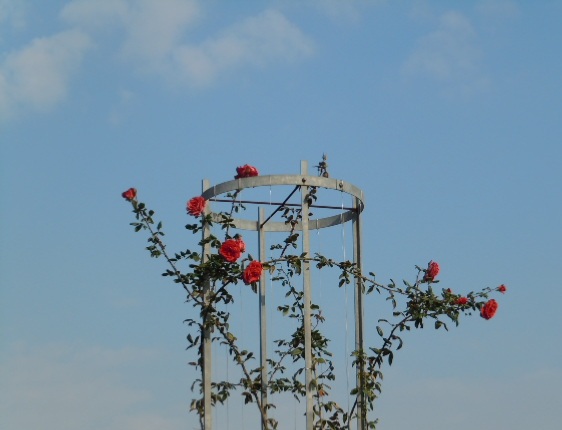
There were quite a few rose varieties blooming and most carried a heady fragrance. We buried our noses in the velvety blossoms, inhaled deeply, and then raced along the path to the next group of bushes.


In the glass conservatory we spotted bananas after the bougainvillea but before the water lotuses.

According to Shinagawa-san, this citrus is called "Fox Face"

Fox Face or Cow Face? You be the judge.

We also some incredibly tall clumps of sunflowers and dahlias.

Japan has changed me into something of a Nature Girl. I wonder how the Norfolk City Planning Department will feel about me transforming my flat side yard into a miniature version of the Japanese Alps.

Tuesday, November 22, 2011

A Pleasant Surprise at Ofuna Botanical Garden

We visited Ofuna Botanical Garden this morning in hopes of seeing some Maple trees in their autumn glory. That didn't happen. Most of the Maple leaves haven't changed color yet and there's some question whether they will do so at all this year since the trees were blasted with salt water for hours on end during a typhoon earlier this fall.

But, as usual, there was lots to see at Ofuna Botanical Garden besides Maples, including a -- be still my heart -- Chrysanthemum Exhibition. And here I was feeling sorry for myself just a few days back about missing the annual chrysanthemum frenzy.


This was my fifth visit to the garden in the six months since Ishii-san first introduced me to its pleasures, and I don't think it will be my last. There is always something new and different in bloom. If I can find a willing co-pilot, I'd like to drive there next time so I can load up the car with a few dozen of the lovely plants in the nursery section.  Who cares that I won't be able to take the plants back to the U.S. next summer?  Why would you think the plants will still be alive then?  You are giving me more credit than is due.

Awesome single-stemmed purple Chrysanthemum

Hisayo, Kayoko, and Tae kindly posed for me to give you an idea of the height of some of these plants.  Artistic was with us but abhors having her photo taken.  I feel much the same so I do my best to honor her wishes even though she's really attractive and I know her mother would appreciate a little glimpse now and then.
This frail magenta mum with a yellow center was my personal favorite.

Of course I snapped a hundred or more pictures of Chrysanthemums within fifteen minutes of arriving at the garden. You would think I was planning to publish a gardening book or something.

These droopy lavender pompoms captured my attention as well. If Hisayo hadn't chatted about these flowers with a man who happened to be standing nearby, I would have thought these prize-winning blooms were bred to droop. But, no, they are simply past their prime.

Tomorrow before the Ancient Mariner throws me over his shoulder and drags me up to Tokyo I'll try to share some of the other interesting things we saw at the botanical garden.

Thursday, November 17, 2011

What? Me Worry?


My only encounter with showy chrysanthemums this fall was a small display near Toshogu Shrine in Nikko. Did someone remember to drag the newcomers to the chrysanthemum exhibit in Yokohama while I was off exploring other parts of Japan? I have to stop worrying about things like this and savor each remaining day in the months left before the Ancient Mariner retires and we leave Japan.

He's downright gleeful about retiring, in case you wondered. He says things like "Next week I'm going to Seoul for the last time" and then does a little tap dance. When I discovered our property manager had executed a 15-month lease on our house without checking with us, I thought he would hit the roof. Where are we supposed to live until the tenants move out on August 31? "We'll spend the summer driving around the United States, visiting relatives." Maybe I should change his name to Alfred E. Neuman. What? Me worry?

I, on the other hand, cringe when I even think the word "last" let alone say it out loud. I am not the least bit gleeful about taking my last trip to the kitchen or fabric district in Tokyo or glimpsing the jizo statues at Hase-dera for the last time. The thought of saying goodbye to my Japanese friends has my stomach in knots. Some things are better left unsaid.

Wednesday, November 9, 2011

An Autumn Stroll Through Verny Park

The blooming season here is fantastically long. There might be a stretch of three or four days between Christmas and the new year when pine trees take precedence, but otherwise there's always a flower or two offering bright splashes in the landscape.

Californians might take this perpetual color for granted, but a girl from Michigan enroute from the Navy base to the JR train station stops dead in her tracks when she spots floral abundance in mid-November.  And a girl from "The Rose City" can't help but gawk at Verny Park roses re-blooming just two weeks before Thanksgiving.  Back home we'd be begging someone to rub linament on our aching back after a day of raking leaves around about now.

"Reach for the sky, Pardner!"

A typically cloudless day

How fortunate that my camera was in my purse, and actually charged for once, and that I wasn't in a hurry the last time I had a JR train to catch.

Friday, September 30, 2011

Kencho-ji with Ishii

Ishii-san and I went searching for bush clover in Kamakura today. We didn't see much of that but we did see a whole lot of other things, munched on some very yummy fresh rice crackers, and walked our usual zillion miles.

Ishii read somewhere that Kencho-ji temple in Kita-Kamakura is a good place to see bush clover. Our route took us past Haruki-san's kimono exhibit so of course we took a little detour. Haruki and his wife were so gracious. They remembered my name! He pronounces "Kathy" the same way Yuuko Kaji does, with a very soft "th" that makes me feel all warm and fuzzy.

Ishii was wearing a lovely sashiko vest for the occasion, a long duster she spent a year creating. I wish I had taken some closeup pictures so you could see her exquisite craftsmanship. I, on the other hand, had spent the morning shelving books at the base thrift shop in a sleeveless shirt and found a ratty cardigan in the trunk of my car to cover my bare shoulders, something I feel as compelled to do when I am out and about in Japan as when I visited the Vatican at the age of fifteen.  (As the day grew warmer, the sweater grew increasingly loathsome.  I'm going to abandon it at the thrift shop the next time I shelve books.)

Karamon at Kencho-ji

Kencho-ji, constructed in the 13th century, is the oldest Zen training monastery in Japan -- surely you've heard this before -- and the first-ranked of the five great Zen temples of Kamakura. This was my third visit since March 2007 yet I still took a dozen pictures of the statue of fasting Buddha and the dragon picture (unryu-zu) on the Hatto ceiling. No matter where you stand in the room, the dragon's eyes seem to follow you. This is quite eerie and, so far, impossible to capture in a photograph.

Fasting Buddha

The map provided by the man at the ticket booth showed a garden near the rear of the temple grounds. This seemed like an obvious place to find bush clover so off we went. Except we skirted the building on the left when we should have marched directly through the building straight ahead and, lo and behold, we were behind the garden with no way to get through the tall hedge. That's when Ishii-san got that innocent look on her face that I really ought to recognize by now, the "As long as we're on this path, let's just take a little stroll and see what we can see" look. Those "little strolls" never fail to turn into arduous physical activity. Not that I'm complaining.

Today's "little stroll" took us eventually to the last building on the map, the Hanso-bo, which I think means "8,000 of the steepest steps you will ever climb".  Seriously, even those cute 10-year old school children in their bright yellow caps were huffing and puffing by the time they reached the fourth or fifth flight of stairs.  Japanese landscape designers must all take a special class in Deceptive Neverending Stairs because I can't count the number of times I've scampered up 80 steps only to discover another 80 steps across a short plateau and then yet another 80 steps camouflaged by a leafy maple tree.  Wheeze, gasp.

This is the first time Ishii-san has been to the Hanso-bo.  Her husband knows about those steps which is why I am here with her today and he's not.  


More often than not there's some sort of visual reward for scaling all those steps and today is a more often rather than a not. Thank God.

The Hanso-bo is a shrine that was moved here from Shizuoka in 1890 to protect the temple in the valley below. The final stretch of hillside beneath the shrine is littered with statues of winged creatures called tengu which look like a cross between warrior angels and the Wicked Witch of the West's flying monkey minions.

There's a viewing platform next to the shrine which offers a lovely view of Mt. Fuji on a clear day.  Today we couldn't see Mt. Fuji so I might just have to reprise that ascent.  But you can be darn sure I'll borrow a couple of cell phones and a kid who's willing to scamper up those steps ahead of me to scout out the view.


Ishii-san and Tengu

We spotted a patch of bush clover as we were working our way back toward the temple entrance but it had already finished blooming and that made us laugh. The bush clover seems relatively immune to the effects of the recent Typhoon Roke. Lots of other plants have leaves that are turning brown and shriveling up compliments of all the salt the typhoon carried from the sea to land.

Thursday, September 1, 2011

Distracted by Lotus Blossoms: How I Spent My Summer Vacation


Pardon my absence, please. I've spent the summer gazing at lotus blossoms while pondering priorities for my last year in Japan.

The first sighting was at Koishikawa Korakuen, a lovely Tokyo garden the Yokosuka Officers Spouses' Club visited in late July with a few of our Japanese friends in tow.  The day was slightly overcast which was good since apparently lotus flowers clam up when the sun comes out.

There's lots to see at this garden so I hope to get back there when the maples turn later this fall.

The very next day Ishii-san and I visited the Ofuna Botanical Garden where we found lotus blooming in a shallow pond ringed by a path that let us get up close and personal with the plants.


seed pod on July 28
Ishii-san taught science to junior high students in her heyday so strolling with her is always enlightening. When she isn't pulling cicada shells off walls and trees, she's pointing out things like lotus seed pods which I would otherwise tend to ignore while concentrating on the flowers.

seed pod on Aug 6
A week later, when I introduced Shinagawa-san to the botanical garden, those seed pods looked quite different. The pod was drying and pulling away from the seeds which had started to turn from green to purple.

People in this part of the world eat those seeds raw and use them in soups. After the seeds are removed from the pods, dried pods are used in flower arrangements. Sometimes people fill the holes in dried pods with colorful little balls of fabric. That's something I'd like to try.

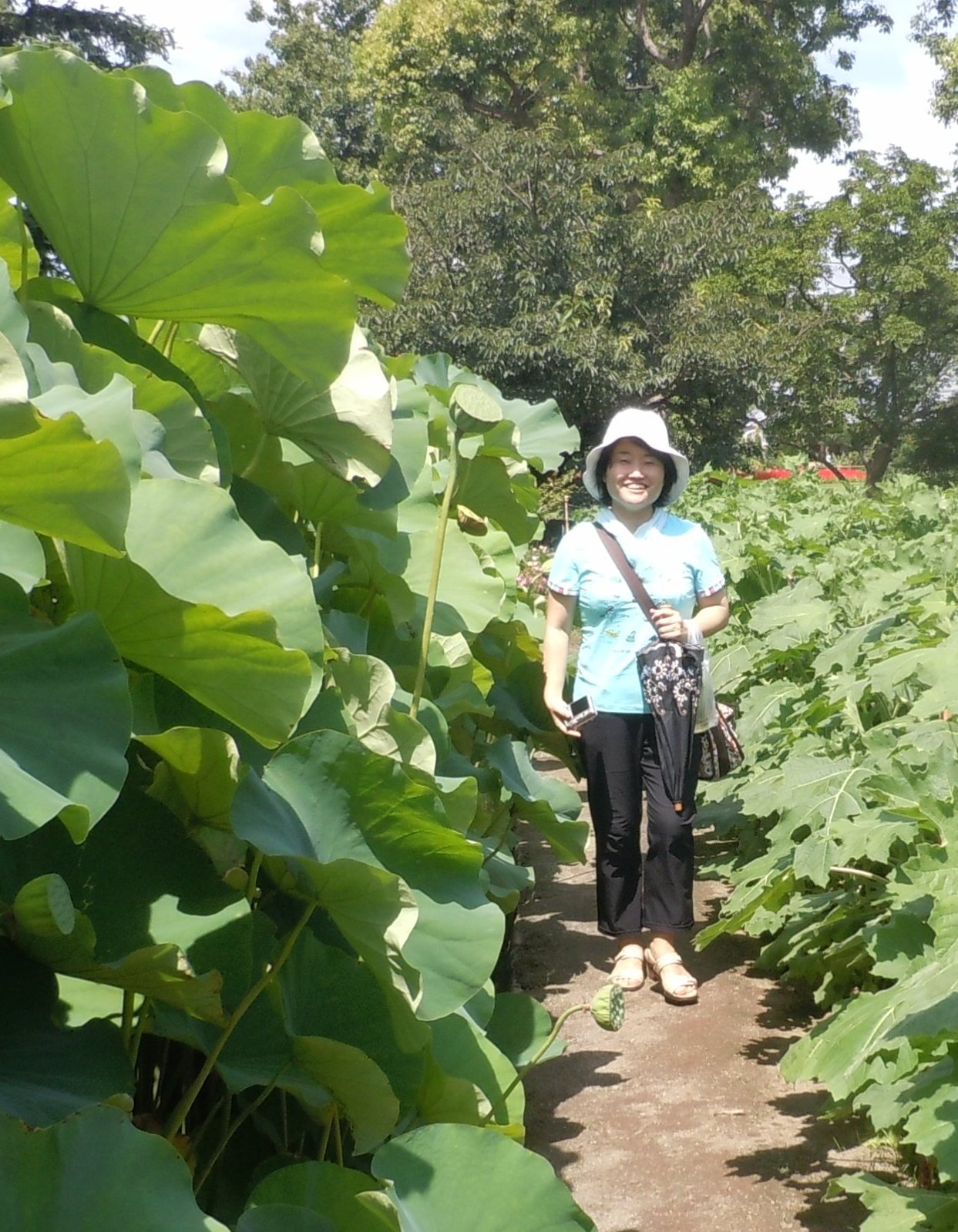
Shinagawa-san is dwarfed by the tall lotus plants

Shinagawa-san and I visited the garden on a bright, sunny day so we had to poke our heads under the leaves to see most of the flowers that were blooming defiantly.

Just when I thought I'd seen all the lotus blossoms Japan had to offer, Kyoko-san lured me to Kamakura with promises of waffles and coffee. I was making a beeline from the train station to the waffle shop when she grabbed my elbow and dragged me to the lotus ponds in front of Hachimangu Shrine. I'd be the last person on earth to complain about bossy friends.

Tuesday, June 28, 2011

Hakkeijima and Sweaty

The camera sat on the kitchen counter all weekend, charging away. She thought it was charging, that is, but nothing happened when she pressed the on button just inside the entrance to Hakkeijima today. The same thing happened the last time she visited a garden with Ishii-san. Push, push, push. Nothing, nothing, nothing. But that was the old camera and today she is carrying the new camera.

Desperate times call for desperate measures so Peevish "borrowed" an image from the Hakkeijima website to illustrate this post. Unfortunately, the only image that halfway illustrates the extent of the hydrangea garden on the island is a map. The hydrangea garden, laced with shady paths, is that dark green area on the right side of the map. If this was a topographical map, you'd see that the hydrangea garden is built around a hill and that those paths take go ever upward to a plateau at the top where a lovely rose garden is ringed with benches.


From the top of the hill most visitors get a panoramic view of the eight scenic views (hakkei) of the island (jima).  One of today's visitors, however, was too busy searching her tote bag for a towel, mopping her forehead and neck with the towel she finally found, and then wringing out the towel before returning it to her bag to gaze placidly at the famous scenic views.

There is an amusement park on the island and an aquarium.  Ishii-san remembers the time she took her parents to the aquarium.  Her mother loved the dolphins.

The doctor says Ishii-san's mother should be completely healed in two more months.  Until then she must wear a stiff corset and is prohibited from carrying anything, including groceries.  So far she has fallen once and snuck off to the grocery store on her own once.  What a pistol.  Maybe Ishii-san should offer to reward her for following the doctor's orders with another visit to the aquarium.

There is an ice cream shop on the island.  This is when a functioning camera would have come in most handy.  The Ancient Mariner might not believe that there is such a thing as an okonomiyaji ice cream cone embellished with tiny shrimp.

Time to solve the camera problem.  There's a quilting bee on tomorrow's docket.  

Saturday, June 25, 2011

Hasedera: Hydrangeas, and Crowds, and Caves, Oh My!


Three or four iris clumps near the gate leading to Kamakura's Hasedera Temple drew quite a crowd  Tuesday afternoon. You'll just have to imagine the irises since my camera was more interested in this enthusiastic photographer than flowers by that point in our garden marathon. Would he lean too far and fall into the pond? No. Almost, but not quite.

A thought crosses my mind.  Do Japanese tourists sneak pictures of me the way I sneak pictures of them?  Maybe I'll start combing my hair and slapping some mascara on my eyelashes before I leave the house.

Hasedera was by far the most crowded hydrangea mecca Weather Explorer and I visited this week.  We did not get in the long line waiting to climb up the hydrangea-bedecked hillside but took pictures of the people taking pictures of the people strolling through the flowers. 

Then, because this was Weather's first visit to Hasedera (and my jaw dropped when I heard that since it's still my favorite temple in Japan and I've been remiss in assuming she's been there), I dragged her through the cave of Buddhist saints.  Which was something of an Act of Contrition on my part, since that cave gives me the heebie-jeebies.  You have to bend at the waist to get from the first chamber to the second and the thought of earthquakes and being buried for eternity in that cave never fails to cross my mind when I make that bow.  Especially now when we are still feeling aftershocks almost every day.

Wednesday, June 22, 2011

More Hydrangeas, or Why I Slept Through Dinner the Night Before He Deployed

The Ancient Mariner trudged aboard the USS Blue Ridge this morning. A few hours later the Seventh Fleet sailed out of Tokyo Bay bound for exotic and not-so-exotic ports. By the time I see my Ancient Mariner again, my stepdaughter Jewls will be married (with her father in attendance if all goes according to plan), I will be another year older (shudder), and Pip will be heading back to college.

Pip and I did not give the Ancient Mariner the send-off he deserved. One of us feels awful about this. The other one of us will no doubt feel similar pangs of guilt about twenty years down the road.

We were going to have a nice "last supper" at home but the Ancient Mariner suggested going out for sushi instead when I limped through the door after a long afternoon of gazing at hydrangeas in Kamakura.  To cut to the chase, I dozed off at 6:00 pm and didn't wake up until after midnight.  Pip disappeared with a friend whose family is leaving Japan today. He said he didn't know we were going out to dinner so he ate with his friend instead.

The Ancient Mariner tells me I snored through two telephone calls, one doorbell ringing, and -- incredibly -- a siren on an emergency vehicle that parked across the street from our house for twenty minutes.  He says this is my typical sleeping pattern prior to one of his deployments, that he's come to expect it and doesn't take it personally.  This made sense fifteen or even five years ago when my body needed to store up energy for the long weeks of single parenthood stretching out ahead of me, but now?  Sheesh.  Old habits die hard.

Engaku-ji in Kita-Kamakura

More likely my body was simply exhausted from hiking the length of the grounds at Engaku-ji after viewing the hydrangeas at Meigetsu-in. The property is narrow. Mainly it's a central path lined with interesting buildings and views. The views and buildings are so interesting that it's not until you've reached the last shrine at the end of the path that you realize you've walked nearly a mile and will have to walk another mile to get back to the exit.

The gardens here are more orderly than the garden at Meigetsu-in. There are fewer varieties of hydrangea and the colors are more traditional, meaning white, pink, and blue.  There's a pond on one side of the path where we stop to admire irises, ducks, and turtles, and one long stretch of hydrangea bushes on the other side of the path that's attracted a pair of amateur artists who look so cute in their little caps and smocks.

My feet were pointed toward the exit when Weather Explorer spotted a directional arrow pointing off to the left toward a National Treasure, the O-gane, one of the three great bells of Kamakura.  I was less than enthusiastic.  I remembered climbing those 200 stone steps to see the bell last year.  Then a wave of guilt washed over me.  She may never pass this way again.  We made our ascent, we glanced at the bell, we admired the view.  Good thing, too, because I don't think I could bear having two things to feel remorseful about today.  One is bad enough.


Tuesday, June 21, 2011

Hydrangea in Kamakura


Meigetsu-in, Kita-kamakura
 A friend of mine who lives in Kamakura has never seen the hydrangeas blooming at the four shrines and temples most renowned for these flowers in her hometown.  Twice she's gotten as far as the Kitakamakura train station near two of these gardens but the sight of all the crowds surging from the station toward the hydrangeas paralyzed her.  She didn't get off the train.

Crowds don't bother temporary residents like Weather Explorer and Bossy.  This is Weather's first and last chance to see hydrangeas blooming in Japan and by the time June rolls around next year Bossy will be frantically rolling bottles of sake in Japanese fabric and hiding her plunder in Rubbermaid bins as a moving van chugs up to her door.

It's not just the "last chance" nature of this hydrangea outing that makes the crowds endurable.  Crowds are part of the attraction of visiting gardens during peak blooming seasons here.  We can and do grow hydrangeas back home, although not (yet) all these remarkable varieties, but enjoying them there is more of a solitary pursuit.  We like the social aspect of peak blooming seasons in Japan.


Our first stop is Meigetsu-in, a temple in North Kamakura with a gardening philosophy that can best be described as abundant, unrestrained, and eclectic.  A stark Zen garden of raked gravel and large rocks is an interesting counterpart to the profusion of hydrangea varieties on the other side of the grounds.  Off to the side there's a rabbit hutch ruled by the biggest tweedy brown bunny I've ever seen. 


This is what I mean by "eclectic"


Thursday, June 2, 2011

Get Thee to a Nunnery: Eisho-ji in Kamakura

Ishii-san at entrance to Eisho-ji
You've seen this little door before, perhaps twice. The Explorers spotted it a year ago on their way to the money-washing shrine and a few months later Ishii-san and I crawled through that door to view the garden on the other side. The garden is attached to Eisho-ji, the only remaining temple for nuns in Kamakura.

Today Ishii-san and I returned to Eisho-ji to see the recently reconstructed gate (left). This gate was destroyed during the Great Kanto Earthquake of 1923. An enterprising man hauled away all the fragments of the gate and rebuilt it in his backyard, which must have been enormous, and not just by Japanese standards.  The gate changed hands again 88 years later and was returned to the temple where it was once again reconstructed.

There's been a bit of construction in the neighborhood surrounding the temple over the course of the past 88 years.  Train tracks have been laid, houses have been built, roads have been diverted.  Visitors these days approach the gate from the interior of the temple complex, through the garden, after paying 350 yen to a nice man who sits in a booth just inside the little door.

Passing through the gate, we turned around to experience the perspective of a 17th Century visitor (above).

There's a ladder to the second story of the gate to Ishii's right (your left). A piece of plywood blocks the ladder. I did not succeed in goading her into removing the plywood and clambering up the ladder, more's the pity, but she was intrigued by a cave on a nearby hillside so we inched our way up that slippery slope and caught another view of the gate.


Later I found out that Ishii-san spotted some very special flowers while we were scaling that slope. These small purple wildflowers, called iwatabako, have a short blooming season in a limited area. She says only lucky people can see this flower. Had I only known, I would have taken a picture for her.

It was another lucky day for both of us.

Monday, May 2, 2011

To Sleep, Perchance on Gel

Ishii-san and I went to Kurihama today to see what was blooming at Flower World. We caught the tail end of the tulips, glimpsed surprisingly early hydrangea, but mainly feasted our eyes on poppies, poppies, and more poppies. It was like walking through the Monet print that adorned the wall over my parents' couch.


We rode a train across the park for 200 yen and then hiked back over the hill. This turned out to be a tactical error. The 2,000 meter path is marked off in 100 meter increments and I couldn't help but notice -- wheeze, gasp -- that we walked uphill for 1,400 meters before descending 600 meters to the poppy field.


"I feel like Dorothy in The Wizard of Oz. I am so sleepy. Do you remember how she fell asleep in that field of poppies just as they glimpsed the Emerald City? I know just how she felt! Opium is really powerful."

You might recall that Ishii-san was a junior high science teacher before her retirement. She informed me, politely of course, that opium poppies are blue. My sleepiness had more to do with hiking uphill for 1,400 meters after gorging myself on ramen and gyoza than inhaling the nectar of red, orange, pink, and yellow poppies.

Visiting Kurihama is always a pleasure. I should do it more often since it's only a short train ride from the base and Flower World is just four or five blocks from the train station. There are hundreds of interesting shops and restaurants to explore between the train station and Flower World.

We stopped in a two-story mall to buy drinks and find out what cream puff fillings Beard Papa's is offering this month (banana, green tea, and whipped cream in addition to the traditional custard). A display of blue pads caught my eye. Ishii-san explained that these gel-filled pads will be spread on beds across Japan this summer to help people stay cool at night since energy conservation measures in the wake of the earthquake/tsunami rule out air conditioners.

Don't tell the Ancient Mariner, but I think I've found the perfect gift for Father's Day.

LinkWithin

Related Posts with Thumbnails