Monday, May 23, 2011
Curious George and the Samurai Helmet
I remembered those boat hats when I stumbled across several fabric samurai helmets at the quilt show the other day. Pip wasn't around during the Boat Hat Era so I think maybe we should spend our time during the Ancient Mariner's summer deployment folding all the fabric in my closet into samurai helmets. I certainly have enough fabric to cover the heads of 24-and-still-counting great-nieces and -nephews. Plus mine and Pip's, of course.
Shinagawa-san is on a quest to find the instructions. My fingers are crossed.
Wednesday, April 6, 2011
Cherry Blossoms at Shinjuku Gyoen National Garden
Hanami is the Japanese word for "enjoying the flowers" and, when it comes to plum blossoms and cherry blossoms, hanami is something of an art form. Couples young and old, groups of students, and families spread blankets under the low-hanging branches and feast their eyes on the flowers while feasting their taste buds on a bento lunch.
Since we didn't think to bring a blanket or pack a lunch, we wandered around the garden for a few hours and then took the subway to Roppongi where we had pizza and pasta at Midtown Tower before continuing on to Ueno Park.
Saturday, April 2, 2011
Signs of Normal: Children and a Wedding
While riding the rails between Kamakura and Tokyo these past ten days one thing I've noticed is children. The school year in Japan ended two weeks ago. In just a few days the new school year will begin. In between school years, mothers and grandmothers have been taking the little darlings to aquariums, art galleries, shrines, and temples.
The children squirm a little in their seats, craning their necks to catch a glimpse of the passing scenery. The mothers and grandmothers endure my semi-surreptitious glances. No one looks the least bit worried. It is vacation time as usual, at least on the Miura Peninsula and from Tokyo west to Kyushu.
Some people on the trains wear masks over their mouth and nose but no more people than I saw wearing masks at this time last year. It is spring and people allergic to cedar pollen must defend themselves.
My friend's son was married on a beach in Hayama last week. She tells me it was a joyful occasion, unmarred by the earthquake and its aftermath. The bride wore a Western-style white wedding gown then changed into a sparkling blue ballgown. No kimono for this modern couple. The picture of the exuberantly happy bridal bouquet startles me - a profusion of primary colors with spiky blue delphinium, vibrant yellow somethings, and blood-red roses. We both grin when she shows me a picture of the cake: the bride and groom facing each other on a green tennis court with the groom arching his back as he prepares to serve.
The wedding pictures and the smiling children on the train put me in such a good mood that I think I might have volunteered to host the next Shonan event if the scheduled hostesses aren't back from the United States by then.
Thursday, March 31, 2011
Snacks-of-the-Month for March
Beard Papa's offered three cream puff fillings this month: custard, strawberry, and banana. Delicious does not begin to describe those banana cream puffs dipped in chocolate. The assortment boxes whispering "Taste test!" appealed to my inner scientist which I did not even know existed prior to the earthquake, proving the existence of that proverbial silver lining for the umpteenth time.
Fujiya introduced several fun new packages to celebrate Girls Day on March 3. The box above contained the usual mixture of hard candies and chocolates, long ago deemed not worth the calories, but the furoshiki (traditional wrapping cloth) featuring a cheerful Peko-chan Cherry Blossom print insisted I part with a few yen. Katherine Hepburn opted for turtlenecks to hide her neck wrinkles as she aged so why can't I conceal my wrinkles in Peko-chans?
The Meiji Corporation had us racing from one convenience store to the next in March. They introduced macadamia and almond bamboo shoot cookies, crunchy honey mushroom-shaped cookies, and cheesecake-flavored bamboo shoot cookies in little snack-size bags. The latter taste more like cheese than cake, meaning not so good, meaning we're glad we only had to polish off the contents of that tiny bag instead of our normal big box portion.
Not pictured and not personally sampled are waffle cookies imported from Holland. I spotted them in the fancy grocery store on the first floor of Sakaiya and picked up both the plain and caramel varieties for Kate and James because their father is three-quarters Dutch and I thought the windmills on the packages would make them smile. Kate doesn't have much of a sweet tooth, go figure, so her unsolicited rave review caught me by surprise. When I asked James which treats he favored in the March shipment, he barely hesitated before ranking the waffle cookies at the top of his list. Now Matt and I are feeling a bit left out, so I'll be marching back to Sakaiya to rectify that little problem the first chance I get.
Which won't be today because I have a date with Misa and Toyoko, two of the original Shonan ladies. By "original" I mean "they remember World War II." I'll be the only person in the car under the age of seventy-five and I'll be in the back seat. I'm a bit nervous about that.
Wednesday, March 30, 2011
Kama, Kama, Kama, Kama, Kama Camellias
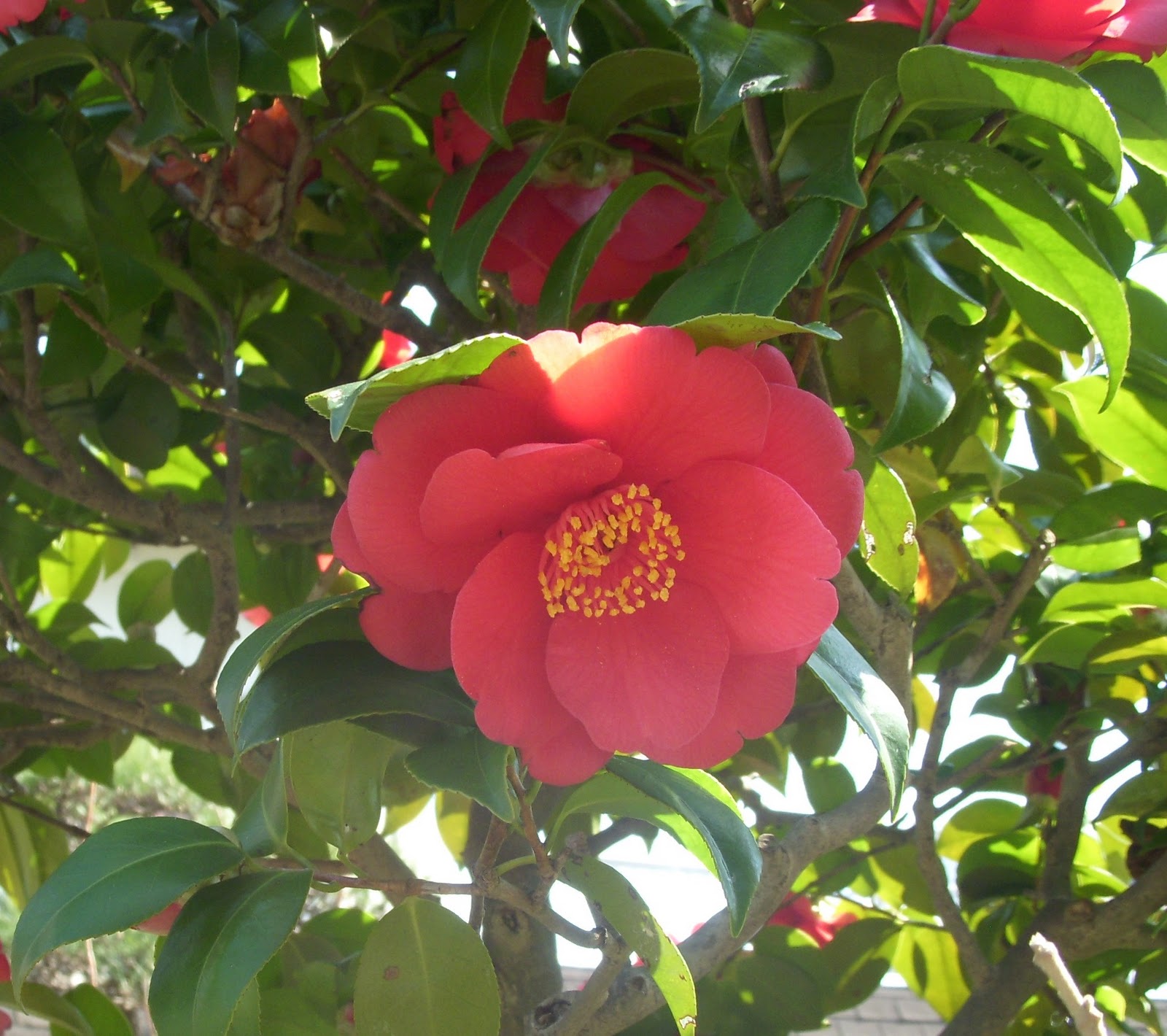
As we wait somewhat impatiently for those papery pale pink clouds to appear overhead, we can feast our eyes on camellias at Daigyo-ji, the nearest shrine to Kamakura station.
Some look just like half the camellias in the backyard of our old house on Magnolia Avenue in Norfolk. Thirty-five mature camellia bushes lined two sides of that yard when we bought the house. I heard that the current owners cut all those bushes down. What a shame.
![]() |
| A variety commonly seen in Tidewater, Virginia. Ho, hum. |
![]() |
| Hmm. Speckles. A bit more interesting. |
![]() |
| Good gracious! White stamens? Rather striking. |
![]() |
| Simple yet elegant. I like this one. |
![]() |
| Positively stunning. Those blossoms are taking their time to unfold. |
Wednesday, March 16, 2011
Fear and Trembling in Yokosuka, Part V: Laughter and Gas Rationing
Between 11:00 pm last night and 7:00 am this morning there were 19 aftershocks. I slept through most of them. This will come as no surprise to my husband and children. What might surprise them, however, is that I slept through most of those aftershocks because I was absolutely exhausted from laughing. For that I am indebted to a cadre of friends and acquaintances around the globe who distracted me with their entertaining comments on facebook for the first two hours following the earthquake. I experienced every type of laughter known to man and possibly invented a new version of 'borderline hysterical'.
What else can you do?
This morning I saw a message from the base commander that the gas tanks at the Autoport had been replenished and that each customer could purchase a maximum of ten (10) gallons. The base commander encouraged us to avoid long lines by waiting until later in the day to collect our ration of gasoline.
"I wonder how THAT is going?" I asked myself mid-morning. (There's a lot of "asking myself" going on here right now in the absence of anyone else to ask but, so far at least, I'm managing to do it without moving my lips.) "Let's go investigate," I said to self. "Great idea!" I congratulated self. "Take precautions when you dress," I reminded self. So I pulled on the Ancient Mariner's almost equally ancient U.S. Navy sweatshirt and tugged the hood over my tresses before marching out the door and briskly hiking the four or five blocks between my house and the Autoport.
By the time I reached the Autoport, the base commander had issued a new directive, further rationing gasoline to five (5) gallons per customer. To put this in perspective for owners of those dinosaur SUVs, some Japanese automobiles have a 7-gallon capacity.
![]() |
| Autoport Manager directs customers into four orderly lines |
While many car owners seem to have ignored the advice about waiting until later in the day, I have to give them credit for lining up in an orderly fashion. What struck me as odd was the number of non-military middle-aged men wearing lanyards around their necks behind the wheels of those cars. I say non-military because a) they were not in uniform, b) their hair was rather long, and c) they sported physiques that strongly suggested they had not passed a physical fitness test within the last six months (or even six years). Those neck lanyards made me suspect the men were civilians employed by various "military support" enterprises such as the Navy Exchange, MWR, Commissary, and schools.
My deeply-ingrained work ethic chimed, "Wrong! Wrong! Wrong! You're supposed to be at work. You would scream bloody murder if your doctor or dentist cancelled your appointment so they could dash off to the Autoport for their ration."
Oh, wait. There's more:
Turning around, I saw a line of cars stretching from here to the proverbial eternity. The drivers, bless their hearts, were waiting patiently to be waved into one of those four orderly lines.
The Autoport serves all military personnel stationed here, not just those of us who live on the Main Base. There are not enough houses and apartments on the Main Base to accommodate everyone who works here so many people live in satellite housing areas either near Yokohama or on the other side of the peninsula. And there are also many people who live in Japanese rental houses scattered across the peninsula.
So far no one seems have thought of granting some sort of priority to the people who live outside the Main Base and have to use their cars to get to work. Maybe they've thought of it, but just haven't worked out a reasonable system yet. Let's hope that's the case. Because I, for one, am more concerned that the emergency physician who lives twenty minutes from the base has enough gasoline to get to work than the teacher who lives across the street from the school.
When it comes to mass hysteria, though, I am ashamed to admit that I'm no more immune than those people waiting patiently in line at the Autoport. Walking home, it dawned on me that perhaps I should see how much gas was in the tank of my car. The Ancient Mariner, dream husband that he is, topped off the tank in late January before abandoning me to my own devices. Six weeks. Hmmm. That's a pretty long time.
Whew! My fuel gauge assures me the tank is still half full. (I know. Incredible, isn't it?)
How many gallons do you suppose that is? How much do you suppose a car-addicted person would be willing to pay for a gallon of gas? How much do you suppose one of those siphon things costs?
Just kidding, of course. I would happily give it away free to any physician who needs it.
Tuesday, March 15, 2011
Fear and Trembling in Yokosuka, Part IV: Low-level Radiation and Pinball Expertise
****** FOR IMMEDIATE RELEASE *******
by Commander Fleet Activities Yokosuka on Tuesday, March 15, 2011 at 10:44am
At approximately 0700 local (Japan) time, 15 March 2011, sensitive instrumentation on USS GEORGE WASHINGTON (CVN 73) pier-side in Yokosuka, detected low levels of radioactivity from the Fukushima Dai-Ichi Nuclear Power Plant. While there is no danger to the public, Commander, Naval Forces Japan is recommending limited precautionary measures for personnel on Fleet Activities Yokosuka and Naval Air Facility Atsugi, including:
A. Limiting outdoor activities.
B. Securing external ventilation systems as much as practical.
These measures are strictly precautionary in nature. We do not expect that any United States Federal radiation exposure limits will be exceeded even if no precautionary measures are taken. We are continuing to analyze the situation and will update you as we learn more.
The reaction here ranged from "Uh-oh" and "Don't panic" to "What about our schoolchildren?" The credit for that question goes to my next-door neighbor, a commanding officer and father of two small children. Thanks to him, the message was subsequently amended to let us know that the children would remain indoors, school would end at the usual time, and school will be held tomorrow. I'm glad that someone like Curt has the ear of the base leadership. I wish they were smart enough to run their messages past him before posting them on facebook.
Right now my brain feels like a pinball machine right after the first ball hits the sweet spot and releases all those bonus balls. There are so many thoughts pinging around in my head. I hope I can capture at least a few of them in words. I won't take it personally if you don't have the energy to process my efforts. I just need to talk right now and you're there while I'm way over here. Which has some distinct advantages, of course. Mainly you can walk away in the middle of our 'conversation' and I won't think you're rude because I won't even know. And if some sort of worst-case scenario unfolds, you can always come back and read this at a later date. Don't feel guilty if that happens. Don't ever, ever, ever feel guilty about anything you have ever said or not said to me, or any attention you have paid or not paid to me.
Here are my first three thoughts:
1. I'm not worried.
2. Don't feel guilty.
3. Do not ever assume someone in a position of authority is half as smart as you.
Fear and Trembling in Yokosuka, Part III: My Japanese Friends
The Ancient Mariner called to verify my continued existence. This is the first time we have spoken to each other by telephone during a deployment since December 24, 1998. Most people find my moratorium on telephone calls odd but I have never been able to bear saying goodbye to him over and over and over again. He humors my quirks, bless his heart, but was forced to break the moratorium thanks to lessons the Navy learned in the aftermath of Hurricane Katrina when they were unable to account for the whereabouts of countless family members. It was a job-related telephone call so I'm not counting it against him. And I must admit it was reassuring to hear his voice. Emergency physicians tend to have the sort of voices people like to hear during disasters.
Then began the long process of checking on the well-being of my friends in Japan. Most of the Americans had posted on Facebook within a few minutes of the earthquake so I knew they were okay. A couple of them made me laugh, especially Sherri who was driving to her off-base hilltop house when the earthquake hit and simply assumed something was wrong with her car. A couple of them were borderline hysterical. I didn't know what to do about that.
My Japanese friends took longer to surface. They suffered power outages to which those of us fortunate enough to live on an American military base were immune. Eventually their stories began to dribble in. I'm sharing a few because I think you have come to care about these people almost as much as I do.
Nagasaki lives in Hayama. Her grandchildren were riding the train home from school when the earthquake happened. Their train was halted at the Kita-Kamakura station, about 15 minutes from Nagasaki's house. It was 7:00 pm by the time she learned of their predicament. It took Nagasaki and her husband two hours to reach their grandchildren due to traffic jams and power outages (no traffic lights). They loaded their grandchildren and as many other children that could fit in their car and drove them home. They did not arrive back at their house in Hayama until 4:00 am.
My friend Sayuri is married to a retired Navy Master Chief Petty Officer who now holds a civilian job on base. Sayuri manages a building owned by her elderly parents. She lost electricity, water, gas, internet, and telephone service for most of the day following the earthquake. Since cell phone service was also down immediately after the earthquake, she felt compelled to drive to her parents' home and building to make sure they were okay. She says, "It was the most dangerous drive I’ve ever made because almost all the traffic lights are off and no cops were controlling the traffic. On top of that, it was the time for lots of kids to go home after school. Running across the disordered traffic roads. I really hope those kids got home safely. Even though I had a lot of flashlights, candles, and emergency food in the house, no water was not easy....you know, no flushing." Sayuri has concluded that we might be too dependent on electricity. "My parents who are survivors of the Tokyo bombing handled this situation much better, I think. Well, it was not their first rodeo, you know!" I forgot to mention that Sayuri's husband is a Texan...
Yoshiko was the Ancient Mariner's secretary when was Commanding Officer of US Naval Hospital Yokosuka. She retired in December 2007 and moved across Tokyo Bay to Chiba Prefecture with her husband, Kaz, and his father. They lost telephone service on March 11 but neither they nor any of their neighbors suffered damage from the earthquake. She was scared once the sun went down. They live pretty close to the Isumi river and are watching the water level closely. The river rose by more than three meters during the tsunami and almost all the floating piers were washed away. She tells me not to worry about them because they have a local cable broadcasting system and will be able to act quickly to evacuate if any emergency situation comes up.
My friend Kazumi called Saturday afternoon to tell me there had been an explosion in a nuclear plant in the disaster area. She instructed me to close my doors and windows and to turn off any fans. If I absolutely had to leave my house, she told me to cover myself completely. She emphasized wearing a hat. She also told me to not to even think about leaving the house the next time it rains because those raindrops will likely contain residue from the chemical plant that exploded in Chiba during the earthquake. That was the fire we saw across Tokyo Bay throughout the night following the earthquake. Kazumi's Japanese husband, a civilian helicopter pilot, was summoned to the disaster area Friday night but was unable to obtain information on where to land. Kazumi thinks this is because too many media helicopters are in that area. He came home to sleep and returned to the disaster area the following day.
Everyone in Ishii's family is fine (especially her brother who they were surprised to learn was in Memphis, Tennessee, on a business trip when the earthquake occurred). Ishii's son-in-law is going to the earthquake area to help one of his company's branch offices so Ishii has headed up to Tokyo to help her daughter and little granddaughter until he gets back. Before she left, Ishii clued me in on planned power outages that will roll from one area to another so that as much power as necessary can be diverted to hospitals. She also warned me to expect train service to be disrupted. I will miss Ishii. We'll surely share a few chuckles about that brother of hers the next time we meet.
And then there's our friend, Dr. T:
My wife, I and everyone else who matters to me did not suffer from the earthquake and tsunami.
Of course, 15 medical doctors including me and three stuff members who attended to the meeting at 21st floor of a high and new building near the Shinagawa station were frightened during the earthquake. After the terrible meeting (Editor's Note: Dr. T loathes meetings) we could not use an elevator and went to the 1st floor using emergency steps. I slept on a cardboard like a homeless in the Shinagawa station because I could not catch a train and a taxi to Yokohama.
Please come to see me tomorrow afternoon. I will tell you my miserable experience in the clutter room. (Editor's Note: Just last week I teased Dr. T that his office is so messy it could not possibly look any worse after an earthquake.)
The trains aren't running so I hope I can find a taxi driver willing to take me to Yokohama this afternoon. I am desperate to hear the details of his miserable experience. I am desperate to get back to Japan after four straight days on this base.
Monday, March 14, 2011
Fear and Trembling in Yokosuka, Part II: Emergency Contact System
Then I glanced at my computer. Facebook was on the screen and my youngest child had just posted a message to his buddies.
College Boy: Man, that earthquake was crazy. Wish I was there to experience it.(Johnathon Bures and 3 others like this.)
"What is he doing up in the middle of a Virginia night?" I fumed just as the first aftershock sent me racing back to the table's shelter. That aftershock was almost as interminable as the earthquake. By the time the ground stopped shuddering, my thoughts had been transformed into "Thank God he inherited my Grandpa Sykes's nightowl gene. There's an inexplicable comfort to be derived from sharing this experience with a loved one who is not at risk of suffering bodily injury from said experience." I stumbled back to the computer.
Peevish: I am so glad you are NOT here because it is very, very scary. Much as I don't want to die alone, I would really prefer that you outlive me by at least 50 years. (no one liked this; I hate it when that happens.)
College Boy: Call me! (Johnathon Bures likes this.)
Summoning up the calmest and most soothing tone of voice available to me under the circumstances, I placed the call. I wanted to make him laugh. My memory is a bit muddled, but I believe I succeeded.
As it turns out, he's on Spring Break from classes right now. So it was okay he was up so late. Not that he isn't up just as late when he's not on Spring Break.
Golden Girl and Texas Star subsequently informed me that College Boy took it upon himself to alert all six of his siblings, including the one he's met only twice in his 18 years on earth, that I had survived a natural disaster which none of them knew had occurred.
The Ancient Mariner and I derive great comfort from knowing there is a communication mechanism in place to spread the news when one of us eventually kicks the bucket. We are quite shocked, however, to find that the child who didn't even know how to pick up a telephone until two years ago would actually know how to activate that system. I certainly would not have known how to reach all seven kids as quickly as he did.
I decided to leave that book to my sister.
Sunday, March 13, 2011
Fear and Trembling in Yokosuka, Part I
Natural light was plentiful last Friday. I've noticed I spend less and less time gazing at the sky these days, something I blame on years living in or near major metropolitan areas where stars can no longer be seen, but the sky was quite remarkable Friday morning. Could that color be described as cobalt? I wondered when I sauntered out to the patio with my first cup of coffee that morning. Not cobalt, I decided, but nevertheless a breathtakingly dramatic shade of blue. I admired the sky and then laughed at myself for admiring the sky.
My plan for the afternoon had me delivering a second load of contributions to the submarine wives for their Saturday yard sale. That morning I dropped off the first load then piled more contributions on the kitchen counter before stretching out on the couch with John Hart's The Last Child. One chapter led to another just as one chapter has led to another since the dawn of the printing press and it was 2:45 pm when I finally managed to exercise enough self-control to close the book and think about loading up the car.
The book landed on the coffee table just as the house started shaking. "Ick," I thought. ("Ick" is what I think whenever I feel the ground shake. I am not proud of thinking "ick". I would much prefer to have thoughts demanding a more refined vocabulary like "seismic event" or "techtonic plate shift" but I want to accurately and honestly record my memories of this historical event so "ick" it is.)
In my limited experience of earthquakes - mind you, I never felt a single tremor for the first two years we lived in Japan - they last for two or three seconds. Until now, the basic procedure has been: ground shakes, Peevish mutters "ick", ground stops shaking.
Except this time the ground did not stop shaking. The Anshinkan Disaster Simulation kicked in. I sprang around the coffee table and dove headfirst under the dining room table, gripping one of those claw-and-ball feet for dear life. Life did strike me as being ever so dear at that moment. How could I have taken it for granted?
"Lulu!" I have a houseguest but had no idea if she was in the house. She's been sleeping in Matt's room for the past month and our paths have crossed about seven times for a sum total of 12 minutes. "Lulu!"
The floor continued to shake. From under the table, I watched in horror as the dining room chairs danced around the room. My life started flashing before my eyes. The vertical blinds had started to sway like a hypnotist's pocketwatch by the time my early training kicked in. Those Hail Marys poured out of my mouth but, truth be told, it was the Our Father that stopped the earthquake. That surprised me. I'll have to spend some time pondering that one. At the time, I was merely grateful.
The blinds continued to swing long after the earth stopped trembling. Then I crawled out from under the table to assess the damage. There was none I could see. The spice jars on the little ledge above the sink were still lined up in alphabetical order. The laptop computer on the back porch was still connected to the internet.
I gazed at the computer in astonishment. While I was praying for my life and gripping that table leg, my youngest son had posted on Facebook: Earthquake in Japan!
I shot him a quick return message just as Lulu appeared in the living room in a state of semi-shock. She was stepping out of the shower when the earthquake started. That was pretty funny (glad it wasn't me kind of funny) and we were sharing a chuckle when the first aftershock hit.
We both dove under the dining room table. I grabbed my book as I passed the coffee table. What in the world was I thinking? That I was going to read rather than pray? That I would actually be able to concentrate on the plot in the midst of a 7.something intensity earthquake? Maybe I was simply trying to exude calm for the benefit of my 24-year old guest. Maybe I was thinking my children would appreciate knowing I died with a book in my hand.
This was 200 miles from the epicenter. I cannot begin to imagine the horror those people in Sendai experienced.
Thursday, May 13, 2010
Dyed and Gone to Yokosuka
Creative Explorer was a Shibori artist at the Hermitage Museum near our Norfolk house before she moved to Japan last summer. Now she takes a Shibori class in Tokyo every month. When we were looking for ways to repay the Japanese quilters for taking us to the fabric store and money-washing shrine in Kamakura, Creative offered to share her expertise with us. Weather Explorer and I thought that was a great idea. (Weather Explorer and I are both praying to be struck by a bolt of expertise-in-something lightning before it is our turn to plan an activity for Hiroko, Hisayo, and Kayoko.)
Before we got our hands dirty, Creative Explorer showed us some examples of her incredible work. The flowers and leaves on one quilt (above) were fashioned from her children's handprints. You can see I was not exaggerating when I gave her that nickname.
We ran thread across our scarves in the places Creative had marked with colorful pins, gathered the stitches, and wrapped the thread around the fabric as tightly as we could. You want to wrap the thread tightly so the fabric in that area will resist the dye. I mention this to prove I was paying attention.
After we posed with our virgin bundles, Creative soaked the scarves in soda ash to make the fabric more receptive to dye and then she mixed eight or nine batches of dye in various shades of purple, blue, and green.
We applied the dye of our choice with sponge brushes, rolled the scarves in plastic sheets so they looked like sausages, squeezed out the excess dye, and let our projects rest while we ate lunch. Creative, however, did not get to eat lunch because I forgot she is a vegetarian until I was placing the fruity chicken curry salad in front of her. I will not sleep until I come up with a way to atone for this faux pas.
The Japanese quilters were thrilled to learn a traditional Japanese craft from a passionate young American artist. They want to return the favor by taking us to Kamakura next month to see the hydrangeas in bloom. Weather Explorer will be in New York then so Kate might have to fill in for her. This will require an appropriate nickname. Junior Explorer? Ignoring-her-thesis Explorer? This has all the earmarks of a contest.Sunday, May 9, 2010
On Why I Deserved to Attend the 34th Tokyo Hobby Show
Interest: a state of curiosity about something; something that evokes this mental state
Hobby: an activity or interest pursued at one's leisure for enjoyment
The operative word here is pursuit. Devoting time and energy to an interest transforms that interest into a hobby.
Last Thursday I decided I could legitimately move knitting from the interest to the hobby column in my life ledger since I've spent a heck of a lot of time learning the basics over the past few months. This was excellent timing on my part. The Tokyo Hobby Show at Big Sight, a cavernous convention center in Odaiba, opened Friday. Having a pertinent hobby lent a patina of credibility to my attendance. Or at least I like to pretend so.
Scarf #2, that white ribbed number pictured above, is a done deal (or will be once I weave in those dangles where two skeins of yarn connect). Now I'm working on a blue scarf in a checkerboard pattern for my sister Suzi. I've reverted to calling her Susan for the duration of this project because the pattern changes every five stitches and I've discovered it's easy to keep track of those changes by chanting "S-U-S-A-N" when knitting and "S-Y-K-E-S" when purling. The end stitches merit a perky "Marion," her middle name and our grandmother's first name. Knitting this scarf has a slightly holy aura, like saying a rosary.
Yesterday I finished knitting my first pair of socks. My teachers decided I would knit the second sock on a circular needle, two needles attached to each other by a plastic cord. Hmpf. Teacher Tara then decided to go into labor. This is her in the hospital elevator, cheerfully answering my pesky questions until the midwife arrived.
Then Teacher Megan and Teacher Cari took off for China with The Other Kathy. They are pictured here knitting on The Great Wall. That left Teacher Betty, the only one of the bunch who can be talked into fixing my mistakes for me rather than showing me how to fix the mistakes myself. So "I" made fairly rapid progress on that sock until Betty and Lulu grabbed their backpacks and hopped a plane to Singapore just when the harsh taskmistresses climbed down off The Great Wall and picked up their whips.
Tara, meanwhile, returned to the knitting circle with darling Logan and a dozen skeins of yarn she dyed herself - between contractions no doubt - using natural materials like onions and other vegetables. They just keep raising that bar higher and higher.
In any event, I spent Friday wandering around the Tokyo Hobby Show with that second sock stuffed in my bag in case I was asked to prove I have a hobby. I spent 480 yen (about $5) on a pair of metal needles since I'm still in the experimental phase of knitting, testing the various tools to see which work best for me. The cashier tucked a set of complimentary circular needles in my bag to thank me for my purchase and that tickled me immensely since I'm pretty sure the circular needles cost more than the metal ones I bought.
Here's the thing: I enjoy knitting socks. If you send me a tracing of one of your feet, I will try to whip* up a pair for you.
*whip = 2-3 months
Saturday, April 10, 2010
Cherry Blossom Viewing Party #2: Reconstructing Mt. Minobu
The camera fiasco worked to your advantage, dear reader, as Sue is an amazing photographer with equipment even the Ancient Mariner could envy. She generously stuck a DVD of Minobusan pictures inside my front door yesterday by which point I had sobered up sufficiently from the hot sake fiasco to attempt this reconstruction of the Minobusan odyssey.

Sue was not my only friend on the tour bus. Erin, whose husband is on the Seventh Fleet staff and currently sailing the ocean blue with the Ancient Mariner, brought her three boys: studious Ethan, mischievous Matthew, and - my special friend - the irrepressible Seth who was plotting his disappearing act when this picture was snapped. You might recall that Sue's husband, an emergency physician, was sent to Afghanistan in January and will not be returning to Japan until October. What an honor it was for me to spend a Sunday in the presence of these inspiring young Navy wives.Yamanashi Prefecture, about two and a half hours west of Tokyo, is the home of Mt. Fuji and the eastern foothills of the Minami Alps. Our driver negotiated the bus over hill, over dale, and around multiple hairpin turns before depositing us within walking distance of Kuon-ji Temple, halfway up the sacred Mt. Minobu. Before visiting the temple, we took a tram ropeway (see speck, below) to the top of the mountain to savor the splendid view of Mt. Fuji and the Pacific Ocean. There were several temple buildings, including the inner shrine (Okunoin Shishinkaku), and lots of statues on the mountaintop.

Why does this statue look so familiar? Gadzooks, it's Nichiren, the radical Thirteenth Century Buddhist saint who died in that place in Ikegami where the mysterious old lady kidnapped the Explorers just a few weeks ago. Kuon-ji, as it turns out, is the head temple of the sect Nichiren established, Nichiren Shu, and the place where he asked to be buried. I think I might prefer to be stalked by Van Morrison's moon shadow than the ghost of a radical Buddhist monk.
This is a statue of Shakyamuni Buddha, regarded by Nichiren as the Eternal Buddha as preached in the 16th chapter of the Lotus Sutra. Which, I presume, explains the lotus on which this Buddha is perched.
After inhaling some incense to purify our thoughts (note lotus blossom beneath incense burner), we rode the tram back down to the main temple where we flagged down a passing monk who was surprisingly amenable to having his picture taken.
The temple attracts over 1.5 million visitors yearly. Since we approached the magnificent temple grounds from above and behind, we did not, (sarcastic) alas, have the opportunity to climb the Bodaitei, 287 stone steps leading up to Kuon-ji from the temple town below.
This weeping cherry tree is over 100 years old, hence those timbers supporting its limbs.
We spent an hour or so wandering around the temple grounds, admiring the splendid buildings and lovely cherry blossoms. Since my buddy Seth decided to wander further afield than the rest of us, our fellow pilgrims were treated to the sight and sounds of a six-foot tall frantic American mother racing back and forth across the plaza, which is about the length of three football fields. This is the point when I checked out those 287 stone steps, saw they were as steep as a Grand Canyon cliff, and prayed (to St. Nichiren, of course) that Seth had disappeared in the opposite direction so I wouldn't have to rappel down to fetch him. My prayers were answered.
Our next stop was the temple town for shopping, which I eschewed, and festival food, which I embraced. On offer was sakura (cherry) ice cream, bananas and strawberries dipped in chocolate (above), and footlong hot dogs (below) plus a bunch of other stuff that did not stand a chance of passing between my lips although I was more than happy to egg on a young sailor sucking up his courage to taste something exotic before he moves back to the States in a few weeks.
A bun would have been a welcome addition in terms of soaking up residual hot sake.
Leaving Mt. Minobu behind, our bus took us to Katsunuma where we toured the Shirayuri Winery and sampled L'Orient wines. One tiny sip of cherry blossom wine later, I was elbow to elbow with Ethan, Matthew, and Seth at the grape juice station, comparing the virtues of white grape juice vice purple.Tuesday, March 30, 2010
Wild Wild Camellia Hike in the Wilds of Kamakura
My flower walk guidebook recommended the Gionyama Hiking Trail. This is how I read the opening paragraph before convincing five Explorers ranging in age from five to sixty years to join me in searching for wild camellias last week: Wild Japanese camellia is best seen in its native habitat in Kamakura, on the east side of the Nameri-gawa valley, where a thickly wooded narrow ridge running north-south is kept intact from surrounding urban development. There, the smooth gray-barked trees bloom mysteriously in the shade of tall broadleaved evergreens. Many of its flowers fall along the narrow ridge and are vividly red with a central boss of golden stamens retained in the tubular forms.
This is how I should have read that paragraph: Wild Japanese camellia is best seen in its native habitat in Kamakura, on the east side of the Nameri-gawa valley, where a thickly wooded narrow ridge running north-south is kept intact from surrounding urban development. There, the smooth gray-barked trees bloom mysteriously in the shade of tall broadleaved evergreens. Many of its flowers fall along the narrow ridge and are vividly red with a central boss of golden stamens retained in the tubular forms.
In Japan a "narrow ridge" is an 11-inch wide strip of rocky, muddy, slippery dirt suspended 60-500 feet above the forest it traverses. Live - if you're lucky, that is - and learn.
Following the guidebook's advice, we stopped at Hokaiji temple first to see garden variety camellias.
Nicky and Xan are admiring a stray camellia blossom in an old stone lantern on the temple grounds.
We studied the handy map at the beginning of the trail. What's that Takatoki Harakiri Yagura? Yagura means cave, I learned that a few days ago. Takatoki was the last Hojo regent of the Kamakura shogunate. Harakiri sounds disturbingly familiar. Hmmm. Reiko confirms that we will soon pass the cave where Takatoki ended his own life. Nicky finds this quite disturbing so we don't dally at the cave.
The initial incline is deceptively slight.
This is one of the last pictures I managed to take before my hands were otherwise occupied, gripping tree trunks and branches to avoid an untimely demise. Xan and Nicky kindly offered their hands and helpful tips on where to plant my feet next.
Camellias grow very tall in the wild. Kim, Reiko, and Xan are admiring what I'll bet is a lovely specimen but I can't say for sure since the only camellias I saw were the ones littering the ground at my feet.
This is an example of the sort of stuff we clambered over but you will just have to use your imagination to sketch in Grand Canyon-type cliffs on either side of the roots.
Near the end of the hike there's a nice flat resting place offering a magnificent view. The only thing that could get me back on that ridge was the promise of waffles.Sunday, March 7, 2010
Down the Rabbit Hole, Through the Looking Glass, Over the Rainbow: Wrapping Up Ikegami
The icing on the cake, for Bossy at least, was the tiny lady in the purple bucket hat who materialized in the Daibo Hongyo-ji courtyard when we were lacing up our shoes after exiting the Secret Garden. For brevity's sake, we'll call her Merry Prankster.

Merry Prankster had the mannerisms of a songbird, tweeting away in rapid-fire Japanese for twenty or so seconds then standing as still as a statue with an expectant smile on her face. We shrugged, shook our heads, and smiled apologetically, pretty much in unison after the third or fourth refrain. A casual observer might have taken us for a pale imitation of a famous Motown quartet.
Eventually she pointed to the cemetery on the hill behind us. We pointed toward Honmon-ji temple on the hill in front of us. She reached into the plastic bag she was carrying, extracted a bottle of what looked like tea, waved the bottle in the air, and tucked the bottle back into the bag. We started walking toward Honmon-ji. Merry Prankster planted her tiny feet in gravel and jabbed her index finger toward the cemetery. A stream of Japanese poured from her mouth. It sounded like this: beekaydeekayneekay-SAMURAI-shoodoobeekaymeekaynooshoo.
What can I say? She was vivacious, insistent, and vaguely mesmerizing. Maybe she hypnotized us when she waved that magic bottle. At any rate, for reasons that remain unclear two days later, the Four Explorers accompanied Merry Prankster to the cemetery on top of the hill.

There were many stairs to climb but they were shallow and liberally interspersed with broad landings. In other words, the Explorers were not so winded they could not engage in witty repartee.
- Maybe she's leading us to a store where we can buy bottled tea.
- Maybe she's going to show us the grave of a famous Samurai warrior.
- Maybe she's taking us to the cemetery because that's the most convenient place to dispose of our bodies after she murders us.
That last contribution was Bossy's which will come as no surprise to most of you. Weather and Artistic seemed to find it slightly amusing. Novice just looked completely terrified.
We reached the summit. Merry Prankster tugged on Bossy's sleeve. Notwithstanding the language barrier on top of Bossy's hearing issues, dropping her ear to the level of Merry Prankster's mouth seemed the polite thing to do. Just before dissolving into peals of laughter, Merry Prankster chortled, "I know English."

Duly chastened and completely mortified, the formerly sarcastic Bossy and her fellow Explorers followed the Merry Prankster across the broad summit and partway down the other side of the hill until they reached a monument (above). Merry Prankster claimed the monument honors Ieyasu Tokugawa but Bossy believes Ieyasu is buried in Nikko so this is certainly not the great Shogun's final resting place. Bossy is grappling with trust issues at this juncture.
Merry Prankster chatted with another woman, we'll call her Granny Yoda, at the base of the monument then gestured for us to follow Granny Yoda. Which we did (!) until we reached the edge of a precipice (!) overlooking a pagoda with a shiny golden roof.

Bidding sayonara and domo arigato (for not pushing us off the cliff) to Granny Yoda, we followed Merry Prankster to Honmon-ji temple. We had the temple in our sights, it was just across the street in fact, when Merry Prankster shooed us into a modern temple compound, across a stretch of white gravel the length of a football field, and into a building where we admired a pair of ancient statues, the fierce alpha and omega warrior gods traditionally situated at the entrances to Shinto shrines.
After we emitted the obligatory oohs and ahs, Merry Prankster ushered us around the building to a square of gravel in the rear, an extremely stark setting featuring an octagonal wooden building flanked by two very bushy shrubs about seven feet high. Merry Prankster poked her arms into the shrub on the left and pulled out five small oranges the size of a chubby toddler's fist. Mikan oranges are notoriously easy to peel. The rind had already burst open on the Mikan the Merry Prankster handed to Bossy. Bossy popped the juicy fruit out of the rind and into her mouth in one swift motion. The fruit landed in Bossy's mouth just as Artistic warned, "Be careful of the seeds!"
Bossy scooted around to the far side of the bush to expel the seeds as delicately as possible. Seconds later Novice and Weather joined her and pitched their uneaten Mikans into the bush. "How could you put that in your mouth," they asked in concern/disgust/amazement. "Thanks to you, we're still worrying about being buried in that cemetery." (Note to Self: Assuming we survive the Ikegami expedition, take Novice and Weather to Little Mary's Grave when we are all back in the States.)
Compared to the adventure of getting there, Honmon-ji itself was fairly anticlimactic. Bossy's camera died - from Mikan poisoning no doubt - about halfway across the temple grounds but here are some of the early highlights to reward anyone with the patience to have stayed with me this far (Hi, honey!).
The Kyozo sutra storage building (above) is among the historic landmarks that survived the 1945 air raids. That's why Bossy took this picture. Looking at it now, Bossy sees Granny Yoda is standing near the building's entrance. Did she follow us from the cemetery?
A dragon is spitting or vomiting water into the purification tank.
Weather thinks this statue (above) is the patron saint of curling. Bossy thinks (a) this statue is the patron saint of janitors, and (b) Weather might have overdosed on the Winter Olympics.
Novice takes a picture while Artistic, Merry Prankster, and Weather head toward the five-story pagoda, the "oldest and largest wooden tower in the Kanto region".We had lunch at a lovely cafe near the train station. I had a salad and a piece of toast three inches thick and deeply scored to encourage optimal butter penetration. Weather had pasta with every possible variety of mushroom, while Artistic and Novice settled on a seafood and rice concoction. For the benefit of any readers who might be interested in exploring Ikegami on their own, we left the base at 8:00 am and were back home by 2:30 pm.