Showing posts with label exploring. Show all posts

Saturday, October 1, 2011

The Japanese Book Club and the Chatty Cab Drivers

Here it is October already and I haven't yet written about my trip to Nagano Prefecture with the Japanese Book Club ladies in late August.  It's taken me over a month to get a good geographical and historical fix on where I spent three of the most memorable days of my life.

You probably know Nagano as the site of the 1998 Winter Olympics.  The long-term benefit to Nagano of hosting those games was the building of a bullet train line to shuttle athletes and spectators to and from Tokyo.

We took one of those trains from Tokyo's Shinjuku station to Chino where we loaded up on perishable items like milk, eggs, and bacon at a shop across from the train station before hopping in a taxi for a twenty-minute mostly uphill ride to Suzuki's "rustic mountain cabin" -- her words, not mine -- in Tateshina Village. Our driver prattled non-stop for the entire twenty minutes. Later Suzuki told me she had never been treated to such an indepth monologue on local history and hot spots in all her years of riding in a cab from the station to her cabin. Ishikawa said the driver might have been a bit nervous and giddy about transporting a foreigner. I was a bit giddy myself.

Suzuki's parents built this vacation getaway in the 1960s and she has continued to pay the taxes since they passed away.  There are hundreds of cottages scattered across the hillside but all are on lots of at least a half acre and are hardly visible to each other.  Homeowners are not permitted to build fences or to remove any trees surrounding their cottages.

They take that tree covenant seriously. There's one hosting a hairy sort of pale green moss partially blocking the steps that provide the only access to Suzuki's cottage. Inspecting that moss, I decided it might offer an adequate cushion should I smack into the tree while fleeing from a fire in the middle of the night. But Suzuki's daughters will probably have to remove the tree when their turn to pay the taxes arrives.

The mossy tree mentioned above
Tateshina Village offers a quiet, cool respite from the summer heat and the hustle and bustle of Tokyo and its suburbs. People come here to commune with nature, to soak their weary bones in natural hot springs (there are hundreds from which to choose), and to feast their eyes on fabulous views of the Yatsugatake Mountains, a volcanic range situated on the border between Nagano  Prefecture and Yamanashi Prefecture.  There are more than twenty peaks in the Yatsugatake Mountains, ranging in height from 2300 to 2900 meters.  (By way of comparison, the tallest mountain in Japan, Mount Fuji, is 3776 meters high.)
 
This road was pretty scary after the sun went down
We spent the first afternoon hiking the dirt roads and paths that honeycomb Tateshina Village. Suzuki has been coming here every spring, summer, and fall for fifty years yet never ventures out the cottage door without her large laminated map. If I had paused to reflect on the possible ramifications of getting lost in the wilderness with two women a dozen years my senior, I would have insisted on holding that map. My bad.

There are neither street lights in Tateshina Village nor road signs. The only signs are short cedar posts stamped with the number of each lot although one of Suzuki's neighbors has affixed a sign atop his post dubbing his domain "Walden". This tickled me, of course, and even more so late that evening when I happened to glance through his window and see his profile bent over a book.

To be perfectly frank, at the time I spotted him I didn't care that he was reading. After spending fifteen minutes wandering around an inky dark highlands forest with two seventy-something women who would not let me hold one of the two feeble flashlights, that man could have been washing dishes or sitting on the toilet and my heart would have rejoiced at the sight of another human being. Our afternoon hike had eventually led us to a charming French restaurant where we celebrated our June, July, and August birthdays with a marvelous meal prepared by an owner-chef who spent his youth collecting John Lennon memorabilia and his middle age attending cooking classes in Paris. The restaurant is only a ten-minute walk from Suzuki's cottage but she left the map at the restaurant and we took the first wrong turn we could possibly take. Eventually she admitted her error -- one thing I love about Suzuki is she hates to be wrong as much as I do -- and we managed to find our way back to the restaurant where the waiter informed us the owner had found our map and set off in his car to return it to us. We didn't pass each other on the road thanks to that wrong turn so we loitered in front of the restaurant until he came back and then we set off for the cottage again.

Even with the map, we managed to take a wrong turn but Suzuki was quicker to admit her error the second time around and the cottage emerged on our right blessedly soon after Ishikawa-san's voice alerted the noctural forest creatures to our presence. "This reminds me of one of those American teenage movies where they all start disappearing one by one." It's funnier now than it was at the time.

The Yatsugatake Mountains

On the second day, after a nourishing breakfast of salad, bread, and corn on the cob, we hiked half a mile to the nearest bus stop where we caught a ride to a rice field in the middle of nowhere. Our destination was a rustic open-air hot springs favored by the locals. The hot springs are about two miles from where the bus dropped us and I was so hot and sweaty by the time we got there I almost forgot to be embarrassed about disrobing in front of people to whom I'm not married.

If embarrassment wasn't such a powerful emotion, the big toe on my right foot would have been the only part of my anatomy to experience the rustic open-air hot springs favored by the locals. Conversations about onsen experiences with my American friends tend to focus on nudity (for people who favor bare midriffs and plunging necklines, we are a strangely modest nation). No one ever mentioned that the water in those hot springs is almost unbearably hot. Maybe they thought the name was self-explanatory but we're talking beyond tepid, beyond lukewarm. We're venturing into the region of boiling point here.

WARNING: That sign means "hot springs" not "coffee shop"
My flesh was a glowing pink when I emerged from the hot spring and my bones felt like a Slinky.  I was sorely tempted to extract a beer from the vending machine conveniently located between the entrances to the separate men's and women's facilities but Suzuki-san had a different agenda. She called a cab and we were whisked to Hotel Heidi for cake and coffee by our second chatty cab driver who took us on a scenic route past a golf course and former iron mine.  Hotel Heidi (click here for photo) was the villa of an imperial family member before the war.  The cake was excellent and the waitresses were adorable in their Alpine costumes.

After strolling the hotel grounds and poking our heads into a little Swiss chalet where guests can have their pictures taken in Tyrolean garb, we headed downhill to man-made Lake Tateshina.


Suzuki-san and Ishikawa-san kindly pointed out our location on the tourist map near the lake. The Tateshina Village cottage is located off the road that's extending due north over Ishikawa's head.  A third chatty cab driver responded to Suzuki's call and took us back to the cottage where we polished off the corn and talked about books late into the night.  

The idyllic Lake Tateshina

On the third morning we aired our futons on the deck rail while closing up the cottage. Ishikawa cleaned the kitchen and bathroom while I vacuumed and Suzuki packed all the dirty linens in a box to be shipped back to her house in Kamakura. There's a washing machine in the cottage but Suzuki wanted to spend our last day sightseeing rather than doing laundry.

There's also a twin bed in one of the cottage bedrooms. They offered it to me upon arrival but I opted to sleep with them in the tatami room on double futons. This was both a great experience and something of a science experiment. I had heard that Japanese body temperatures are lower than ours and now I know for certain that at least two Japanese ladies can snuggle under down comforters for eight hours straight while at least one American woman tosses aside the comforter after a mere three hours.

Futons airing on the deck rail

Suzuki-san arranged for a cab driver to whisk us to a museum and shrine in nearby Suwa before our train was scheduled to depart Chino. This driver was remarkably less chatty than his predecessors, perhaps because he knew in advance he'd have three hours in which to regale us with insights and remarks. First he took us to some dumpsters where we placed three pre-sorted bags of trash in the appropriate receptacles and then he stopped at a building where Suzuki arranged to ship the box of linens while he showed me a wide variety of vegetables and fruits at an outside market beside the building.


The Suwa Taisho (Grand Shrine) was a real show-stopper but, alas, my camera battery petered out about fifteen meters into the first courtyard. The architecture of the museum we visited was more interesting than its contents which tended towards scrolls and mounted heads of boars and deer.  The person who designed that museum is also responsible for a number of whimsical structures like the tree house shown above that dot the landscape of the hills overlooking Suwa.  I'll have to ask Suzuki to remind me of his name.  She bought a book about his work in the gift shop next to the train station just before we called it an adventure and headed for home.

Guess what?  (Insert squeal of delight here.)  Suzuki and Ishikawa want to hold another book club slumber party in Tateshina before I leave Japan!  We're going back in May.  Between now and then I'll be searching every nook and cranny of my brain to come up with the best possible reading assignment to cap off my tenure as their book guide.  Your suggestions are most welcome.

Thursday, June 23, 2011

The Japanese Book Club Plans a Road Trip

There is no better antidote for Deployment Dejection than my Japanese book club ladies. Since our bi-monthly meeting just happened to fall the day after the USS Blue Ridge took a right turn out of Tokyo Bay, I barely had time to perfect my pout let alone wallow. I vacuumed up most of my guilt along with a ton of cat hair and went skipping off to meet Kyoko and Tsuneko at the front gate.

We had a birthday to celebrate (Tsuneko turned 70 last week) and a book to dissect (Eleanor Brown's The Weird Sisters) before capping off our session with lunch at Chili's.  Now that they've sampled fajitas and molten chocolate cake I doubt they'll ever want to see the inside the Officers' Club again.  That is good news in my world.

Usually we have to schedule our August meeting around the comings and goings of Tsuneko's grandchildren who live in Germany and Thailand, the price she continues to pay for allowing her daughters to spend a year abroad (the United States in both cases) during college.  But the German-Japanese grandchildren won't be visiting this summer on account of the nuclear reactor issues and the American-Japanese granddaughter, the one who lives in Thailand, is here right now, enrolled in first grade at the elementary school in Tsuneko's neighborhood for three weeks to hone her Japanese language skills.

While I was doling out our next book, Kurt Vonnegut's Cat's Cradle (will I like it as much at 59 as I did at 19?), Tsuneko said any of the last three days of August would work for her.  When I said any of those days would work for me as well, Kyoko proposed spending all three days at her rustic mountain cabin in Nagano Prefecture.  We'll take a train and a bus and maybe a taxi to get there.  We'll sleep on futons, go for hikes, and soak our tired bones in hot springs.

This is a lovely gesture on Kyoko's part.  It's one thing to speak a foreign language for three hours every two months.  It's an entirely different matter to do it for three days straight.

I am so excited that I've already started researching Nagano Prefecture which is often called the "Roof of Japan" because it includes nine of the twelve highest mountains in Japan.  The capital city, Nagano, hosted the 1998 Winter Olympics, but you probably already knew that.  It's famous for mountain views, hot springs, soba noodles, and a special type of silk fabric used for kimono.

I've traveled the world through the pages of books, now I get to travel across Japan because of books.  Life doesn't get much better than this. 

Thursday, May 26, 2011

Ofuna: Better Late Than Never

The USS Blue Ridge returned to port today after several days of "exercising" off Japan's coast but, since the Seventh Fleet does not embrace the concept of compensatory time, Pip and I had no hope of glimpsing the Ancient Mariner until evening.  Some women wail and wring their hands at a time like this.  Me?  I turned cartwheels and pirouettes around the fabulous roses in Verny Park enroute to another incredible adventure with Ishii-san.  Pouting is impossible when it's springtime on the Miura Peninsula.

Except.  But.  However.  When I pulled out my camera to capture the total sensory overload of acres of roses at their peakiest peak, the camera would not turn on.  The battery seemed to be loose.  The miniscule pin which holds the battery in place refused to snap into position.

So you are just going to have to use your imagination today as you travel with Ishii-san and I to Ofuna, just two stops past the Kamakura station and technically part of Kamakura City. Ofuna is a train junction where you can catch a ride north to Tokyo and beyond or head west toward Hakone and the Izu Peninsula.  I've changed trains there before but never exited the station until today.

The enormous Kannon bust overlooking the station from a nearby hilltop is worth a closer look but today our destination was Flower World Ofuna Botanical Garden, a 15-minute walk from the station.  There were a number of signposts to guide our steps but Ishii-san took pains to bring a detailed map as well.  We did not want to spent eight hours hiking in circles around Ofuna.  Although I can think of worse ways to spend a day.        
Kurihama poppies because I can't bear to post this without a flower picture
We pay 350 yen to enter the garden.  There are hundreds of tempting potted plants for sale just inside the gate and next time I'll take a sturdy bag to carry a few home.  There is a shady path lined by maples that order me to come back in the fall to admire them in their glory.  We wander into two small buildings and see an exhibition of azalea bonsai in one and hydrangea bonsai in the other.  I thought I knew a lot about hydrangea thanks to my friend Jill, but here are at least a dozen varieties she's never mentioned.  How long will this exhibition last?  How can I lure the Ancient Mariner into coming here with his fancypants camera to capture these hydrangea for Jill?

Outside again we wind back and forth across an acre of peony beds.  There are as many peony varieties as hydrangea it seems.  The magenta with white flecks are especially captivating.  I decide I want to plant a lot of peonies when we return to the States.  Where do they grow best?

Canals filled with irises wind around and through the garden.  It will be another couple of weeks before the irises hit their stride, yet another reason to return to Ofuna.

We enter a tropical greenhouse.  Many of the plants in there are slightly frightening.  There are four or five rooms in the greenhouse and the air gets warmer as we move from one into the next so I think there is a theme but I can't tell you what it is.  The last chamber is cooler, perhaps because we are walking between pools filled with specimen water lilies in breathtaking colors.  I thought all water liles were white but I see blue, lavender, pink, magenta, yellow, and green.  Hmmm.  Is there a climate somewhere on earth where both peonies and water lilies thrive?  Or maybe the Ancient Mariner will want to spend his retirement constructing a greenhouse for me.  Probably not.

At last we enter the rose garden.  A lot of people are sitting on benches in the gazebo at the center of the garden, feasting their eyes on the roses, but we are on the move.  We spend time admiring each variety, sticking our noses into the ones that seem especially fragrant.  I remember my Grandma Sykes and her roses and the brandy snifter in which the most perfect roses floated.

Just outside the rose garden we see hundreds and hundreds of lilies on the verge of blooming.  I pat myself on the back for recognizing them as lilies.  I think about the first lily I ever planted, a "Kiss Me Kate" that bloomed the spring my Kate graduated from high school.  This planting hundreds together rather than scattering a few in a perennial bed seems like a good idea.  Note to self:  be sure retirement home sits on at least two acres of land.

Near the garden exit a bed of delphiniums and foxgloves makes us pause.  The delphiniums come up to my chest and some of the foxgloves are my height, which was 5'8" before I commenced the shrinking process.

Yet again, I am grateful to my friend and "student" Ishii-san for sharing another special corner of her amazing country with me. 

Saturday, April 16, 2011

A Lenten Pilgrimage Featuring the Seven Gods of Fortune and a Partial Rosary

I spent a lot of time watching cartoons as a kid. One of my favorite visuals from that era is the snowball that gets bigger and bigger as it rolls down a mountainside. Maybe the reason I liked watching that snowball's size and momentum grow is that I imagined one of my family members, whichever one had tattled on me most recently, standing at the bottom of the mountain just where the cartoonist positioned Wile E. Coyote. In my defense, I never imagined an anvil dropping on any of their heads. I've always considered myself a slightly over-sensitive pacifist.

Our trip to Asakusa in Tokyo this week was a good snowball.  Weather Explorer got wind of a shrine not far from Sensoji famous for happy cats.  Since our friend Shinagawa-san has quite a collection of happy cats, Weather and I thought she might enjoy visiting that shrine.  I'll tell you more about those happy cats when we actually get to the Imado Shrine which won't be today.  The snowball has to roll about halfway down the mountainside before we reach the Imado Shrine.

The three of us squeezed into the first car of the train that left Yokosuka-chuo station shortly before 9:00 am.  The trains are more crowded since the earthquake because they are shorter.  I think this has something to do with energy conservation.  A 12-car train on March 10 is now an 8-car train but as many people are riding the trains so they tend to be squishy.  Squishy doesn't bother me the way it bothers some Americans, and Weather and I rarely have to stand past Yokohama because we have developed keen eyes for seats about to be vacated and quick reflexes.  A facial expression that combines innocence and cluelessness is also helpful when you're trying to beat a young salaryman out of a seat.

Tomoko-san was waiting on the platform when our train pulled into Yokohama.  The trains here always stop in the exact same place next to the platform so Tomoko-san only had to take two steps forward to join us in the first car.  She pulled out a little map and that snowball started rolling down the mountainside.

What's not to like about maps?  The one Tomoko-san was clutching was about as intriguing as a map can get.  It charted a pilgrimage to the shichi-fukujin (Seven Gods of Fortune aka the Seven Lucky Gods).  Our original destination, the Imado Shrine, was number four on the proposed pilgrimage so how could we possibly resist turning our little outing into a hatsumode (which I think means pilgrimage)?  This tradition began in the Edo era all across Japan when the common people who believed in the power of these gods to bring good luck and happiness began making circuits shortly after the new year.  The Asakusa circuit we followed was popular until the beginning of World War II.

It being Lent and all, I opted to view the shrines and temples on the circuit as "stations" on the order of "Stations of the Cross".  I said a Hail Mary at each shrine and temple after tossing a coin into the money receptacle.  Call me ecumenical.  And brace yourself for a summary that just might take as long to read as we spent on our pilgrimage.
 
Shinagawa-san, Weather, and Tomoko-san at Sensoji
Daikoku-ten was the first god we visited. We found him in a little garden off to the left of the main hall at Sensoji. Daikoku-ten is the god of wealth, commerce, and trade. He is often paired with Ebisu on the walls of small retail shops.

Asakusa Shrine for Ebisu (the god, not the beer)
We found Ebisu, the god of fishermen or merchants, at Asakusa Shrine, to the right of Sensoji's main hall. Ebisu is the happy chap who graces the Japanese beer of the same name, my personal favorite. He is usually shown holding a big fish which my sources tell me is a sea bream.

The Asakusa Shrine was erected in memory of the fishermen who are believed to have found the large statue which is the focal point of Sensoji Temple. As we were approaching the shrine, Tomoko-san taught me something new. She told me to walk on the side of the path leading to the shrine rather than the center. The center of the path is apparently reserved for the shinto gods. Walking on the side of the path is not required when approaching a temple. Apparently Buddha is more casual than the gods in the Shinto pantheon.
After an interesting little ramble along the Sumidagawa (Sumida River) which will be the subject of a separate post so as not to confuse you, we entered the incredible grounds of Matsuchiyama-shouten. Shinagawa-san taught me that "-shouten" is the suffix denoting a combination shrine and temple.

Matsuchiyama-shouten is the home of Bishamonten, the god of warriors.

The temple is on the top of a small hill but we took a quick right halfway up the hill to explore a lovely garden before poking our noses in the temple. Tune in tomorrow if you want to glimpse that garden and continue on our pilgrimage.

Thursday, April 14, 2011

Hanami at Mitsuike Park

Mitsuike Park is located in Yokohama's Tsurumi Ward. It's about a forty-minute walk from the Tsurimi JR station if you turn left rather than right at the top of the first mountain range.  But if Bossy Pied Piper is holding the map, you can count on spending at least an hour wandering over hill and dale.

Four kind strangers merit thanks for steering us in the right direction:  an elderly gentleman walking his dog, a perky young lady out for a stroll, and two middle-aged ladies who let us follow them.  While Bossy might have trouble reading a map now and then, she has a good eye for picking out polite and helpful Japanese citizens.  This is probably because every Japanese citizen is polite and helpful.

Weather and Sunshine never, ever complain when I march them three miles in the wrong direction.  This time their reward was a stop at Takano Fruit Parlor for chocolate parfaits on the way back to Yokosuka.  My children should take note of this "Never Complain = Chocolate Parfait" scenario.


The park has three entrances. I'm fairly certain we approached the park from the west but I'm not willing to swear this on a stack of Bibles since Japanese maps are not always oriented with north at the top. The park is located in a valley and I know for certain that we entered from above. Those nice middle-aged ladies pointed us toward the upper path and then hightailed it down steep steps to the lower level, leaving us to our own devices. We took their advice.


When I returned to the park with Ishii-san three days later, I learned two things: Mitsuike means "three ponds" and a ten-minute bus ride from the train station to the park costs 210 yen. The ponds are girded with paths and there are lots of other paths at higher elevations.  The park is enormous. 

A view from a lower path

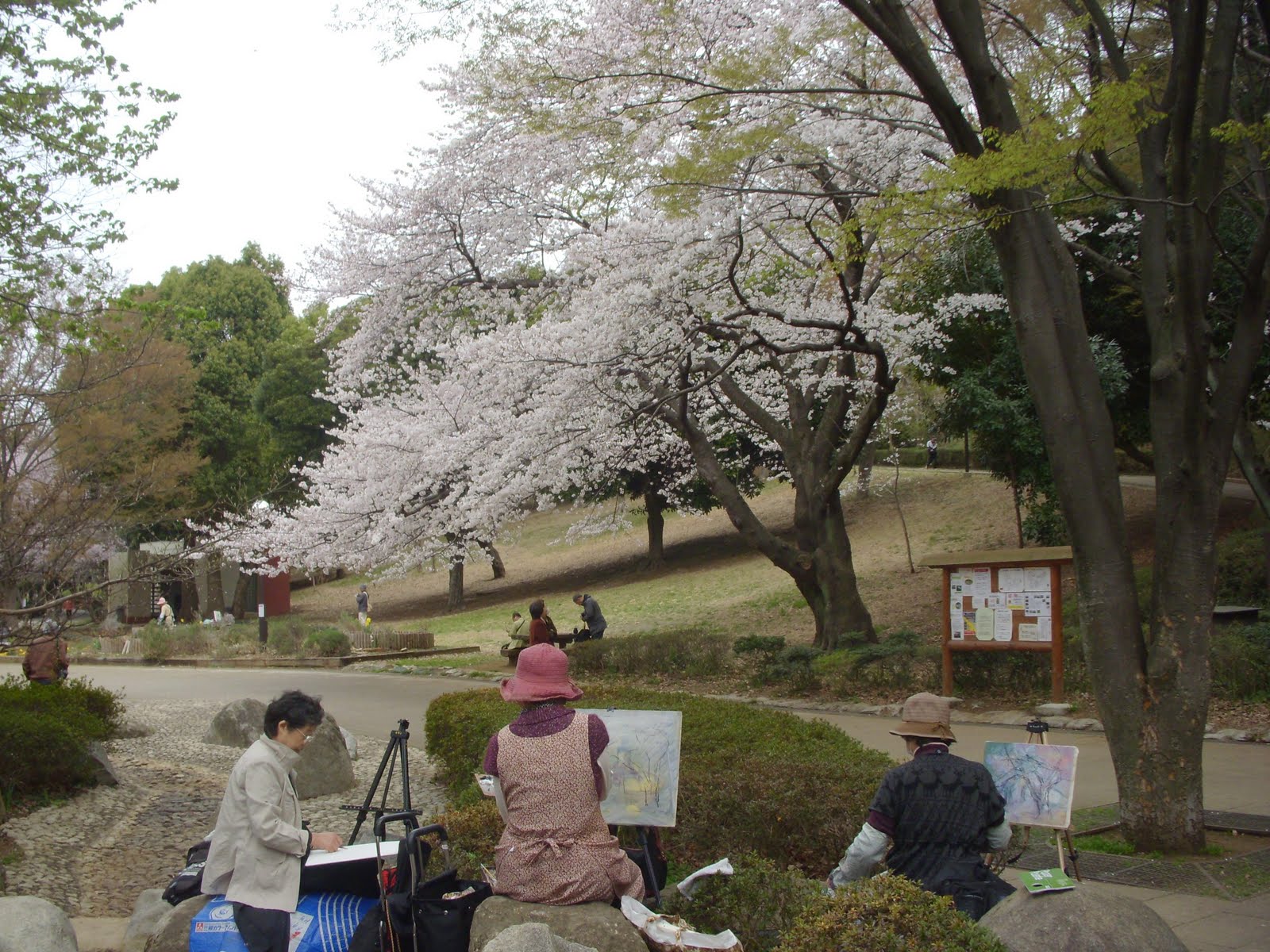
The hanami crowd on Thursday was about one-tenth the size of the Sunday crowd and tended toward artists, photographers, and dog-walkers.  Weather and Sunshine took hundreds of pictures of cherry blossoms.  Bossy took hundreds of pictures of artists, photographers, and dog-walkers. 


A professional photo shoot under a weeping cherry tree
My favorite photographer

Friday, February 25, 2011

Random Mito Stuff: And Therein Lies a Tail

There is lots more to Mito than gardens and black swans. While my friends were snapping artsy nature pictures with their 50-pound, professional calibre cameras, I pointed the remnants of my little pocket Nikon at little vignettes I found amusing. I am easily amused.

Rabble Rouser pitches in at a mochi booth

And we thought Mel was spoiled . . .

The Three Stooges: Fearless, Weather, and Rabble Rouser

I can personally vouch for the plum flavor (pink)

The Plum Blossom Princesses

Where do you suppose she found that tail?  I know a few young ladies who could use one.

I would really like to show you what my pocket Nikon looks like these days but I can't take a picture of it with my newer and fancier little Nikon because the shutter refuses to open. Apparently I dribbled plum-flavored ice cream on it . . .

Tuesday, February 22, 2011

Plum Blossoms at Kai-raku-en

High on a hill overlooking the town of Mito in Ibaraki Prefecture, one hundred kilometers northwest of Tokyo, there's a plum orchard shouting, "Do not despair!  Spring will soon be here!"

More than 3,000 ume (plum) trees have been planted here since 1841.  Kairakuen, one of the three most acclaimed gardens in Japan, was the brainchild of Tokugawa Nariaki, the ninth Lord of Mito.  Kairaku means "to share pleasure with people" and one of the significant aspects of this garden is that it was always meant to be shared with the common folk rather than reserved for the nobility's enjoyment.


We meant to visit Kairakuen on February 15 but a dusting of snow that morning scotched that idea. Thank God for that snowfall since postponing our adventure for a week landed us in Mito during the annual Plum Festival.

Where there's a festival, there is always festival food.  The paths leading to the garden were littered with vendors offering all sorts of tasty treats. Alas, there were not any potatornadoes to be found, but a fried beef cutlet and plum-flavored ice cream consoled my taste buds. 


Steel yourself. You'll be seeing at least three more posts somehow related to Kairakuen.

Tuesday, May 4, 2010

In Search of Wisteria

It's Greenery Day, the second of three consecutive Golden Week holidays (yesterday was Constitution Day and tomorrow is Children's Day). Today half the population of Japan will be visiting parks and gardens to admire nature's gifts. Make that half the population of Japan plus a half dozen batty American women who are always in the market for a good adventure, especially one that entails being packed like an upright sardine in a train car for 90 minutes.

Our destination is Jindai Botanical Garden in Tokyo where we hope to see lots and lots of many varieties of wisteria. Or maybe we'll go to Koshigaya in Saitama Prefecture north of Tokyo to see wisteria drooping over the river. My flower guide book and two sets of train directions are in my bag. I'd tuck my knitting in there too but there's little chance I'll find space to move my wrists on a train today.

LinkWithin

Related Posts with Thumbnails