Saturday, November 12, 2011

Yokohama Quilt Show: Through a Magnifying Glass

American readers might be surprised to hear that roughly ninety-seven percent of the quilts accepted for display at the Yokohama Quilt Festival were stitched by hand.

This boggles my mind.

Today I'm sharing photographs of three of those hand-stitched quilts together with close-ups to give you an idea of the exquisite artistry involved.

If this one isn't called "Rally 'Round the Flag", it should be.
An Elfish USA?
One of three quilts created by Russian children in memory of tsunami victims

I'm pretty sure they had help from their mothers

According to Artistic, compasses are particularly difficult
"Start of Things in Yokohama" highlights the city's history

Someone spent a lot of time embroidering historical artifacts

The creativity of these people fascinates me. How hard is it to sew a straight line? Stay tuned and you'll soon find out.

Friday, November 11, 2011

Yokohama Quilt Show: If These Don't Inspire Me, Nothing Will

If quilts aren't your thing, tune out right now and don't come back for a couple of days. As usual, I snapped pictures of every amateur quilt at the Yokohama Quilt Festival. I would have captured the professional quilts as well but those security guards were shadowing me all day.

The "Comfort Quilts from Around Japan" exhibit consumed a lot of my time and a corresponding amount of space on that little plastic card in my camera. Since I'm going to become a grandmother in the Year of the Dragon, the baby quilts seemed even more fascinating than usual. Surely a baby is all the motivation I need to finally try to create a quilt myself. Cribs aren't all that big so this seems like a perfect project for a beginner.

By the time I'm 90, maybe I'll be able to hand-quilt hearts like these.

The 3D triangle border sure is cute

Simple squares and lots of different fabric--I think I can do this
Maybe my tenth grandchild will get an umbrella quilt

The "Memory Quilts" exhibit was also fun. If I run out of grandchildren, I suppose I could whip up a little quilt for my (only) favorite dog, Mel.

Three ladies were mesmerized with this quilt depicting plates and dolls displayed in a hutch. They stood right in front of it for over twenty minutes, at which point I settled for a sidelong picture. A quilt like this would be a perfect way to use all the random pieces of fabric in my stash although, let's face it, for now I need to be content with joining squares, rectangles, and an occasional triangle.

Sigh.

Thursday, November 10, 2011

Yokohama Quilt Show: One Block Wonder

A gargantuan quilt suspended from the ceiling

Today was opening day of this year's Yokohama Quilt Festival and we got to Minatomirai just after the doors opened. No way were we going to miss seeing Big Bird receive her prize for her "One Block Wonder". She was the only American quilter to get an award and one of the few non-Japanese prize winners, the others hailing from Taiwan.

Note that her sweater complements the quilt's colors.

A closer view of the quilt (above) might help explain its title. Big Bird pieced this quilt from a single length of fabric rather than using lots of different fabrics. She has a lot more self-restraint than someone else we all know, the person who can't walk out of a fabric store without at least a quarter meter of every fabric on offer.

Here she is twiddling her thumbs in the winner's circle a few minutes before the prizes were awarded. Note the pink sweater is the only item of clothing in the winner's circle that isn't black, dark blue, or grey. As if we wouldn't be able to spot her by her hair . . .

Our Japanese quilting friends helped celebrate the occasion

We are all so proud of Big Bird. Next week she's teaching interested Navy medicine spouses how to make a tote bag from four fat quarters of fabric. Not me, though. I am still working on the quilted purse Shinagawa-san taught us how to make last year.

Wednesday, November 9, 2011

An Autumn Stroll Through Verny Park

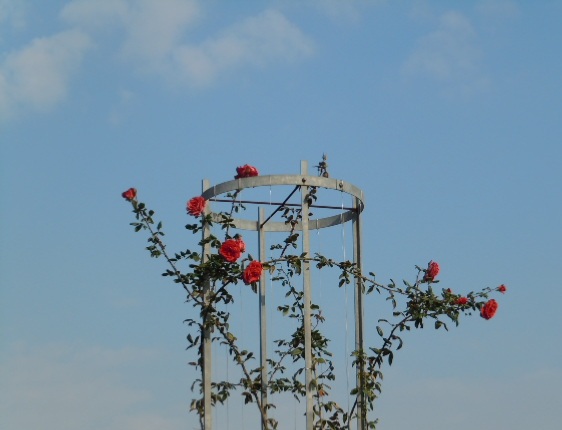
The blooming season here is fantastically long. There might be a stretch of three or four days between Christmas and the new year when pine trees take precedence, but otherwise there's always a flower or two offering bright splashes in the landscape.

Californians might take this perpetual color for granted, but a girl from Michigan enroute from the Navy base to the JR train station stops dead in her tracks when she spots floral abundance in mid-November.  And a girl from "The Rose City" can't help but gawk at Verny Park roses re-blooming just two weeks before Thanksgiving.  Back home we'd be begging someone to rub linament on our aching back after a day of raking leaves around about now.

"Reach for the sky, Pardner!"

A typically cloudless day

How fortunate that my camera was in my purse, and actually charged for once, and that I wasn't in a hurry the last time I had a JR train to catch.

Tuesday, November 8, 2011

In Celebration of Children: Shichi Go San

A three-year old near Toshogu in Nikko
The Shichi Go San or 7-5-3 Festival is one of my favorite Japanese traditions. Boys who are 3 and 5 years old, and girls who are 3 and 7 are taken to a shinto shrine, often in their first kimono, and the parents pray for their continuing good health and prosperity.   The parents of this little girl kindly allowed me to take her picture when I spotted them exiting the shrine.

In feudal times, Japan's high childhood mortality rate was blamed on evil spirits.  When children reached the ages of 3, 5, and 7 (three and seven are especially lucky numbers here), the parents would thank the gods for protecting their offspring. 

See the bag the little girl is clutching in her right hand?  A sweet candy called chitose-ame is often given to the children in a bag decorated with cranes and turtles, symbols of longevity.

Remind me to pick up some crane and turtle washi paper before I leave Japan.  I'm sure my future grandchildren won't complain about getting bags of candy after I dress them in kimono and make them stand in front of the church on their birthdays.

Monday, November 7, 2011

"Believing in the Power of Flowers"

Artistic wanted to see the Sogetsu Exhibition -- the 93rd annual exhibition, no less -- at the Takashimaya department store in Nihombashi last Friday. I tagged along because (a) I never turn down a chance to scoot up to Tokyo and (b) I couldn't help but wonder how the Sogetsu school of Ikebana flower arranging had evolved since the 90th annual exhibition which my sister and I somewhat accidentally visited on her first trip to Japan.

Artistic is a student of Sogetsu, she takes classes here on base and is determined to achieve a new level before her family departs Japan. From what I can surmise, Japanese flower arranging is something like martial arts but she's aiming for a new level rather than a colorful belt.

While she remembered to charge her camera, my Nikon battery went into a coma about 30 meters into the first of about ten exhibition rooms. Still, I think these pictures will give you the gist of what we saw.

A slightly obscene bamboo arrangement

Vertical Moss with Jutting Branch (The "Gonzo" Arrangement)

All kidding aside, it was an inspiring exhibition. So inspiring, in fact, that I invested in a "Beginner's Guide to Ikebana" before leaving the store. And the next day, while strolling across the base just after the grounds crew trimmed the hedges, I picked up a cute little branch sporting three red berries and stuck it in a vase that's now perched cheerfully on my kitchen window sill.

Not that the Ancient Mariner has noticed.

Sunday, November 6, 2011

Tokugawa's Tomb and the Worst Job in Japan: Nikko, Part 5

The tomb of Ieyasu Tokugawa is at the top of a heavily wooded hill. You must climb two hundred and seven stone steps to get there. (The guidebook says 200 but Ouiser counted otherwise.)

Vending machines are everywhere in Japan and the tomb is no exception. I stopped complaining about the steps after I passed a middle-aged man who apparently is responsible for restocking those machines.

Bless his heart!
Copper gate guarding the tomb
The copper tomb sits in the center of a quiet clearing. The unpretentiousness of the tomb and setting, especially after all those ornate wood carvings, reminds me of Robert Kennedy's grave in Arlington Cemetery.

Circling the tomb, we notice a small crowd gathered at the base of a hollow tree. Mineko tells us the tree is thought to be something like a prayer amplifier so we stand in line to pray for our children and future grandchildren.
Ieyasu Tokugawa's Tomb

Before we leave Toshogu Shrine, Mineko takes me into a building, the Yakushi-doh, that has a dragon painted on the ceiling. A monk gives a brief lecture about the history of that painting (I can only assume since the lecture was in Japanese) and then strikes wooden clappers so we can hear the sound of the dragon crying. Cameras are not allowed in the Yakushi-doh or I would show you what a crying dragon looks like.

Enough of Nikko. I have a zillion more pictures to share but I'll save them for later, for those days when I forget to charge my camera.

LinkWithin

Related Posts with Thumbnails