Verbosity tends to be a natural by-product of any adventure with Ishii-
san. She chooses such interesting places with tantalizing histories that I never come home without a hundred photographs or a hankering to research the heck out of what she's shown me. Right now I have no idea how many posts today's outing to Yokohama's Noge neighborhood will demand but I know it will be more than two.
Our adventure started out as a simple quest for pie. Ishii-
san wanted to visit that pie shop adjacent to Sakuragicho station where the Ancient Mariner, College Boy, and I infamously sampled five different wedges a few months back. But we couldn't just make a beeline for dessert. Absolutely not. We were going to
earn our pie wedges.
Sometimes I think Ishii-
san might be my mother reincarnated. Maybe that's why I'm so fond of her.
She decided we would visit the pie shop via Yokohama's most famous temple and most famous shrine. We hopped off the express train in Kamiooka and dashed across the platform to a local train going in the same direction, toward central Yokohama. Disembarking at Hinedoche station, just a few stops up the line, we started walking toward Landmark Tower.
Just when things were starting to look familiar -- "This is the same route Kaji-
san took to the Yokohama Quilt Show last November, when I first saw the pie shop!" -- we turned left into a narrow lane and then left again into a slightly less narrow lane. Straight ahead of us was Enmei-in, also called Narita-san Yokohama Temple since it's a sister temple of Chiba Prefecture's Narita Shinsoji Temple which is a major temple of the Buddhist Shingon sect. Local residents call it Nogeyama Fudoson which I'm betting loosely translates to "at the top of Heart Attack Hill in Noge".
 |
| Ishii-san ponders the fork in the road |
We could have marched straight up those cement steps to the temple but chose the scenic route through the door on the left instead. The scenic route offers a staged ascent past fascinating lava outcroppings and scores of very old statues and tablets. A great deal of red paint is in evidence, probably to make the inscriptions easier to read (assuming, of course, that one can read Japanese).
The temple was originally built in 1870 in Ota-mura and was moved to its present hilltop location in 1893. According to every description in English I managed to find, people visit this temple to ward off evils and bad omens and bring about better fortune and career promotions. The
torii near the pond at the base of the hill and the statues, especially the main statue - Fudomyoo -- are thought to be the main attractions.
Yet it was the
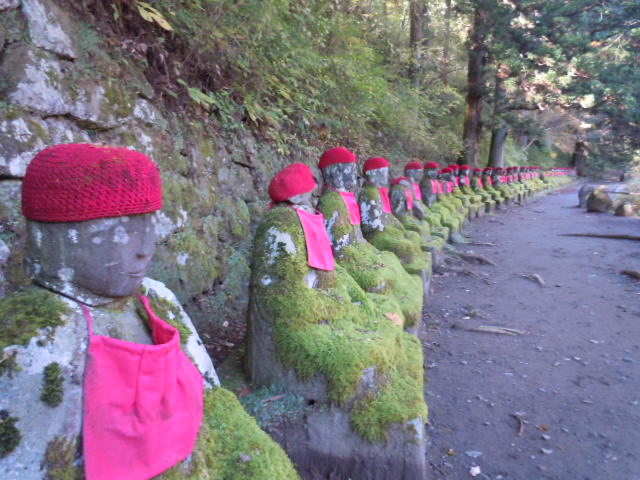
Jizo statues that captured my attention and heart. How is no one has mentioned them? This Bosatsu, known in Japan as as O-Jizo-Sama or Jizo-san, is the patron of children, expectant mothers, firemen, travelers, pilgrims and aborted or miscarried babies. I never expected to see a
Jizo display to rival the one at Hase-dera in Kamakura but Enmei-in absolutely takes the prize.
An elderly woman chanted a prayer while ladling water over the stone heads of three infants clambering up this statue in an alcove decorated with colorful pinwheels. Ishii-
san supposes the lady lost a baby. I feel so sad but I can't stop watching the woman. I want to pray with her. I want to know if she's praying for her child, grandchild, or great-grandchild.
We move along to the other small shrines arranged along the sidewalk in front of the temple and the elderly woman seems to be following us. She tosses a coin in the money box at each altar and says another prayer. She does not seem the least bit bothered by our presence.
One of the small shrines holds a display of six
Jizo. Ishii-
san tells me that each of these is assigned to one of the six realms of existence. Buddhists believe that all living beings are born into one of these six realms and are doomed to death and rebirth in a recurring cycle unless they can break free from desire and attain enlightenment.
Jizo vowed to relieve the suffering souls in each realm and this is why they are often shown in groups of six (
Roku Jizo).
The six realms, from worst to best, are: hell, hungry ghosts, animals, bellicose demons, humans,and heavenly beings.
Worship of the Six Jizō can be traced back to the 11th century in Japan, and specifically to the Shingon sect, but this grouping has no basis in Mahayana scripture or in the writings of Buddhist clergy.
Stay tuned for some of my favorite
Jizo.