Monday, April 18, 2011

Imado Shrine: Beckoning Cats and Happy Marriages

Our original destination, the fourth stop on our shichifukujin pilgrimage, was Imado Shrine.  The lucky god with the cone-shaped head, Fukurokuju, is enshrined here.  He is the god of happiness, wealth, and longevity.  But Imado Shrine is most famous as a legendary birthplace of  Manekineko, the beckoning good fortune cat, one of the most treasured good luck items in Japan.

Manekineko is the subject of a number of legends. Here are three of the most popular:

The Temple Cat: A wealthy feudal lord taking shelter under a tree near Gotoku-ji temple (in Western Tokyo) during a thunderstorm saw the temple priest's cat beckoning to him and followed.  A moment later the tree was struck by lightning. The wealthy man became friends with the poor priest and the temple became prosperous. When the cat died, the first Manekineko was made in his honor.

The Courtesan: A courtesan named Usugumo, living in Yoshiwara, in eastern Tokyo, kept a cat, much beloved by her. One night the cat began tugging at her kimono. No matter what she did, the cat persisted. The owner of the brothel saw this, and believing the cat bewitched, cut its head off. The cat's head then flew to the ceiling where it killed a snake, ready at any moment to strike. Usugumo was devastated by the death of her companion. To cheer her up, one of her customers made her a wooden likeness of her cat as a gift.  (I don't know about you, but seeing my cat's decapitated head fly to the ceiling would have given me a heart attack.)

The Old Woman: An old woman living in Imado (eastern Tokyo) was forced to sell her cat due to extreme poverty. Afterwards the cat appeared to her in a dream and told her to make its image in clay. She did as instructed, and then sold the statue. She then made more, and people continued to buy them. They were so popular she soon became prosperous and wealthy.  (This is the shrine we visited and statue makers continue to prosper today thanks mainly to Shinagawa-san whose cat statue collection rivals my Peko-chan collection.)

Right paws raised mean "bring money in".  The male cat has black spots.

Thousands of prayers for love and marriage
The small wooden plaques pictured above are called ema. Shinto worshippers write their prayers or wishes on these plaques and then hang them at the shrine.  In ancient times people would donate horses to the shrines for good favor, over time this custom was transformed to a wooden plaque with a picture of a horse, and later still to the various wooden plaques sold today for the same purpose.  Sales of ema help support the shrine.  Most ema I've seen cost 500 yen, or about $6 these days.

Sunday, April 17, 2011

Asakusa Pilgrimage: Cutpurses, Radishes, and a Garden Oasis

Honryuin is the actual name of the temple listed as Matsuchiyama-shouten on our pilgrimage map. I mention this in case you visit Tokyo some day and want to visit the temple's peaceful garden on a little hillside just west of the Sumida River.
Weather-san and Shinagawa-san at Matsuchiyama-shouten
Two (other) middle-aged ladies wandering around the garden when we were there pulled Shinagawa-san and Tomoko-san aside while Weather and I feasted our eyes on pink cherry blossoms floating against a background of red maples and restful green stuff. There was a little waterfall off in a corner trickling into a pond at the center of the garden. I am beginning to understand why my gardening friends are so enamored with "water features".

Those two (other) middle-aged ladies were quite a Godsend as they told us about a garden behind the five-story pagoda at Sensoji that is open to the public only a few days a year and one of those few days is today. Our circuit will end back at Sensoji so this is fortuitous news. But we are worried that such a diversion will cause Shinagawa-san to miss an appointment with her computer repairman. One peek at her face tells me that, computer repairman or not, we will not be returning to Yokosuka until we have seen that special garden.
Weeping cherry, red maple, and waterfall
We visit the temple after exiting the garden.  We watch a lady pick up an enormous Daikon (Japanese radish that resembles a fat white carrot) at a booth halfway up the path.  She pays the cashier 200 yen and then marches up the steps and into the temple.

Daikon and kinchaku (money bags) are the temple's special prayer items.  The lanterns on the walk circling the temple are decorated with forked radishes and money bags.  Apparently the forked radish represents a health family unit and a money bag is a symbol for business success. 

We slip off our shoes, congratulate ourselves on remembering to wear shoes that don't tie, and enter the temple.  A benefit of exploring with our Japanese friends is that they encourage us to walk through doors we would be hesitant to open on our own.

Inside the temple there are a few people kneeling or sitting on the floor reading or praying.  About a dozen radishes and half a dozen bouquets of flowers are lined up on the step leading up to the altar area.  I am dying to take a picture for you but manage to control myself.

Money bag on lantern

Daikon radishes on lantern
On one of the two dozen websites I perused while preparing this post, I read that the radish represents hate and ambivalence. You hold the radish and pray to purify your mind, strengthen your body, and bless your family with happiness.  These strike me as worthy objects of prayer no matter what I might be holding.

What strikes me even more is the number of people praying in that temple on a Wednesday morning.  Is it because of the earthquake/tsunami/radiation or are they there every day?

Saturday, April 16, 2011

A Lenten Pilgrimage Featuring the Seven Gods of Fortune and a Partial Rosary

I spent a lot of time watching cartoons as a kid. One of my favorite visuals from that era is the snowball that gets bigger and bigger as it rolls down a mountainside. Maybe the reason I liked watching that snowball's size and momentum grow is that I imagined one of my family members, whichever one had tattled on me most recently, standing at the bottom of the mountain just where the cartoonist positioned Wile E. Coyote. In my defense, I never imagined an anvil dropping on any of their heads. I've always considered myself a slightly over-sensitive pacifist.

Our trip to Asakusa in Tokyo this week was a good snowball.  Weather Explorer got wind of a shrine not far from Sensoji famous for happy cats.  Since our friend Shinagawa-san has quite a collection of happy cats, Weather and I thought she might enjoy visiting that shrine.  I'll tell you more about those happy cats when we actually get to the Imado Shrine which won't be today.  The snowball has to roll about halfway down the mountainside before we reach the Imado Shrine.

The three of us squeezed into the first car of the train that left Yokosuka-chuo station shortly before 9:00 am.  The trains are more crowded since the earthquake because they are shorter.  I think this has something to do with energy conservation.  A 12-car train on March 10 is now an 8-car train but as many people are riding the trains so they tend to be squishy.  Squishy doesn't bother me the way it bothers some Americans, and Weather and I rarely have to stand past Yokohama because we have developed keen eyes for seats about to be vacated and quick reflexes.  A facial expression that combines innocence and cluelessness is also helpful when you're trying to beat a young salaryman out of a seat.

Tomoko-san was waiting on the platform when our train pulled into Yokohama.  The trains here always stop in the exact same place next to the platform so Tomoko-san only had to take two steps forward to join us in the first car.  She pulled out a little map and that snowball started rolling down the mountainside.

What's not to like about maps?  The one Tomoko-san was clutching was about as intriguing as a map can get.  It charted a pilgrimage to the shichi-fukujin (Seven Gods of Fortune aka the Seven Lucky Gods).  Our original destination, the Imado Shrine, was number four on the proposed pilgrimage so how could we possibly resist turning our little outing into a hatsumode (which I think means pilgrimage)?  This tradition began in the Edo era all across Japan when the common people who believed in the power of these gods to bring good luck and happiness began making circuits shortly after the new year.  The Asakusa circuit we followed was popular until the beginning of World War II.

It being Lent and all, I opted to view the shrines and temples on the circuit as "stations" on the order of "Stations of the Cross".  I said a Hail Mary at each shrine and temple after tossing a coin into the money receptacle.  Call me ecumenical.  And brace yourself for a summary that just might take as long to read as we spent on our pilgrimage.
 
Shinagawa-san, Weather, and Tomoko-san at Sensoji
Daikoku-ten was the first god we visited. We found him in a little garden off to the left of the main hall at Sensoji. Daikoku-ten is the god of wealth, commerce, and trade. He is often paired with Ebisu on the walls of small retail shops.

Asakusa Shrine for Ebisu (the god, not the beer)
We found Ebisu, the god of fishermen or merchants, at Asakusa Shrine, to the right of Sensoji's main hall. Ebisu is the happy chap who graces the Japanese beer of the same name, my personal favorite. He is usually shown holding a big fish which my sources tell me is a sea bream.

The Asakusa Shrine was erected in memory of the fishermen who are believed to have found the large statue which is the focal point of Sensoji Temple. As we were approaching the shrine, Tomoko-san taught me something new. She told me to walk on the side of the path leading to the shrine rather than the center. The center of the path is apparently reserved for the shinto gods. Walking on the side of the path is not required when approaching a temple. Apparently Buddha is more casual than the gods in the Shinto pantheon.
After an interesting little ramble along the Sumidagawa (Sumida River) which will be the subject of a separate post so as not to confuse you, we entered the incredible grounds of Matsuchiyama-shouten. Shinagawa-san taught me that "-shouten" is the suffix denoting a combination shrine and temple.

Matsuchiyama-shouten is the home of Bishamonten, the god of warriors.

The temple is on the top of a small hill but we took a quick right halfway up the hill to explore a lovely garden before poking our noses in the temple. Tune in tomorrow if you want to glimpse that garden and continue on our pilgrimage.

Friday, April 15, 2011

Mitsuike Park: More Than Cherry Blossoms

While uploading my Mitsuike Park hanami pictures from Thursday and Sunday, I found as many pictures of children as of cherry blossoms. Here is my pictorial evidence that Yokohama parents are not very concerned about air-borne radiation.

A Preschool Field Trip on Thursday

A baseball game on Sunday

The playground on Sunday.  That's a very long slide on the right.

A better shot of the slide
The top of the slide

Feeding the fish
The wide slide on Thursday

The wide slide on Sunday

A badminton date

If I could do this, I could use a Japanese toilet

This kid has a remarkable throwing arm. 

The path around the pond is measured for runners.

Thursday, April 14, 2011

Hanami at Mitsuike Park

Mitsuike Park is located in Yokohama's Tsurumi Ward. It's about a forty-minute walk from the Tsurimi JR station if you turn left rather than right at the top of the first mountain range.  But if Bossy Pied Piper is holding the map, you can count on spending at least an hour wandering over hill and dale.

Four kind strangers merit thanks for steering us in the right direction:  an elderly gentleman walking his dog, a perky young lady out for a stroll, and two middle-aged ladies who let us follow them.  While Bossy might have trouble reading a map now and then, she has a good eye for picking out polite and helpful Japanese citizens.  This is probably because every Japanese citizen is polite and helpful.

Weather and Sunshine never, ever complain when I march them three miles in the wrong direction.  This time their reward was a stop at Takano Fruit Parlor for chocolate parfaits on the way back to Yokosuka.  My children should take note of this "Never Complain = Chocolate Parfait" scenario.


The park has three entrances. I'm fairly certain we approached the park from the west but I'm not willing to swear this on a stack of Bibles since Japanese maps are not always oriented with north at the top. The park is located in a valley and I know for certain that we entered from above. Those nice middle-aged ladies pointed us toward the upper path and then hightailed it down steep steps to the lower level, leaving us to our own devices. We took their advice.


When I returned to the park with Ishii-san three days later, I learned two things: Mitsuike means "three ponds" and a ten-minute bus ride from the train station to the park costs 210 yen. The ponds are girded with paths and there are lots of other paths at higher elevations.  The park is enormous. 

A view from a lower path

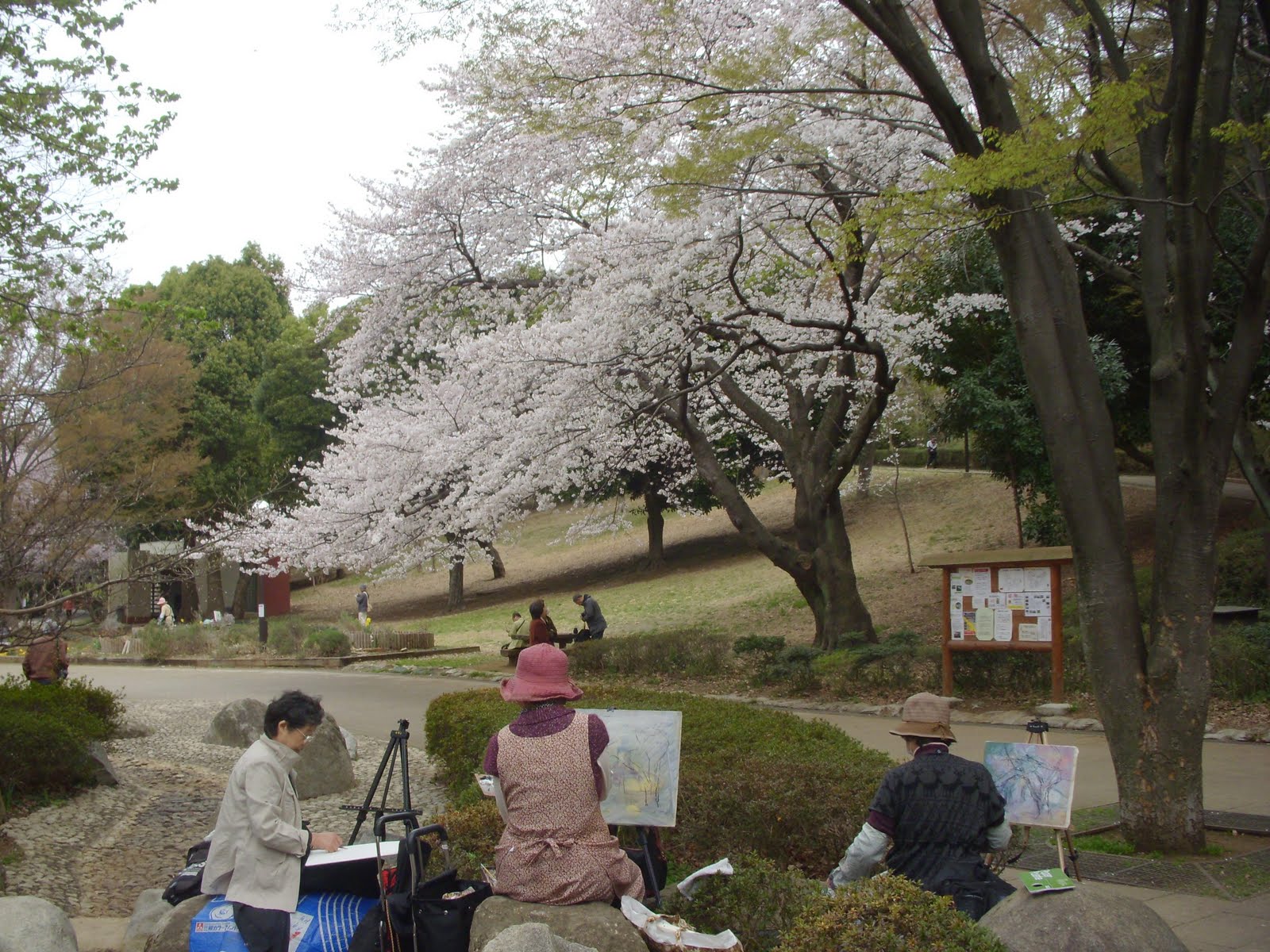
The hanami crowd on Thursday was about one-tenth the size of the Sunday crowd and tended toward artists, photographers, and dog-walkers.  Weather and Sunshine took hundreds of pictures of cherry blossoms.  Bossy took hundreds of pictures of artists, photographers, and dog-walkers. 


A professional photo shoot under a weeping cherry tree
My favorite photographer

Wednesday, April 13, 2011

Counting Down to Sakura Fubuki

Pardon me for keeping you hanging. Those cherry blossoms in seemingly infinite varieties have been occupying my days and getting to the last page of A Girl in a Blue Dress before the Japanese Book Club meets tomorrow has occupied my evenings.

Tomorrow or the next day I'll start sorting the scores of photographs Weather Explorer and I snapped at Mitsuike Park last Thursday.  Mitsuike Park was one of Yokohama's best kept secrets until I saw it mentioned on a cherry blossom website a few weeks back.  The helpful clerks at the tourist information center in Yokohama Station were speechless when we poked our heads in the door in search of directions to the park but they rallied and came up with a Japanese map that gave us a vague idea of how to get there.  Prepare yourself for a long story; I was so smitten with the park that I went back three days later with Ishii-san in tow.

There's little chance I'll get all my favorite cherry blossom pictures posted before sakura fubuki time. That's the Japanese expression for "cherry blossom storm" when the petals cascade from the trees with every gentle puff of wind.

As a bit of respite for your eyes before I barrage you with more pink, pink, pink, here are two more pictures I admired at the Sogenkai Exhibit last week.


The Ancient Mariner puttered into port Monday in time to experience a few significant aftershocks. He's admired the new kitchen faucet and refrigerator and is starting to wonder when I plan to replace the owner's manual in the latter with something edible. Hopefully I'll get around to that before he vanishes over the horizon again less than two weeks from now.

Saturday, April 9, 2011

Hanami at Tadodai House

Returning to the scene of the crime, an expression familiar to mystery fans, is just what Weather Explorer and I did Friday morning. Except Weather Explorer was not guilty of any crime the last time we visited Tadodai House to view cherry blossoms. The party who imbibed three tall glasses of hot sake on a chilly spring evening in 2010 was me.

This year we experienced hanami in the morning, the weather was much more obliging, and the hot sake was noticeably missing. The only similarity between this year and last, in fact, was the Ancient Mariner's absence.  He has the misfortune to spend the loveliest part of the year floating around the Pacific Ocean and Sea of Japan aboard the USS Blue Ridge. But rumor has it that he'll be back in two days to catch the tail end of this year's cherry blossoms. Be still my heart.

Hiroko, Yoko, Hisayo, Weather, Tomoko, Yuuko


Just when I was thinking life doesn't get any better than this, a group of preschoolers marched around the corner of the Tadodai House and life quickly got better than this. Their teachers lined them up under the spreading branches of a cherry tree for class pictures. The five-year olds wore blue hats, the four-year olds were in yellow, and the littlest cuties -- the three-year olds -- sported green caps.


Weather and Bossy entertain the adorable little moppets

Weather and I were expecting to head for a local restaurant with our friends after we'd had our fill of cherry blossoms. Much to our surprise, they marched us out the gate and up the next driveway to the home of the Yokosuka District Commandant of the Japanese Maritime Self-Defense Force where Takashima-san hosted a lovely and bountiful luncheon for about a dozen current and former JAW members.


I tasted food I've never tried before -- mochi, a Korean casserole with radishes so large I thought they were potatoes, and a delicious salmon salad with cabbage and corn -- and was seated next to a very sweet lady who shares my love of books. She is the first person I've met who's read the Japanese thriller Out besides my sister and me. Simply having that book in common made me feel like I'd known her for several years rather than just an hour.

What a blessing it is to have such hospitable friends.

LinkWithin

Related Posts with Thumbnails