Showing posts with label kimono. Show all posts

Monday, November 14, 2011

Making a Kimono Scarf, Wherein Peevish Nearly Reprises the George H. W. Bush Vomiting Incident

Just when I was starting to envision a cushy post-Japan career as an overpaid State Department consultant, offering humble pearls of wisdom on international relations, reality arrived in the shape of a mushroom. Alas, it wasn't the cookie variety with a chocolate cap. It also wasn't a shiitake, but more on that later.

We went to Mineko's house today to transform kimono remnants into scarves.  The scarf at left is an example of the style I made. I can't show you mine because I still have three more seams to sew. By hand, so it might take me a few months.

Here's another example. We used black kimono fabric for the body of the scarf and then added swatches of colorful fabric. Artistic and Fearless were more ambitious.  (This is nothing new.)  Their scarves have about two dozen colorful squares running lengthwise.

Mineko folds furoshiki
Mineko treated us to a tea ceremony in the tatami room on the second floor of her house before we got started on those scarves. She had arranged four cushions on the floor and one stool. She invited me to sit on the stool. I was more relieved than embarrassed since kneeling on one of those cushions for longer than thirty seconds is sheer agony.

Artistic and Fearless assembling their masterpieces
While Misa and Yuko helped us with our scarves, Mineko bustled around her kitchen preparing an elaborate and educational lunch. This is when I learned that there are at least seven varieties of mushroom in Japan besides shiitake.

A bit of backstory: Mineko and I somehow touched on the topic of food preferences during last week's trip to Nikko. When I mentioned that Artistic is a vegetarian and that Fearless and I dislike mushrooms, Mineko asked, "Shiitake?" I assumed she meant "including Shiitake?" and said yes.

It seemed like a fairly reasonable assumption so I was surprised to open the foil packet on my plate and find a chunk of salmon covered with slender pale mushrooms. I surreptitiously scraped them off and hid them inside the re-folded foil while ignoring the silent laughter of Artistic to my immediate right and avoiding eye contact with Fearless across the table. Just when I was starting to congratulate myself on dodging a bullet, Mineko let loose a Gatling gun volley in the form of what looked like a macaroni-and-cheese casserole but, upon cutting, turned out to be a tofu-onion-mushroom medley topped with melted cheese. 

She served me three sizable squares of the casserole. I made quick work of the cheese and not so quick work of about half a square. When Mineko pointed out that I had not finished my casserole, the dish she had gone to such pains to make, I cast a desperate glance around the table and saw that Misa was the only other guest who had not licked her plate clean. Misa has undergone abdominal surgery and has the appetite of a sparrow. She also has about fifteen years on me, but I was willing to claim kindred elderhood to escape finishing my casserole. "Your appetite shrinks when you get older. Look at Misa's plate."

Yes, I am seriously ashamed of myself. That's why I'm not plugging in my sewing machine to finish my kimono scarf. Stitching by hand is my self-imposed penance for bad behavior.

Tuesday, October 18, 2011

Recycled Kimono Sale: The Map

More than two dozen American women congregated in the Kanagawa Community Relations Center this morning for the Fiber Recycle Network's semi-annual sale of used kimono, obis, and textile scraps. When the first 100 shoppers were admitted to the sale room at 10:00 am, we attacked those racks and tables like a swarm of locusts. 

This will be my final post about the Recycled Kimono Sale since I can't think of a single (valid) reason to attend the next sale (April 25, 2012), the last one before I move back to the United States.  Here is some advice for those of you who hope to experience this event when/if you have the chance to visit or reside in Japan.

First and foremost, there are enough kimono and obis for everyone.  Don't worry if you can't get to the sale early enough to snag one of those first 100 admission tickets.  The nice volunteers hang new items on the racks almost as quickly as you can pull a kimono off a hanger and stuff it in the large clear plastic bag you were handed just before you entered the room.  Customers are admitted in groups of 25-50 at fifteen or thirty minute intervals.

How can you find out when the sale will be held?  The date is listed on the Fiber Recycle Network webpage which is in Japanese but numbers are numbers and dates are dates so just check the bottom right corner of the webpage for the date.  You should be able to go directly to that webpage by clicking on the headline of this post.

When do you need to leave Yokosuka if you want to get your hands on one of those first admission tickets?  We never failed to be among the first 100 in line when we departed the bus shelter just inside Womble Gate at 7:30 am and hopped on an express train a few minutes before 8:00.  The limited express (green) trains don't start running until 8:30 am so you'll have to settle for a "red" train which will get you to Yokohama Station around 8:45.

Follow the signs to the West Exit.  You will walk two short blocks to the Kanagawa Community Relations Center (in the upper right corner of the map below).


You are most welcome.

Inside the Center, you will line up four abreast (left) until shortly after 9:00 am when a volunteer hands you a sheet of paper with a number stapled to it. Please pardon the poor photograph; I rode up and down those escalators twice to capture the gestalt for you. Once again, you are most welcome.

With number in hand, you will have time to grab a cup of coffee and cinnamon roll at the Starbucks on the second floor of More's next to Yokohama Station.  Perhaps the Starbucks will have moved back inside the train station by the time you get here.  Be flexible, but make sure you are back in line, four abreast, by 9:50 am.

Paying for your treasures
My previous post includes photographs from inside the sale room but I don't think I've shared pictures of the check-out process before.  Once you've filled that big plastic bag, head for the end of the room opposite the entrance and a volunteer will help you empty your treasures into a laundry basket.  She will direct you to one of the four tables staffed by volunteers who will bag your purchases and write the total amount due on that little piece of paper containing your admission number.  (Don't throw away the big piece of paper until you have scanned it for and memorized the date of the next sale if you want to avoid checking the website.)

The cashiers are seated at the last table before the room's exit.

It is almost impossible to spend more than forty-five minutes inside the sale.  If you stuff your bag with the most expensive kimono, you might manage to spend $150.  I've filled a bag with a dozen children's kimono that cost me less than $50 and sometimes I've spent less than $20. 


Some Americans take rolling suitcases to the sale to make it easier to lug their purchases home on the train. The suitcases are not allowed inside the sale room; ask a volunteer to show you the nook where you can store your suitcases while you are shopping. I prefer to transport my treasures in bags like that big patchwork number Big Bird is sporting in the above photograph. A bag looks less greedy than a suitcase to me but it's really a matter of personal preference and how much you want to "fit in" with the locals.

P.S. Speaking of Big Bird, have I told you that one of her fantastic quilts has been deemed award-winning by the Yokohama Quilt Show people? We are so proud of her and will be at the award ceremony in force on November 10.

Monday, October 3, 2011

Peeking a Gift Horse in the Mouth

There are families in the Tohoku region of Japan who for several generations have earned their livings making traditional doll clothing. They lost everything in the immediate aftermath of the March 11 earthquake. The tsunami washed all their supplies out to sea.

Hearing of their sad plight, my friend boxed up all her best obis and kimono. The boxes were crammed into a van and delivered to the doll company families near Fukushima.

She said she had many kimono and obis and scraps of kimono fabric that were not good enough to be included in her humanitarian shipment. She wondered if Fearless and I would be at all interested in taking them off her hands.

She didn't have to twist any arms.  But you already knew that, didn't you?

This morning we met for breakfast at Ble Dore. After we crammed as much fresh bread into our mouths as human beings can ingest in ninety minutes, we repaired to the parking lot to transfer the sixteen 30+ pound bags from her car to mine. But we could only squeeze ten of those gigantic bags into my trunk and back seat, so she followed us back to Yokosuka where Fearless fetched her van and we completed the transfer on a parking lot roof.

It was all a bit clandestine as she didn't want any elderly Japanese ladies to catch her passing her "smelly old kimono fabric" to foreigners.

Tomorrow night Fearless and I are going to sort through those sixteen bags and decide what to do with our plunder. Some of it will undoubtedly go to the spouse club thrift shop to raise money for local charities and we'll auction off something or other to the Seventh Fleet spouses to benefit the Relay for Life this weekend, but it sure would be swell if we could figure out a way to auction off some of it to directly benefit the earthquake/tsunami victims. The base regulations are rather rigid (ie, ridiculous) in that regard.

So far the Ancient Mariner and I have lugged four of those bags from the car to the house. I taken a quick peek for triage purposes: obis in the living room, fabric scraps in the family room, kimono in the dining room. Here is what I found at the top of one of those bags:


Smelly old kimono fabric indeed.

Tuesday, September 27, 2011

A Kimono Exhibition with Friends

A year ago this past May Matsuzaki-san took the Shonan Ladies to a kimono artist's studio on a Kamakura hilltop. That artist was Mitsuo Haruki and his works are currently on display in an ancient gallery in Kita-Kamakura. When Matsuzaki-san proposed visiting the exhibition today, how could I possibly say no?

My Norfolk neighbors probably couldn't pick me out in a police lineup, but Haruki-san's charming wife remembered me from our previous meeting. Being the oldest American woman in Japan -- by a landslide -- is a blessing and a curse but today I counted it a blessing and endeavored to comport myself in a somewhat dignified fashion. I even asked permission before snapping pictures. What I'm sharing here, the pictures I've spent the past three hours coaxing from my computer into this post, is just the tip of the iceberg.

The kimono featured in my May 22, 2010 post

Three old houses were connected sometime in the past to form the exhibit gallery. The building alone was worth the train fare if you are fond of ancient beams and charming courtyard gardens. I certainly am.

The first floor was devoted to Haruki-san's work - his preliminary sketches and kimono in various stages of completion -- while upstairs we found children's antique kimono, some more than a century old, lavish obis, and ornate dolls. The wall spaces not filled with kimono and obis held framed squares of Haruki-san's yuzen-dyed fabric.

Child's kimono from Taijo Era (1912-1926)

The antique kimono were displayed behind glass as were the obis. My favorite child's obi was this simple purple one from the late Meiji or early Taisho period; my apologies for the reflection in the glass.

This kimono began as a bolt of white silk
Detail of narcissis on right sleeve

One of the American Shonan Ladies interviewed Haruki-san shortly after we met him in May 2010. Her interesting article appeared in the Stars and Stripes. You can read it by clicking here.

Haruki-san and Fearless
The congenial artist draped pieces of his art across the shoulders of Fearless and Artistic but ignored my shoulders and looped an exquisite length of turquoise silk around my neck instead. Maybe he was tempted to choke me. I can think of worse ways to die.

Fearless doesn't mind having her picture taken. We're going to have to drag her along on more outings this year.


The obis were incredible. My favorite -- not this orange one -- was reversible with a traditional Japanese bridge and cherry blossoms on one side and cheerful contemporary patterns on the other.

Not my favorite, but you're getting warmer.
Here we go!  This is Side A.
Here's a tiny glimpse of Side B.

This is part of one of the staircases connecting one old house to another. Old wood speaks to me but I'm not sure what it's saying. (Here is where my mother, who was justifiably fond of her old oak staircase, would pipe up, "Please wipe me with Murphy's Soap!")

This is a closet door.  Excuse my drool.
The artist surrounded by his adoring fans
What a wonderful day in a long, long string of wonderful days.  I treasure every moment of these marvelous adventures with my American and Japanese friends.

Friday, April 29, 2011

The Sale of the Decade: Yet Another Reason to Visit Kamakura in May

Matsuzaki-san -- aka "Shonan Reiko" or "The Other Reiko" -- will close her shop near Kamakura station at the end of May. Weather and I arrived at the shop to pick up a special order today just minutes after the 50 percent off signs went up. Lucky us.

See the blank spot on the wall in the photo at left? The tote bag that was hanging there is now relaxing on my kitchen counter.

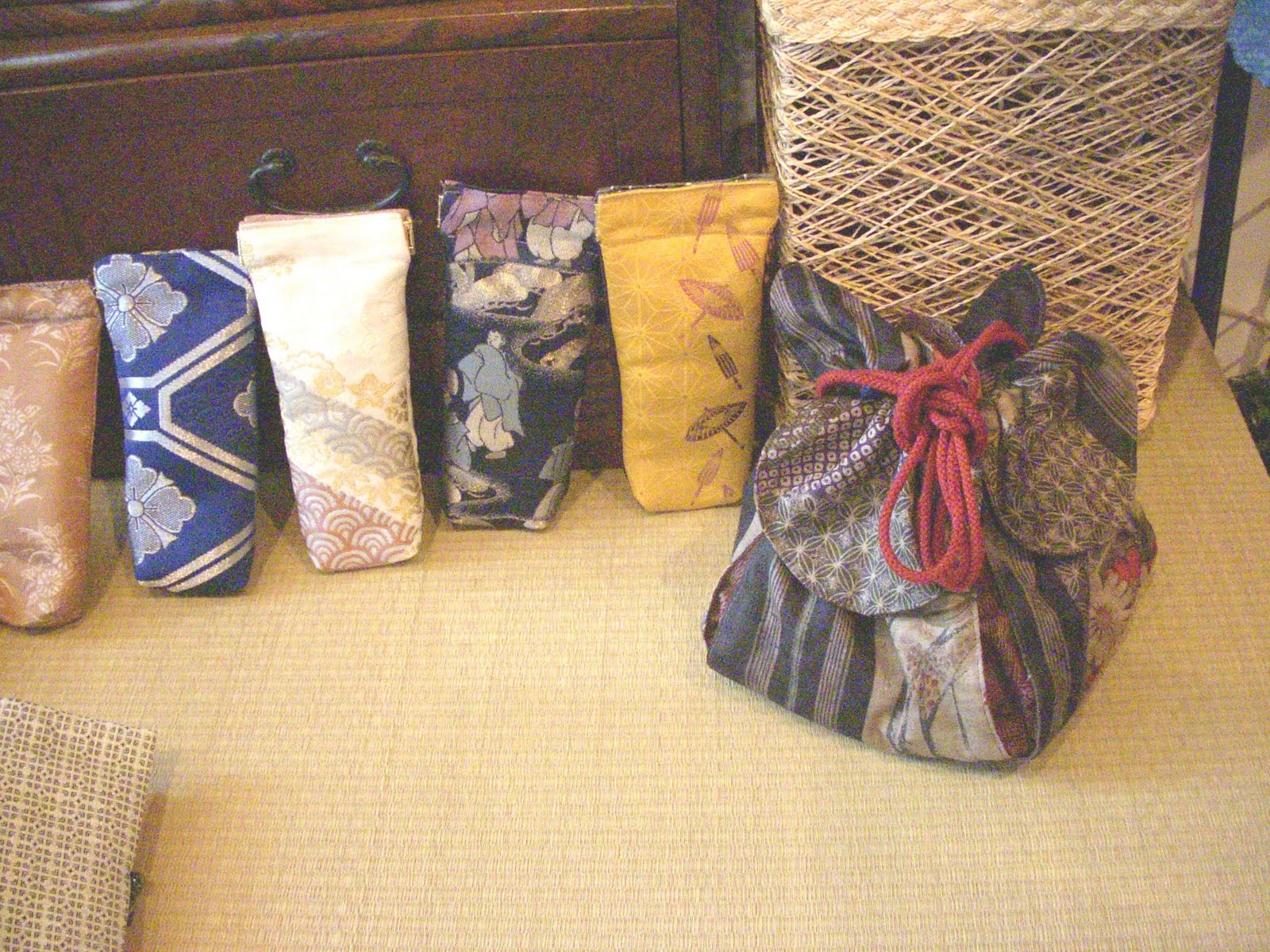
Matsuzaki-san specializes in transforming old kimono and obis into all manner of bags, book covers, cases, and clothing.  Among other things, she has turned a blue silk kimono into a stunning jacket for me and two obis into an amazing tote bag for Weather.  Next she will make placemats out of two obis that Weather nabbed at last week's recycled kimono sale.


Her son Yutaka, shown here wearing an aloha shirt Matsuzaki-san made from a samurai yukata, has managed the shop since it opened four years ago. Closing the shop will allow him to pursue other business interests and spend more time with his wife and their three-year old daughter. The terms of their lease have been onerous, especially for a two-person family operation, since their landlord requires that the shop be open all but five days a year.


Speaking of aloha shirts, did you know they were invented by Japanese people who took their kimono with them to Hawaii? They found the climate too warm for kimono so cut them up and sewed them back together as shirts.
 

If you want to take advantage of the sale, visit Kamakura between now and the end of May. The shop is on the second floor of the The Scene arcade building, on the same side of the street and just past the Peko-chan/Baskin-Robbins store. Take the stairway on your right to the second floor and the shop will be the first one you encounter. There's a live turtle in the window.

Otherwise, look for Matsuzaki-san at bazaars around our base.  The next one, sponsored by ATG, will be the first weekend in June.  The big Navy Exchange bazaar has been re-scheduled to late July.

Wednesday, April 27, 2011

Inside the Recycled Kimono Sale

I had no intention of buying even one tiny scrap of fabric at last week's version of the semi-annual recycled kimono sale in the Yokohama Community Center. This was my fourth recycled kimono sale and I already have more obis and kimono, not to mention random fabric, than I will ever put to good use. To entertain myself while my friends elbowed their way to the obi bins and snatched display kimono off the walls, I pulled out my camera so you, too, could experience the delightful frenzy of sale day.

Betty made a beeline for the 100-Yen bin

Weather prepares to snatch an obi from an unsuspecting elderly Japanese lady

The intact kimono are grouped by type
Then my eyes started to wander around the room.  The two racks of children's kimono and yukata were screaming my name.  Every little girl needs a kimono in her make-believe chest, right?  How many great-nieces under the age of ten do I have?  How tall are they? 

Let's just say I made a good start on my Christmas shopping.  And I can finish this project in plenty of time to meet the international mail deadline since the next recycled kimono sale is October 18.  Mark your calendars, Yokosuka peeps.

We introduced four Japanese ladies to the wonders of the sale this time around which made it especially fun.  As you can see, no one went home empty-handed.  Now what in the world am I going to do with this hunk of muslin I picked up for 50 yen?

Tuesday, November 2, 2010

Kimono and Obi Creations

Just around the corner from the Kamakura train station is La Mia, my friend Matsuzuki's shop and gallery. Matsuzuki transforms old kimono and obis into purses, book covers, coasters, and all manner of interesting clothing.

My path first crossed Matsuzuki's in the fall of 2006, shortly after I arrived in Japan. When it was the medical spouses' turn to host the monthly luncheon for all the officer spouses on base, my friend Ginny asked Matsuzuki to provide the entertainment. She showed us how to turn kimono scraps and sake cups into pincushions. The following spring I ran into her again at my first Shonan event. We've been friends ever since.

Last week I visited her shop with Mimi and Denise. Mimi had commissioned a skirt embellished with a fancy obi to wear to the hospital Christmas party. By the time left the shop, Denise had selected an obi for a skirt and a gold-colored kimono which Matsuzuki will turn into a blouse.

Matsuzuki also sells her creations at various bazaars on base but I prefer to visit her shop because I believe she should not have to share one-eighth of her profits, not counting the cost of renting booth space, with the Navy Exchange or any other organization. Some Americans, I suspect, do all their shopping at these bazaars and rarely venture off base. Just think what they are missing.

This jacket catches my eye while Mimi and Denise are being fitted.  With the exception of the three-quarter length sleeves, everything about it appeals to me. "Can you make me a jacket with wrist-length sleeves so I won't have to worry about what I wear underneath?" "Certainement!" Have I mentioned that Matsuzuki spent most of her childhood in France?

Which kimono ahould I choose for my jacket? My choices are especially plentiful because Matsuzuki and her friends have been cleaning their closets. The gallery is filled with basket upon basket of old kimono this week.

The pale blue kimono with turquoise lining speaks to me. It says, "You are getting on in years. Your kimono jacket will likely outlive you. This pale blue shade will look very nice on your sister and your daughter."

Look who's here! It's Hagiwara-san, another Shonan friend. She is shopping with her husband who is very handsome. You'll have to take my word on that, though, since I was so caught up with uttering the polite introduction syllables in their proper order that I didn't think to snap a photograph of him. Gomen nasai.

We had warned Matsuzuki in advance that we would be visiting her shop that day so she tasked her son with minding the store while we enjoyed a leisurely lunch. She took us to a lovely Chinese restaurant above the Enoden Line side of the train station.

The food and conversation were not all that was memorable about the lunch. Two little girls at the table next to us were all dressed up in kimono, perhaps celebrating 3-5-7 day two weeks early. Matsuzuki's explanation of the November 15 holiday differs from ones we've heard previously but makes eminent sense. Just a century or so ago, many children did not survive until their third birthday so the nation rejoiced over the ones who did. The nation rejoiced again when a child turned five and turned seven. Children who lived to the age of seven were considered likely to reach adulthood so further celebrations were not required.

Saturday, May 22, 2010

Dyed Again: Yuzen-zome with the Shonan Ladies

Last week it was shibori in my back yard, this week it was yuzen-zome high on a hill above Kamakura. No, I am not pursuing a graduate degree in textile dyeing. I'm just a girl who likes to have fun.

Izumi and Reiko took the Shonan Ladies to Mr. Haruki's charming studio a few doors down from Rin Rin Chinese restaurant. Mr. Haruki designs and paints fabric that is stitched into one-of-a-kind $40,000 kimono. He spends three years on each of his creations so this is not a terribly lucrative craft but Haruki-san does not seem to regret his career choice. On the contrary, he struck me as a walking advertisement for one of the most thought-provoking books I've read this year, Shop Class as Soulcraft: An Inquiry into the Value of Work. How much more satisfying it must be to shepherd a project from idea to finished product than to be a replaceable-every-two-years cog in the U.S. military machine.


Each kimono panel features Haruki's original drawings. He brought out a box of drawings used on previous kimono and let each of us select one as a memento of our visit. Some favored sketches of bamboo, plum branches, camellias, onions, and peonies but I chose irises to remind me of both my day at Haruki's studio and my day with Maeve and Jen at Shomyo-ji. Efficiently sentimental, if I do say so myself.


After Haruki completes his drawings and sketches them on a paper pattern, he paints them on silk panels coated with a paste of mashed soy beans that heightens the effect of the dye. There's really no way to ignore the amazing versatility of soy beans in this part of the world.

Upstairs, Meagan tried on a kimono-in-process and we met the adorable Mrs. Haruki who was sporting a jaunty beige beret and a handknit checkerboard vest similar to her husband's. Between Haruki's white hair - a rare sight in Japan - and that beret, I nearly drowned in a tsunami of nostalgia. If you're wondering why, please contact my prematurely grey brother and the third of his adoring goddaughters. I'm much too choked up right now to attempt an explanation.

LinkWithin

Related Posts with Thumbnails