Wednesday, May 2, 2012

Flat Stanley Visits a Tokyo Park

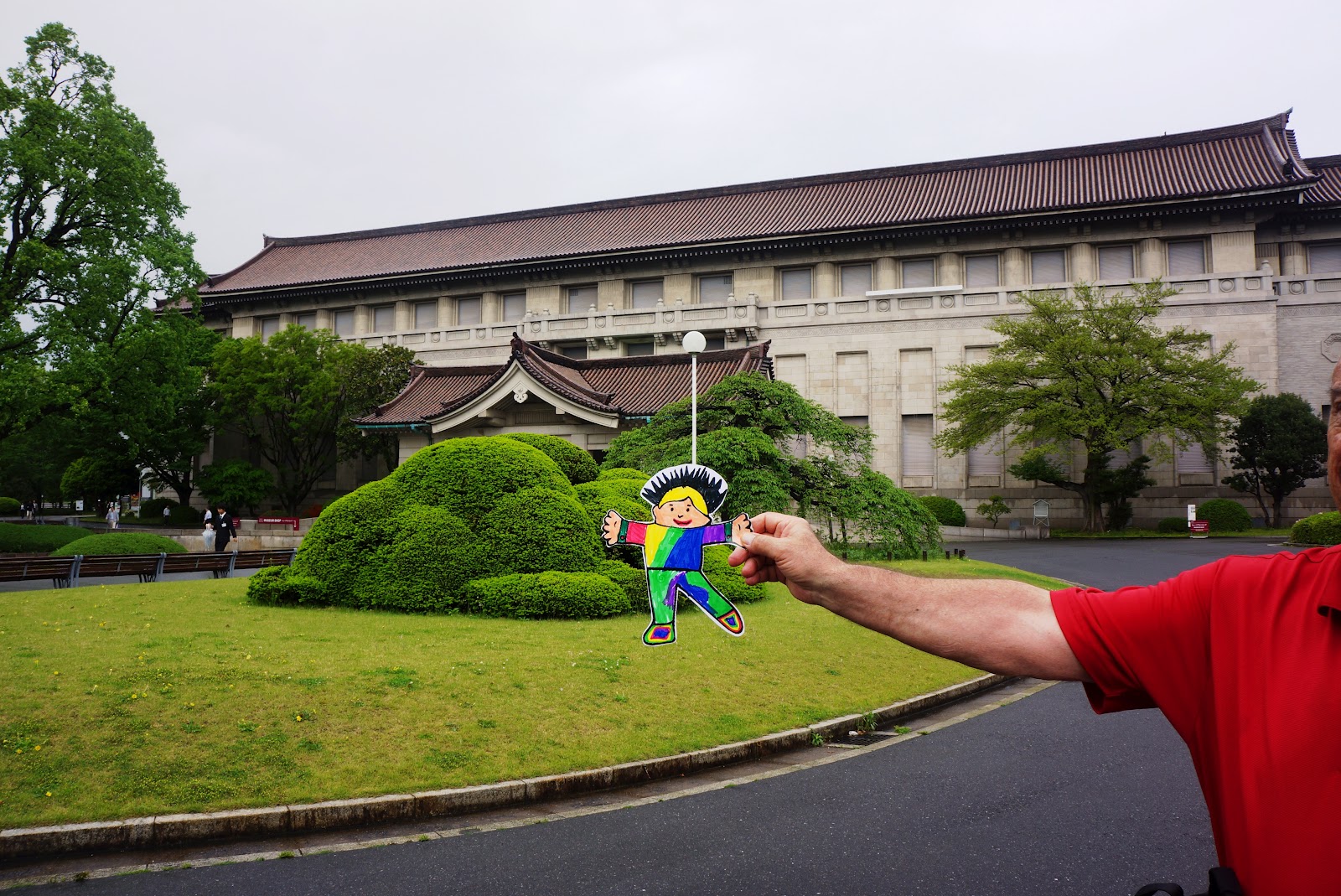
Today we went to Ueno (OOH-EH-NO) Park. The park is famous for its cherry trees, many interesting museums, and Japan's first zoo.

Tokyo subway map

We rode the subway from our hotel to the park. Ueno Park is the green area in the upper right corner of this subway map (above). The large green area in the center of the map is the Imperial Palace where the Emperor of Japan and his family live.

The International Library of Children's Literature is in Ueno Park. There is a statue of Dr. Seuss in front of that library.

Little children like to visit the amusement park in the center of Ueno Park. They can ride on their favorite storybook characters like Anpanman, Thomas the Tank Engine, and Hello Kitty!

Kodomo (KOE-DOE-MOE) is the Japanese word for "children".


I was surprised to see a totem pole in Ueno Park!

You can see all the museums on this park map.

Ueno Park Zoo
Ueno Zoo is the oldest zoo in Japan. It opened 130 years ago!

Two new Giant pandas arrived from China last year.  The male panda is called Lili and the female panda is called Shinshin.

We had a hard time deciding which museum to visit.  There is a science museum, a museum of Western art, and a museum that shows what it was like to live in this neighborhood a hundred years ago.  All of those museums sounded fun to me but we decided to visit the Tokyo National Museum instead to learn more about the history of Japan.

Honkan (Japanese Gallery) at Tokyo National Museum
The samurai armor from 300 years ago reminded me of Ewoks

Ancient metal helmets worn by Japanese warriors (samurai)
These girls attend Nankyo High School. They are proud of their school and are wearing their uniforms during Golden Week when school is not in session.

The girl on the far left has decorated her backpack with cell phone charms. Almost everyone in Japan decorates their cell phone and backpack with charms like this.

The girl on the far right is wearing a mask over her nose and mouth. Many people in Japan wear masks like this when they are suffering from colds or allergies. They want to protect other people from their germs. In Japan it is not polite to blow your nose in public.

We found a Peony Garden in a corner of Ueno Park. The Peony Garden is only open for two weeks every year so I picked a good time to visit Japan. This is one of the biggest flowers I have ever seen!

We spotted an ice cream cart as we were leaving the park.  Some of the flavors surprised me!


From left to right:  chocolate/vanilla, mango, melon, sweet potato, green tea, and vanilla.  Which flavor do you think I picked?

Tuesday, May 1, 2012

Flat Stanley Goes Shopping on a Rainy Day

I was hoping Ryan's friends would take me to Tokyo Disneyland today or Disney Sea but they said both of those amusement parks would be much too crowded with Japanese families during Golden Week. Besides, it looks like it might rain today. This would be a good day to shop for souvenirs.

The weatherman says to expect 20 degree temperatures today. Brrr! Maybe I should have brought my winter coat to Japan. Wait! I just remembered that temperatures in Japan are measured on a different scale than temperatures in the United States. The Japanese use Celsius thermometers. In the United States we usually measure temperatures with Fahrenheit thermometers. Twenty degrees on a Celsius thermometer is about the same as 67 degrees on a Fahrenheit thermometer. I won't even need a sweater!

Can I use my American dollars and cents to buy presents for Ryan and his classmates?  No.  I visited a bank to trade my American dollars for Japanese yen.

Stanley has 1,666 yen

I lined up the yen coins from my toe to my head. The shiny aluminum coin at the bottom is worth one (1) yen and, if placed carefully, can float on water. This coin reminds me of an American penny. You can't buy much of anything with just one.

In order going up, the other coins are worth five (5) yen, ten (10) yen, fifty (50) yen, one hundred (100) yen, and five hundred (500) yen. Two of those 500 hundred yen coins can be traded for one 1,000 yen note made out of paper. A 500 hundred yen coin is worth about six American dollars. I like the way the coins feel in my pocket.

In Japan there are no coins worth twenty-five yen. What coins should I use if I want to buy something that costs twenty-five yen?  Figure that out and then you can look at the pictures from my shopping trip.

Pokemon started in Japan in 1995

What do you think is in the bag?

Hello Kitty! and Anpanman inflatable swords

Did you know that Hello Kitty was born in Japan in 1974? She visited the United States for the first time in 1976.

The most popular fictional character in Japan for the past ten years in a row for children up to age twelve (12) is Anpanman. Anpanman is a year older than Hello Kitty. He first appeared in a picture book in 1973.

There are shopping arcades near many Tokyo train stations.

This shop sells socks.  I see Anpanman!

Here is another familiar Japanese character.

These shops sell vegetables, fruit, and fish.

Shopping makes me thirsty! Lucky for me, vending machines are everywhere in Japan: on street corners, on train platforms, and next to playgrounds. Many vending machines offer both hot and cold beverages. I like hot lemonade. The corn soup tasted good, too.

We had Chinese ramen noodles for lunch.  Yum.
Bakery in a train station
I did not expect to see so many French bakeries in Japan. There is at least one bakery inside or right next to almost every train and subway station. I like the regular French bread, the bread stuffed with cheese, and the little chocolate croissants the best.

I have not yet tasted the rolls topped with peas or the lemon honey donut holes. First I want to try the fish-shaped cakes filled with jam or custard.

Bandai Capsule Station
Bandai capsule stations are not hard to find here since the Bandai company was born in Japan. These days you probably see lots of these machines in the United States too. What does it cost you to buy a toy from one of these machines in Washington, D.C.? The machines in Tokyo cost two hundred yen. Which machine should I try?

Let's take a chance on the Peko-chan machine!

Have you ever heard of Peko-chan? She has been the mascot of the Fujiya Ginza company for more than fifty years. The Fujiya Ginza company is a bakery chain that sells cakes and cream puffs. Life-sized dolls, some with heads that bob up and down, stand outside the door of each shop and are dressed in clothes that change with the season. Peko-chan is so popular in Japan that a special Tokyo museum opened last year to honor her golden anniversary.

Speaking of popular, how many of you like manga (MAHN-GAH)?  Did you know that "manga" is the Japanese word that means "comics" or "cartoon"?  "Anime" (AH-NEE-MAY) is the word we use to describe the animated versions of these books.  Many Japanese people, including young teenagers, follow one or more manga series.  They can hardly wait to read the new story every month.

Luffy-san welcomes Flat Stanley to Japan

Luffy-san is the main character in One-Piece, one of the most popular manga and anime series in Japan today. I was so thrilled to meet him!

Manga and anime character goods are sold at "Jump shops" all over Japan. These shops are usually crowded with customers, mainly young adults. They are even more crowded during Golden Week!

I had fun shopping in Tokyo.  I hope you will like the souvenirs I found.

Cartoon masks in shopping arcade

Monday, April 30, 2012

Flat Stanley in Tokyo: Trains and Baseball

Now we are in Tokyo. Tokyo is the capital of Japan just like Washington, D.C. is the capital of the United States.

More than 36 million people live in Tokyo. Do you know how many people live in Washington, D.C.? The answer is 4 million.

To see the difference, let's pretend one of you is all the people who live in Washington, D.C. Now let's pretend that nine of you are all the people who live in Tokyo. That's a big difference!

Riding a train to Tokyo was easy and fun. Trains are a good way to get around in Japan. Grownups ride trains to go to work and children of all ages go to school by train. One man I saw on the train was going fishing.

Most of the train stations in and around Tokyo have signs in English. When the signs are not in English, friendly Japanese people usually offer to help you get to where you want to go. Most Japanese students study English in junior high school and many of them like to practice speaking English with American and British visitors.

Friendly Japanese people on train platform

If no one is around to help us, we just hop on a train and go where it takes us. Japan is such a safe country that we never worry about getting lost. It is fun to go exploring in a safe country like Japan!

No one talks on their cell phone while riding a train in Japan. Manners are always important but especially so in countries like Japan and cities like Tokyo where millions of people must share such a small amount of space.

I saw lots of people taking naps on the train. Other people were reading books or knitting or playing silent electronic games or texting on their cell phones. I had a book to read (Nate the Great and the Hungry Book Club) but decided to look out the window instead. We arrived in Tokyo just thirty minutes after we left Yokohama.

Ryan's friends took me to an afternoon baseball game. The Yomiuri Giants were playing the Hanshin Tigers at the Tokyo Dome.  I saw a ferris wheel and a roller coaster next to the Tokyo Dome but I didn't get a chance to ride them. 


“Besuboru” (BEH-SU-BOH-RU) is very popular in Japan, where it has been played for more than one hundred years.  The real Japanese name is yakyu (YAH-KEE-YOU), which combines the Japanese letters for “fielding” and “ball.” The first professional baseball team was formed by a man named Hiroshi Hiraoka when he returned to Japan after studying in the United States.  Hiraoka and his co-workers founded the Shimbashi Athletic Club in Tokyo in 1878. The first high school baseball team, Ichiko, started playing in 1886.

Little League baseball
Just like in the United States, people of all ages play baseball in Japan, from little league to the major league Nippon Professional Baseball or NPB.

Many Japanese major leaguers have played for U.S. baseball teams. The most famous are Hideo Nomo (Dodgers), Ichiro Suzuki (Mariners), and Hideki Matsui (Yankees). There are 12 major league teams in Japan, divided into two leagues – Central and Pacific – and they play a “Japan Series” just like the U.S. “World Series” to crown a champion each year.

The most famous team in Japan is the Tokyo Yomiuri Giants. They are like the New York Yankees in American baseball.  Their main rival is the Osaka Hanshin Tigers. The Tigers are like the Boston Red Sox in our country.  Whenever the Giants play the Tigers in Japan, it is like the Yankees against the Red Sox in the U.S. Each team has very devoted fans.

Tigers' cheering section at Tokyo Dome

Baseball fans in Japan really get into the game. Their cheering sections take up the whole bleacher sections.  They are led by a cheer conductor who wears white gloves and stands in the middle of the section next to their band.  They all stand and sing or chant the entire time their team is up to bat.  Then they sit quietly while the other team’s batters are up.

The fans especially like to dress up in outfits like the uniforms that their favorite team wears.
 

Hello Kitty souvenirs
The Tokyo Dome is a great place to watch a baseball game. The fans are fun. The souvenirs are really cool. And the food is yummy!

What fun things will we do tomorrow?  I can hardly wait to find out.

Sunday, April 29, 2012

Flat Stanley in Japan

Hello from Japan! Did you know that Japanese people call their country Nihon (NEE-HOHN)?

Japan is almost halfway around the world from the United States.  When you are getting ready for school at seven o'clock in the morning, it is already nine o'clock at night in Japan and the second graders here are all sound asleep in their beds.

Japan is a country of islands.  The whole country is just a little bit smaller than the State of California.

Most of the people live on the four biggest islands:  Hokkaido (HOH-KAH-EE-DOH), Honshu (HOHN-SHOE), Shikoku (SHEE-KOH-KOO), and Kyushu (KEE-YOO-SHOE).  Ryan's friends live near Yokohama.  Can you find Yokohama on the map?


In Japan the school year begins in April. There is a six week long break in summer and shorter breaks in winter and spring. I picked a good time to visit Japan because the spring break, called Golden Week, began today. Golden Week begins on April 29 when the Japanese people celebrate Showa Day, the birthday of Emperor Showa who ruled Japan for more than fifty years until he died in 1989. His son is now the Emperor of Japan.

Takano Fruit Parlor is a fun place to celebrate birthdays in Japan.  Let's go there to celebrate Showa Day!  The special fruit for April is mango.  Mary ordered the biggest mango dessert on the menu!

Amy had a biwa (BEE-WAH) parfait. Biwa looks and tastes like a peach.

I liked the chocolate parfait, too. Chocolate is less sweet in Japan than it is in the United States but it still tastes good.

We are going to celebrate the rest of Golden Week in Tokyo, the capital of Japan. I am so excited!

Tuesday, January 3, 2012

Just When You Think You've Seen Everything, You See Something Else

Koi at Ofuna Botanical Garden
I have never had to remove my shoes when passing through security at Tokyo's Narita Airport and, until today, had never seen anyone else remove their shoes either.

The Ancient Mariner and I were loitering near the security gate doing our best to embarrass College Boy when we saw a young female guard approach two comely young Asian girls in his line. Both were fashionably dressed in short skirts and tall boots. The guard solemnly presented a pair of slippers to each of these girls. They changed footwear and padded compliantly through the metal detector.

Ah, the civility!

United Airlines gets a thumbs up as well for not charging Matt $200 for his overweight suitcase. The counter clerk waived the fee and wished him a happy new year, thereby changing one teenager's opinion of the airline that extracted $400 from him at the Norfolk Airport when he was returning to Japan from college last summer.

When I was his age, I hadn't flown enough to have opinions about airlines. I also didn't have $400 in my pocket. More like $4 on a flush day.

Monday, January 2, 2012

The Year of the Dragon, Day Two

The Year of the Dragon is off to a rather inauspicious start. The camera has not yet surfaced. What? Me worry? Not until I work my way through a backlog of pictures I've been meaning to share. Surely the camera is somewhere under all the Christmas debris that I fully intend to tackle once we get back from escorting College Boy to the airport tomorrow.  Or maybe I left it at the Indian restaurant in Hayama last week in which case it won't take a lot of arm-twisting to convince the Ancient Mariner to make a return visit.

While I can't speak for College Boy (more's the pity), I imagine he'll be feeling terribly sad when he boards that airplane and leaves Japan for what could very well be the last time.  We will have moved back to the States by the time his school year ends.  When will he see his girlfriend again?  This is definitely the downside of living overseas during high school.  "You can never go home again" takes on a whole new meaning.

Now for some pictures.  I snapped these in early December when we went to the Ikebana International Holiday Bazaar in Tokyo.  The first is one of those rare arrangements to earn an "I could do that!" response from me.  The fences bordering two sides of our Norfolk house are covered with vines that I am forever hacking into shape.  Sticking the debris in a vase would probably be a lot easier than wrestling it into a lawn and garden bag. 


We saw this sign over the restroom door in a subway station near Shiba Park. It cracked me up. Go figure.

Sunday, January 1, 2012

Lucky Bags: A New Year's Day Tradition

More than a hundred years ago, in the late Meiji period, a Tokyo department store came up with the brilliant idea of bagging up their excess merchandise from the previous year and selling those "mystery bags" to customers for deep discounts on New Year's Day.  The idea caught on with other merchants and these days fukubukuro (lucky bag, mystery bag) are more often filled with new products than last year's leftovers.

Fukubukuro come at a variety of different prices. Most bags we eyed today went for $20 or $30 but I also spotted some tempting $100 bags stuffed with yarn at the craft store, all the more tempting because the bags were clear.

We opted to fork over $30 to a pair of charming young clerks manning a table outside the new Tully's coffee shop on Blue Street.  Their fukubukuro was packaged in a nice zippered case rather than the usual paper or plastic bag and the case alone seemed like a pretty good investment.  The cases were available in two colors, pink and grey, and I had my hand on a pink one until the Ancient Mariner suggested a grey one would make a nice "man-purse".

When I remember where I put my camera, I'll snap off a few photos of the case and its contents:  five coupons for free coffee, a 5-pound bag of Guatemalan coffee, six instant drip coffee packets, a Year of the Dragon ceramic mug, and an airtight humidor for storing coffee.

If the Ancient Mariner hadn't been with me, I definitely would have carried home one or two of those yarn fukubukuro too.  I'm counting the hours until he goes back to work.

LinkWithin

Related Posts with Thumbnails