Sunday, January 30, 2011

How to Throw an Olympics Party

Our team's turn to plan, execute, and host one of the semi-monthly JAW parties came last week. Robin suggested a Greek Toga Party but we were forced to reconsider that idea when she left Japan abruptly for an indeterminate length of time. Robin would look a lot better in toga than her teammates.  To put it mildly.

But we didn't throw the baby out with the bath water or the Greek food out with the togas. We decided to stage a Special Olympics for the ladies. Mimi had tons of ideas and artifacts to contribute because her daughter Katerina is an annual participant.

Arranging those artifacts on a bulletin board was one of my assignments. My personal favorite was the t-shirt depicting paper cranes soaring out of the Olympic torch with Mt. Fuji in the background. The encircling slogan says "You are the stars and the world is watching you.  By your presence you send a message to every village, every city, every nation.  A message of hope.  A message of victory."

Pardon me while I find a Kleenex.

We divided our guests into six teams of 4-5 people each (yellow, blue, green, red, black, and orange) and gave them hats to help them remember which team they were on.  Note:  there are only five official Olympic colors but we had enough people for six teams so we added orange.  It's called improvising.

The four hostesses did not wear caps.  We wore whistles around our necks instead.  About thirty minutes into the party, I think some of the guests were ready to strangle the next hostess who blew one of those whistles.  Actually, I might have been the only hostess who blew her whistle . . .
   
Tweet! "Please assemble at your team table. You have twenty minutes to make a team flag using whatever materials you find on your table."

The Japanese ladies used their time and materials wisely and creatively while a few sage Americans knew enough to stand back and watch the process and flowers unfold.

Tweet! The teams lined up behind the Grand Marshall - sporting a Mt. Fuji stick for a baton and my hot pink pashmina for a sash - and paraded out the door and around the apartment tower while inspirational Marine Drum and Bugle Corps' music reverberated through the neighborhood and the other members of the planning team cleared the tables. (Except for the team member who managed to lock herself out of the room when she stuck her head out the door to take this picture. The music was so loud no one could hear her beating on the door.)

After the parade, the Grand Marshall delivered a few remarks on the history of the Special Olympics and I pointed out pertinent items on the bulletin board, like letters from Nelson Mandela and the Governor of California. The Special Olympics began as Camp Shriver in Eunice Kennedy Shriver's backyard in Maryland in 1962 when she learned that special needs children had been barred from attending other camps. What I did not realize - or simply did not remember - until last week was the the first Special Olympics was held in Chicago just seven weeks after Eunice's brother, Bobby, was assassinated in Los Angeles. What a huge heart that woman had.

Katerina, second from left, at Special Olympics in Yokota, Japan

Tweet!

The torch is lit.

Let the games begin!

The Freestyle Swim Relay involved donning swim gear, "paddling" across the floor, and passing the gear to a teammate until each team had crossed the floor five times. Those flippers were tricky. At least one participant capsized.

Debbie did a victory strut when the Black team won.

Yuuko and Hisayo face off.
The Javelin Throw was next. The "javelins" were weighted with pepper corns.

The final game was a Speed Skating Relay. The "skates" are slippers intended for sweeping floors.

You might be interested to hear that Beverly, pictured at left, is a member of the Yokosuka Sushi Rollers, a roller derby team recently formed by local military spouses. They have cute nicknames, like Tuna Roll, California Roll, and Big Mouth Bass Roll (okay, I made up that last one).

All set to grab that baton, a wooden spoon.

Nagata-san took a corner too fast and landed on her fanny but fortunately did not break a hip or anything else.

The Grand Marshall handed out prizes - chocolate bars - to the winning teams and then everyone marched out to the playground for team pictures enroute to my house for lunch.  Greek(ish) food, of course! 

Debbie won a door prize: a pair of "speed skates"!


Apparently the ladies in the dining room spotted my Peko-chan collection

January isn't even over yet and I've finished my mandatory hostessing responsibilities for the year. Life is good.

Spitting Images and Other Distractions: Kyogen in Kamakura

Yes, there are tons of pictures from the 10th Annual Tokyo Quilt Festival in the offing but not until I catch you up on Ikebana and JAW. The third week of January was as hectic as the third week of every other month I've spent in Japan. Between cooking and cleaning for the JAW ladies and - horror of horrors - having to brew my own coffee, clean the litter box, and haul out the trash while the Ancient Mariner pondered the room service menu somewhere in Washington, DC, uploading pictures fell by the wayside.

The Ikebana crowd and their families assembled in Kamakura for a Kyogen performance last Saturday. Kyogen is an ancient form of Japanese comedy that developed alongside Noh. I spent hours researching Kyogen when I was preparing the invitation for the American members but I'll spare you the lecture. If you want to know more, go here.

The actor on the left is a third-generation Kyogen actor frequently seen on television in this part of the world. When he demonstrated the characteristic exaggerated laughter and sorrow for us, he was the spitting image of my favorite character in the Full Metal Alchemist anime series. Matt and I watched about 834 episodes of Full Metal Alchemist in 2006 and 2007 and most of the Japanese I have mastered is compliments of following the bouncing ball in the theme songs (plural, as new songs were introduced every twenty episodes or so).

The actor on the right is Czech. He came to Japan to study Kyogen with the Japanese actor's father. This young man is the spitting image of Professor Miller who taught Eastern European History at the University of West Florida in the mid-1990s.


Front Row:  Xan at far left, Czech Ambassador at far right

Distracted by memories of Full Metal Alchemist, Professor Miller, and a certain college freshman, I spent more time watching the audience than the performance. My little friend Xan was quite fetching in her flowered purple kimono and the Czech ambassador, present to support her young countryman, was a breath of fresh air. The ambassador arrived sans entourage, went unrecognized, and stood patiently in line behind a gaggle of Japanese ladies to collect her name badge. This is an effective form of diplomacy the U.S. State Department would be wise emulating. The phrase 'how to make friends and influence people' comes to mind.

Watanabe-san, standing here, greeted me with the disturbing news that she has been diagnosed with breast cancer. She is scheduled for surgery next week. Please keep her in your thoughts and prayers. These days I am combing the internet for Christmas stocking knitting patterns to help distract her because she told me last month she would like to try making a stocking like the ones my mother knit for my husband and children. Remind me to show you the sewing box she delivered to my doorstep on Christmas Eve.

A happier distraction was running into Nobuko-san, the woman sitting on the far right side of the picture. We spent many happy hours with Nobuko and her husband the last time we lived in Japan, learning country line dancing and watching his band perform in their Hayama restaurant. Nobuko told me that her father, the owner of three department stores, passed away shortly after the Ancient Mariner and I left Japan and the Kyogen performance marked her first reappearance at Ikebana since his death. Her father's death coupled with the economic downturn meant selling the restaurant, shutting down half of the Yokosuka store, and Nobuko taking a job with an uncle. But she still dances as often as she can and I've promised to brush off my dancing shoes for her line dancing party in February.

The nice thing about line dancing is that it doesn't require a partner. Good thing, too, since the Ancient Mariner will be here and gone again by the time that party rolls around.

Thursday, January 27, 2011

Sushi at Tsukiji

The sun never fails to shine on the Shonan Ladies.

Last Friday's weather was glorious, perfect for strolling from Higashi-Ginza to Tokyo's Tsukiji fish market. We approached the market from a slightly different tack than the one the twentysomethings and I took last summer and spent a lot more time shopping and a lot less time in the fish market itself. I'll be a seasoned tour guide by the time the Ancient Mariner manages to squeeze Tsukiji into his busy schedule.

The streets surrounding Tsukiji are very narrow and the restaurants are small so we divided into lunch groups the minute we hit the market. The tempuras went left and the sushis headed right.

One of my blog readers steered me toward a shop offering those tiny fish I mistook for mozzarella cheese on my pasta at the Yokosuka Museum of Art a while back. They come in more than one color. I didn't buy any.


As you can tell from the plethora of shopping bags (left), my companions were less reluctant than I to part with their yen. We are doing our level best to keep the Japanese economy afloat.

I was a bit trepiditious about choosing the sushi group but it boiled down to choosing what I considered the lesser of two evils, octopus, over a mushroom fried in batter. The decision turned out to be excellent. I ended up eating Mimi's octopus as well as my own.

She now owes me a favor. I'm pretty sure I see a mushroom in her future.

Thursday, January 20, 2011

Hot Lemonade: The Latest Thing in Handwarmers

Nothing comes close to piping hot lemonade when you're standing on a train platform and the only thing whistling down the tracks is a bitter wind. Maybe the hot maple syrup drink is even tastier, but we won't know until someone works up the nerve to try it. The fact that a single vending machine offers both hot and cold drinks still amazes me.

The Year of the Rabbit has been delightfully flavorful so far.  Here are a few of my favorite discoveries. 

'Twinkies' for Jim and his banker pals

The seasonal crop of Strawberries and Cream mushroom-shaped cookies are back on the shelves alongside chocolate bamboo shoots with strawberry-flavored icing.

The Ancient Mariner and I inhaled six of these delectable strawberry cream puffs in as many days last week. None of them sat on the counter long enough to be photographed so you'll have to settle for the poster that's propped in Beard Papa's window.

Tully's coffee shops are almost as rampant as Starbucks here. The description on the bag of Dutchman's blend - "deep, spicy, complex" - made me think of my own little Katje and Hans.


"Deep, Rich, Winy" and "Nutty, Sweet, Balanced" for the Ancient Mariner and his bride


Monday, January 17, 2011

Pleasantly Surprised by Dismay at Kamakura-gu, or a Chip Off the Sake Cup

Weather, Rene, Shinagawa, Artistic
Shinagawa took us to Kamakura Saturday to buy fabric for those purses she's going to teach us how to make next month. She was looking for a distraction and four crazy gaijin ladies filled the bill.

Shinagawa's only child - a daughter - was tackling the college entrance examination in Tokyo while we were rambling around Kamakura.  College entrance examinations in Japan are something like SAT and ACT exams in the United States but much more elaborate.  They cover more subjects than language and mathematics and take two days to complete.  As I understand it, the examination results determine whether a student will go on to college or straight into the workforce.

With their child's future hanging in the balance, Japanese parents flock to shrines and temples to pray for good results.  This strikes me as a lovely tradition and I was both honored and thrilled to share this experience with my friend.  Whether I'm lighting a candle in a cathedral or tossing a coin in a wooden box, praying for a child's success feels good to me.  I'm suddenly feeling nostalgic for all those rosaries we offered the night before high school football games.


Because I'm something of a nerd - gasp - I did a little research on this tradition the night before we went to Kamakura and concluded that Shinagawa would be taking us to Egara Tenjin-sha because that shrine is dedicated to the deity of scholarship, Sugawara Michizane, a deity with whom I've become quite conversant under Ishii's tutelage. But - another gasp - I was wrong. Shinagawa took us to Kamakura-gu instead.

A bit dismayed at the amount of time wasted researching the wrong shrine, I wondered (aloud, as is my wont) why we were here and not there. Shinagawa's friend, a former classmate, is a priest and she developed a fondness for Kamakura-gu when he was assigned to this shrine. Shinagawa, a mistress of the sidelong glance and blessed with a pair of wonderfully expressive eyes, doesn't need to plumb the depths of her impressive English vocabulary list to communicate humor.  She lets me know somehow that her friend was the Boy Most Unlikely to Become a Priest.  We share a giggle.  Now I can't stop thinking about the boys in my class most unlikely to become what they eventually became.  Apparently their mothers were offering rosaries when I wasn't looking.

The grounds of Kamakura-gu offered plenty of distractions. The Chinese dragon machine at left is but one example. I did not insert the required 200 Yen in the coin slot but the dragon started dancing the minute I took his picture. Maybe since I don't know what caused it, the performance seemed especially magical and delightful.

Near the entrance to the shrine Shinagawa dropped a few coins into a wooden box and handed each of us a flat clay sake cup. One of us called the cup a souvenir and stuck it in her pocket but Shinagawa was having none of that. She told us to pray for relief from a physical ailment before hurling the cup at one of three large rocks lined up along the fence in what looked at first to be a bed of gravel but turned out to be pieces of broken sake cups.

We threw those cups as hard as we could but none of our cups shattered. The best we could manage was a few chips. Who is responsible for all those shards littering the ground at the base of the rocks? If Major League Baseball does not know about this phenomenon, someone needs to tell them.

At the rear of the shrine we found a statue of a samurai, which I suppose represents Prince Morinaga (1308-1335) since the reason Emperor Meiji built this shrine in 1869 was to honor that prince's spirit.

Prince Morinaga is believed to be the third child of Emperor Godaigo. (The information regarding his date of birth and birth order is understandably a bit sketchy since Emperor Godaigo, a incredibly randy man, had many court ladies and fathered 36 children in all.) To make a long story as short as I can, the power to rule Japan was temporarily restored to the imperial court in the form of Emperor Godaigo when the Kamakura Shogunate (Hojo clan) crumbled in 1333. But the person who helped restore power to the imperial court, Ashikaga Takauji, soon betrayed the emperor by capturing Prince Morinaga and placing him under house arrest at a Zen temple where Kamakura-gu now stands. Prince Morinaga was older than 24 but younger than 27 when this happened.

The Hojo clan did not give up their hegemony without a fight. Ashikaga's younger brother, Tadayoshi, was defending Kamakura when the Hojos attacked in 1335. Realizing he could not protect the prince from the Hojos, Tadayoshi decided to kill the prince himself. I suppose he thought he was doing the prince a favor.

For reasons that escape me, visitors to the shrine nowadays rub this statue and then pray for relief.  They rub his head to ward off headaches, his chest to ward off heart attacks, and one recent visitor rubbed Prince Morinaga's legs to ward off amputation.

Some visitors write their prayers on the backs of little clay statues which ring the statue like battalions. I would like to do that the next time I visit Kamakura-gu.

Oh Me, Oh My, Ume: A Plum Blossom Sighting

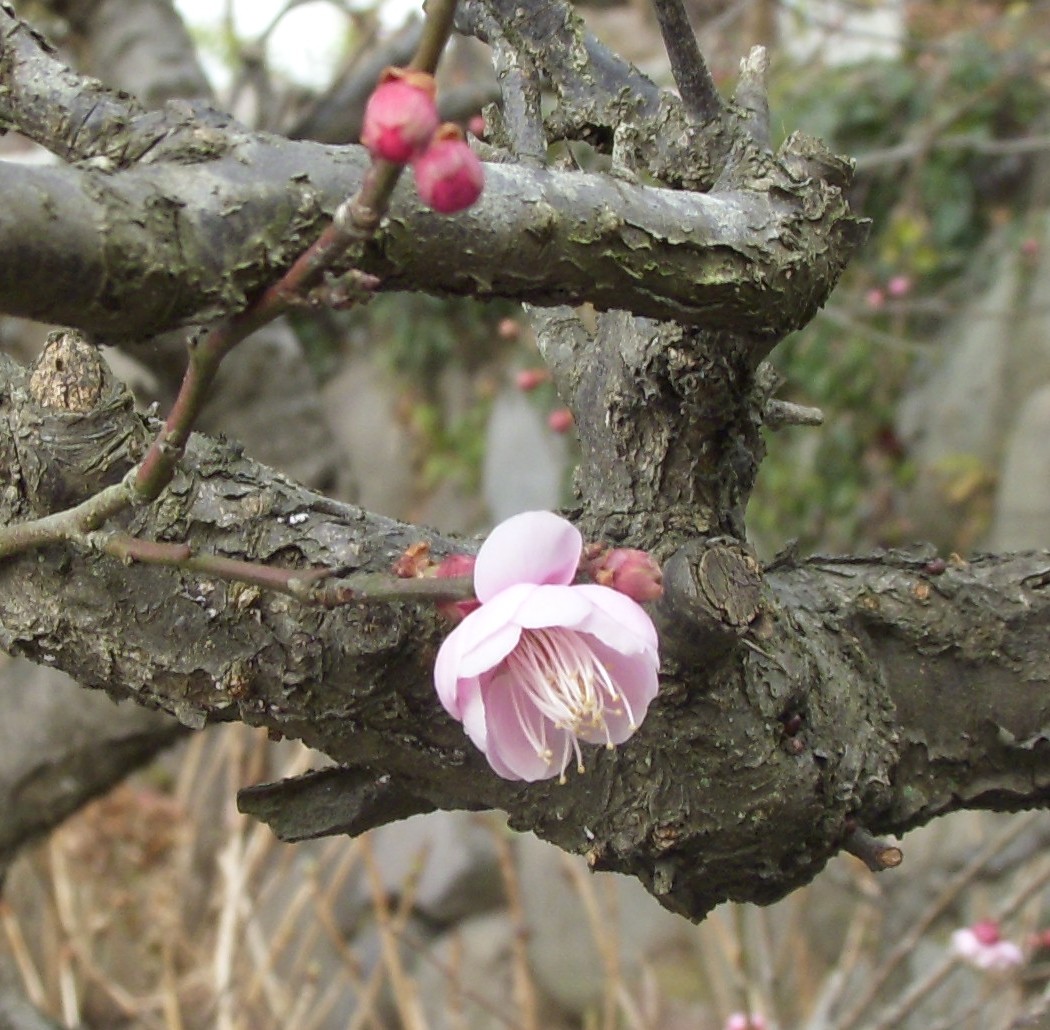
Plum trees (ume) normally bloom from late February until mid-March here but we spotted a few early blossoms on two trees on the grounds of Kamakura-gu Saturday.


On Sunday reports of snow drifted in, first from Nara and then Tokyo.  Does this spell bad news for the ume?  We'll find out next month when the Explorers visit Kairakuen Garden in Mito, one of the top three landscape gardens in Japan.

We hope to see all three gardens this year before Artistic and Weather depart Japan.  We can get to Mito and back in a single day but seeing the other gardens will be overnight trips.  Am I excited?  You bet. 

Sunday, January 16, 2011

A Yokohama Art Exhibit and Pleasant Digressions

Last January I had fun attending the Sogenkai art exhibit with Flat Stanley, Mary Beth, and Mimi. None of them could squeeze the exhibit into their busy schedules this year so I tossed my camera and Kindle in my bag and headed to Yokohama on my own. It was a another rewarding day in more ways than one.
Takako's entry this year is similar to last year's painting in that it's a landscape she recalls from the years she lived and hiked in England. The teachers who critiqued her painting earlier in the week said she should lower the horizon by eliminating some of the distant hills and said the left side of the painting is too dark.

She'll make these changes between now and the Tokyo exhibit in April but won't spend more than a day on it.  A higher priority is a portrait of her son and his bride who will marry in March on a Hayama beach.  This is the wedding gift they have requested.  Based on their choice of wedding gifts, I like this young couple sight unseen.

Over a leisurely lunch of Japanese curry, Takako and I talk about our children and other interests.  I am surprised to learn painting ranks below hiking on her list of hobbies.  Painting for her is simply a way of remembering a few of the most memorable views she's enjoyed while rambling around England and California.  Only lately has she started appreciating the scenery in her native land.  She has identified three potential Japanese views for future paintings and I hope she completes at least one of those paintings before I leave Japan.

The prospect of entertaining their son's new in-laws motivated Takako and her husband to renovate their kitchen and bathroom.  She is the third of my Japanese friends in the past three weeks who has described a thirty-year old house as old, a concept that tickles me due to my affinity for American houses built between 1885 and 1925.  She affably answers all my questions about that kitchen renovation.  Yes, she installed a drawer-style dishwasher like Dr. T's and Shinagawa's.  Yes, her new refrigerator opens from both the left side and the right.  Yes, her new stove features one of the little drawers for cooking fish and making toast.

My one-on-one time with Takako is a memory I will cherish.  Rambling around the interesting neighborhood near the Kannai station before I got my bearings and found the exhibit hall was also rewarding as was my tiny detour into the cream puff shop in Kamiooka when I was transferring from the subway to the train on my return trip to Yokosuka.  Two visits to the cream puff shop in one week might seem a bit much but that strawberry cream filling is a temporary flavor that, for all I know, could change to soy or red bean paste tomorrow.  Carpe diem!

P.S.  If anyone reading this knows anything about electricity, I would be willing to swap a case of sake or mushroom-shaped cookies - your choice - for information on the possibility of getting Japanese kitchen appliances to work in the United States.

LinkWithin

Related Posts with Thumbnails